
Start Here: Your Small Claims Roadmap, Step by Step
A free step-by-step small claims roadmap: from deciding to sue and filing to the hearing and collecting your money. Links to every guide.

Quick answer: Most cases follow 15 steps in roughly this order: check it fits, name the right defendant, add up your losses, send a demand letter, gather evidence, file, serve, watch for a response, try to settle, prepare, attend the hearing, get the judgment, watch the appeal deadline, collect, and close it out. Each step below is numbered and links to a guide.
How long will this take? It varies by court. Your court notice gives your hearing date, and your state page has local details: California, Texas, New York, or find yours on the states hub.
Pick your starting point: Ready to sue? Start here · Just got sued? Start here · Small claims court basics
More guides: Witnesses and subpoenas · Landlord and tenant cases · Write your statement
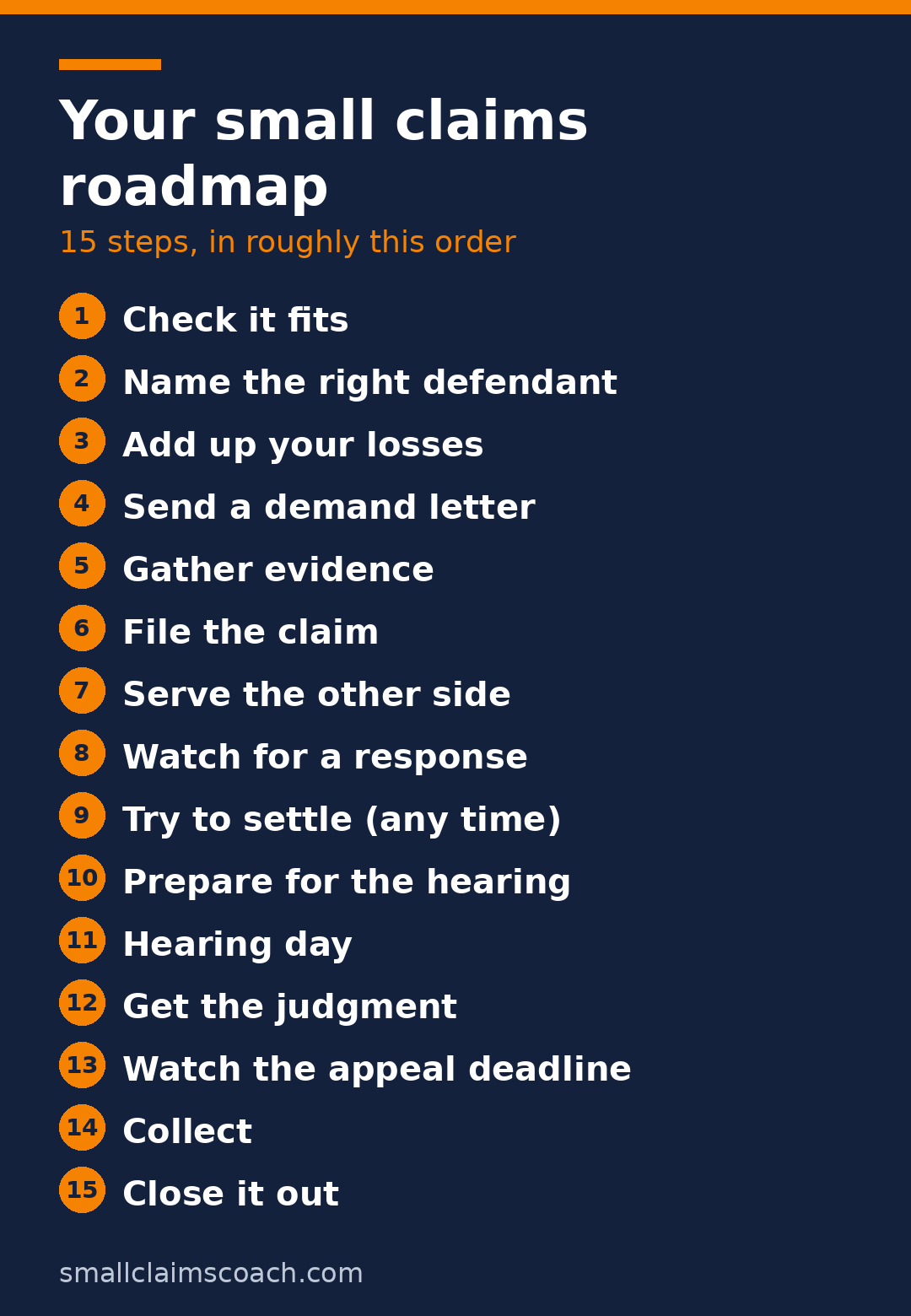
Your small claims roadmap, step by step
- Check it fits. Confirm your amount is under your state's limit and you're within the statute of limitations (the legal deadline to sue). See the states hub and 10 things to do before you sue.
- Name the right defendant. Use the exact legal name. How to look it up: the name and registered-agent check in the filing guide.
- Add up your losses. Only amounts you can prove. Try the free quick total in the damages estimate calculator. See how much you can sue for.
- Send a demand letter. Give a firm deadline and send it in a way that proves delivery (certified mail with a return receipt, or a signature courier). Free tips: 10 things to do before you sue. Playbook members: demand letter templates.
- Gather evidence. See preserving your evidence, saving text messages and photo and video evidence.
- File the claim. See how to fill out and file, including fees and fee waivers.
- Serve the other side. Who may deliver the papers depends on your court: who can serve, and how.
- Watch for a response or counterclaim. Being sued yourself? Start with what to do if you're sued.
- Try to settle (optional, any time). Many cases settle before or on hearing day. Put any deal in writing.
- Prepare for the hearing. Organize exhibits, make copies, line up witnesses.
- Hearing day. See what to expect and what to say.
- Get the judgment. Read it carefully: who owes whom, how much, and by when.
- Watch the appeal deadline. The losing side may have only a short time to appeal or ask the court to set aside (cancel) the decision. Check your state page the day you get the decision.
- Collect. See you won, now get paid.
- Close it out. Once you're paid in full, file a satisfaction of judgment (the form that tells the court you've been paid).
Your case plan in 3 questions
- Where? Your state and county. Find your state on the states hub.
- Which side? Are you suing, or being sued?
- How much? The amount, and whether it fits your state's limit.
Got your three answers? Get the plays for your state.
The Playbook gives you a filled-in sample of your state's claim form with a box-by-box guide (made-up case; every state and DC has one, and for Mississippi, Oklahoma and Wyoming it's a sample layout we made, so you'd get the real form from the court clerk), your state's Playbook section, and prep guides for every step on the roadmap. One membership covers every state. Join now.
Being sued instead?
Skip to step 8 (watch for a response or counterclaim). You don't need steps 1–7. Don't skip the hearing: a no-show can mean a default judgment against you. Start with what to do if you're sued.
Can they pay?
A judgment says someone owes you; it doesn't make money appear. Before you spend time and fees, picture how you'd actually get paid. Use the "Can they pay?" check in the collection guide.
Common questions
What is the first step in small claims court?
Usually it's confirming small claims fits your case: the amount is under your state's limit, you're within the statute of limitations, and you know exactly who to sue. Then you send a demand letter.
How long does a small claims case take?
It varies by court. Check your court's rules and your court notice for its schedule.
Do I need a lawyer for small claims court?
Small claims is designed for people representing themselves. Some states limit or bar lawyers in small claims. Check your state page.
What happens after I win in small claims?
The court gives you a judgment, but usually doesn't collect it for you. If the other side doesn't pay, you use collection tools like a debtor's exam, garnishment or a lien.
This information is for educational purposes only. It is not legal advice. Rules, deadlines, fees and forms vary by state and court. Check your court's rules or self-help center before you act.
In the Playbook (members):
- Your case plan: next 3 steps
- A printable progress checklist for all 15 steps
- Your deadline tracker
- Every Playbook tool, in roadmap order
You do the work. The Playbook hands you the plays.
Members get your case plan (next 3 steps), a printable progress checklist for all 15 steps, a deadline tracker, and every Playbook tool in roadmap order, plus a filled-in sample of your state's claim form and your state's Playbook section.