How to Subpoena a Witness for Small Claims Court
A witness who doesn't show up can't help you. Here are your three paths: a witness who comes on their own, a written statement, or a subpoena served in time.
Updated on October 29, 2026
A witness who doesn't show up can't help you.
To subpoena a witness for small claims, ask your court clerk for a subpoena (a court order to appear), fill it in, have the clerk issue it, and have it served on the witness early enough under your court's rules. Many witnesses come on their own or sign a statement instead, so you may not need one.
Here's our running example. Jordan Sample is suing Typical Roofing Co. over a leak that came back. Jordan's neighbor, Sam Rivera, saw the crew leave early. The roofer's former crew member knows what was skipped. And the shop that sold the shingles has the order records. Each one needs a different path to the judge.
The quick answer: how do I get a witness to small claims court?
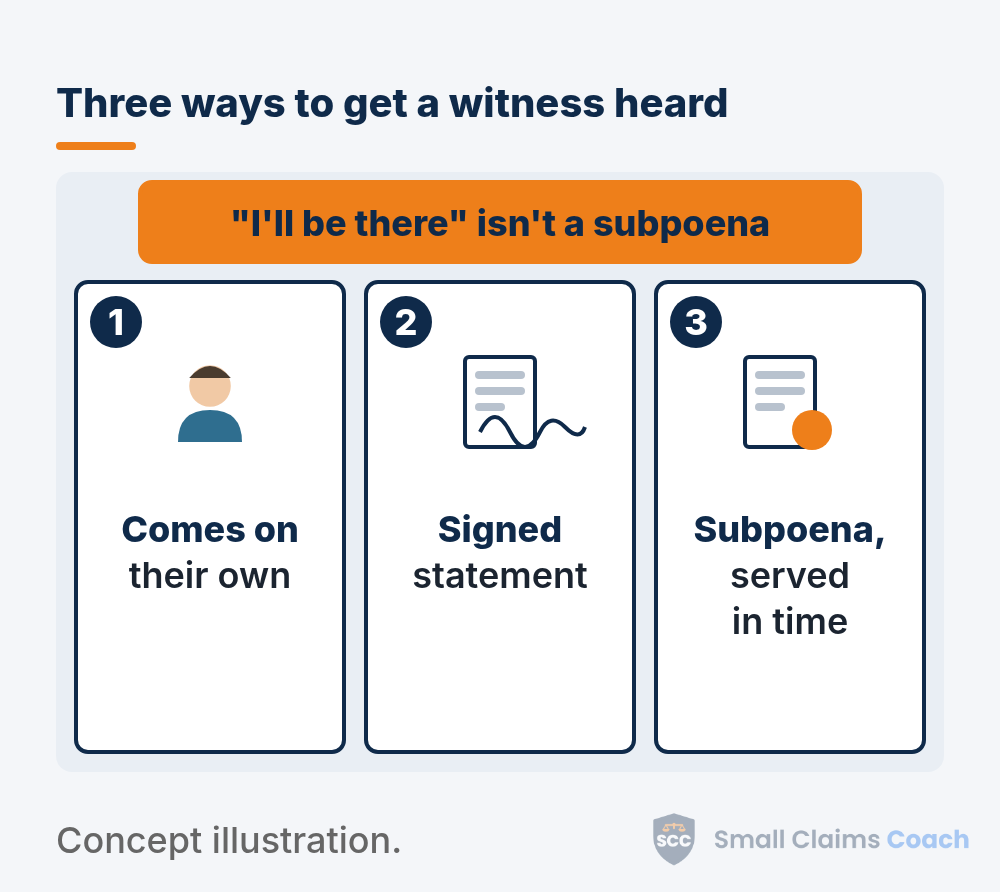
A friend saying "I'll be there" isn't a subpoena. You have three paths:
- A witness who comes on their own. Simplest. Confirm the date, time and place in writing.
- A written statement. A signed, dated account of what they saw. Many small claims courts accept these, but the judge may give them less weight.
- A subpoena served in time. A court order that requires the person to come, or to bring records. Use it when the witness is unwilling, unreliable, or needs an order to get time off work.
Lining up witnesses? Get the full guide.
The full guide is for Playbook members: a witness plan worksheet, a short script for asking someone to be a witness, a sample witness statement with made-up names, a list of what a document subpoena should cover, a subpoena tracker, and do/don't notes for prepping your witness. The Playbook also gives you a filled-in sample of your state's claim form (every state and DC has one; for Mississippi, Oklahoma and Wyoming it's a sample layout we made, so you'd get the real form from the court clerk) and your state's Playbook section. $149 for your first year (introductory offer), then $199 a year. Join now.
What is a subpoena?
A subpoena (say "suh-PEE-nuh") is an order from the court that tells a person to come to a hearing, bring documents, or both. Ignoring one can have consequences that vary by state, such as the judge ordering the person to come back. A subpoena only works if it is properly issued and served.
How do I get a subpoena?
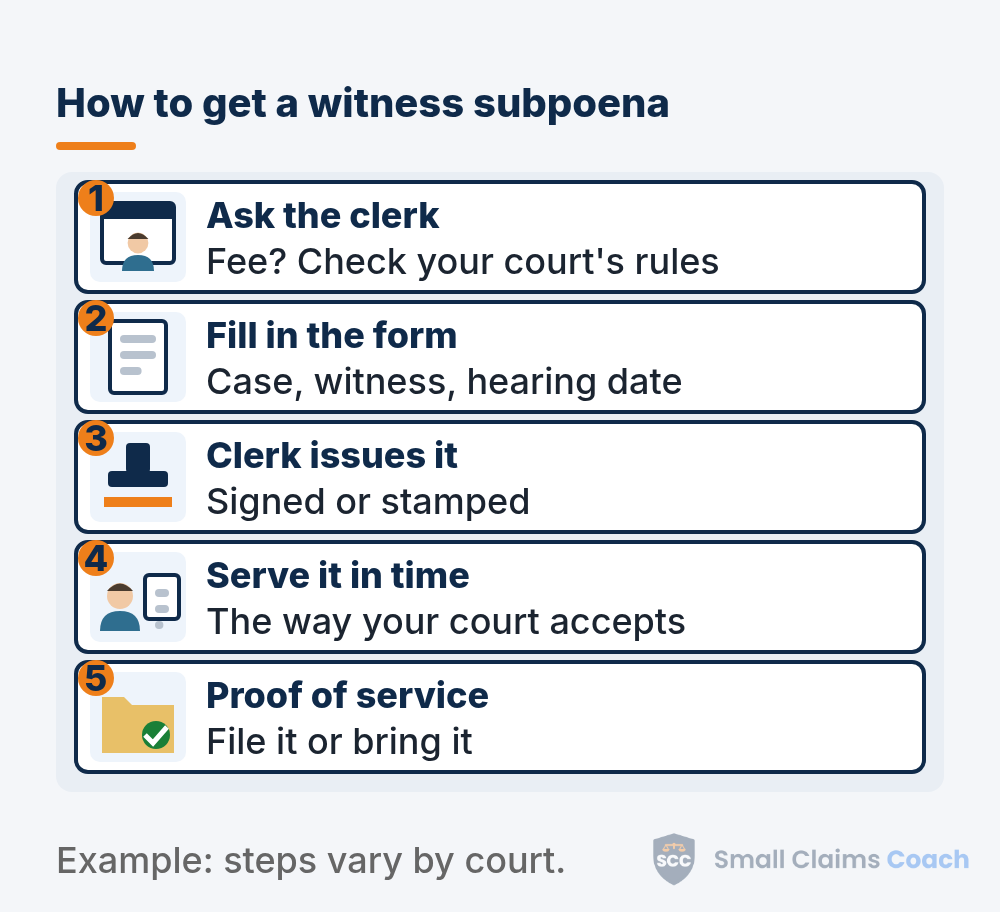
Ask the small claims clerk at the court where your case is filed. Most courts have a subpoena form. You fill in the case name and number, the witness's name and address, and the hearing date. The clerk issues it, usually by signing or stamping it. Some courts charge a fee and some don't. Check your court's rules.
Coach's Tip: Ask the clerk about subpoenas the day you get your hearing date. Getting the form issued and served takes longer than people expect.
How do I serve a subpoena?
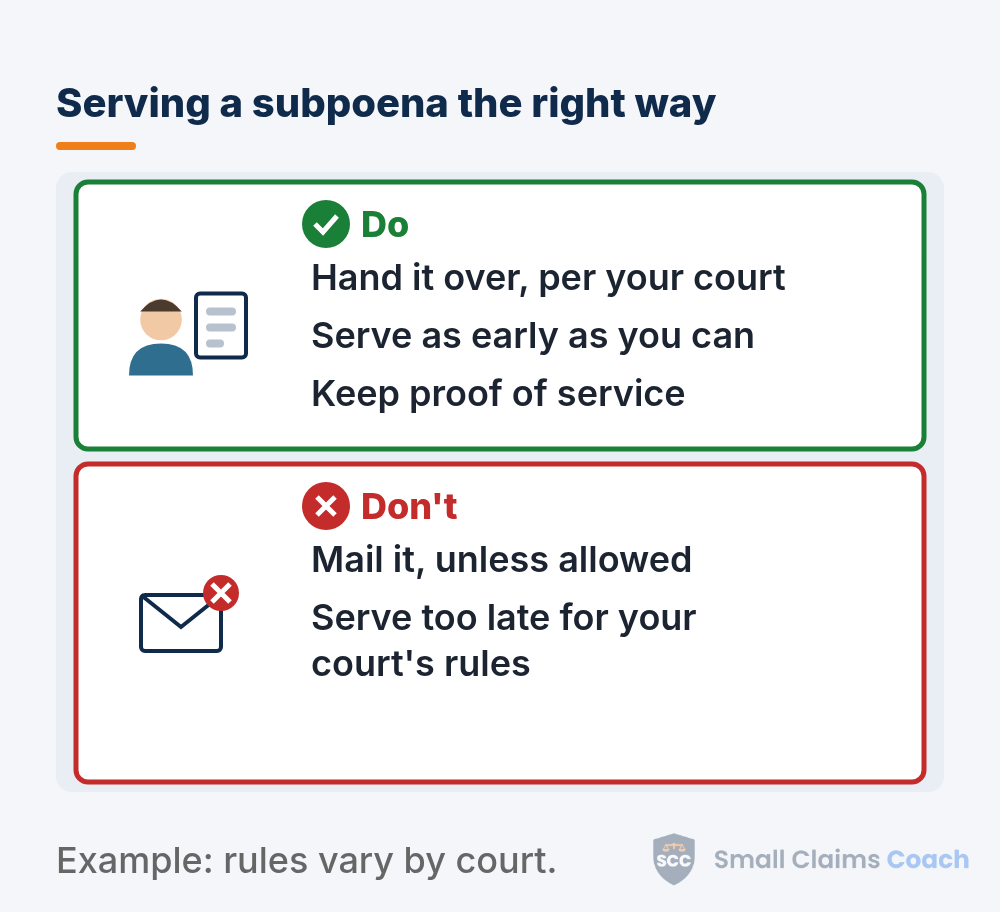
To serve a subpoena means to deliver it to the witness in a way the court accepts. Many courts require it to be handed to the person directly, and many don't allow service by mail. Who may serve it, and how far ahead of the hearing, vary by state and court. After service, the server usually fills in a proof of service form that you file or bring. Check your court's rules.
For how service works in general, see how to serve small claims papers.
Do I have to pay the witness?
Possibly. Some courts let a subpoenaed witness ask for a witness fee (a payment for their time) and sometimes travel costs. In some places, a witness who asks for the fee and isn't paid doesn't have to come. Whether a fee applies, how much, and when you pay it vary by state. Check your court's rules.
How do I write a witness statement?
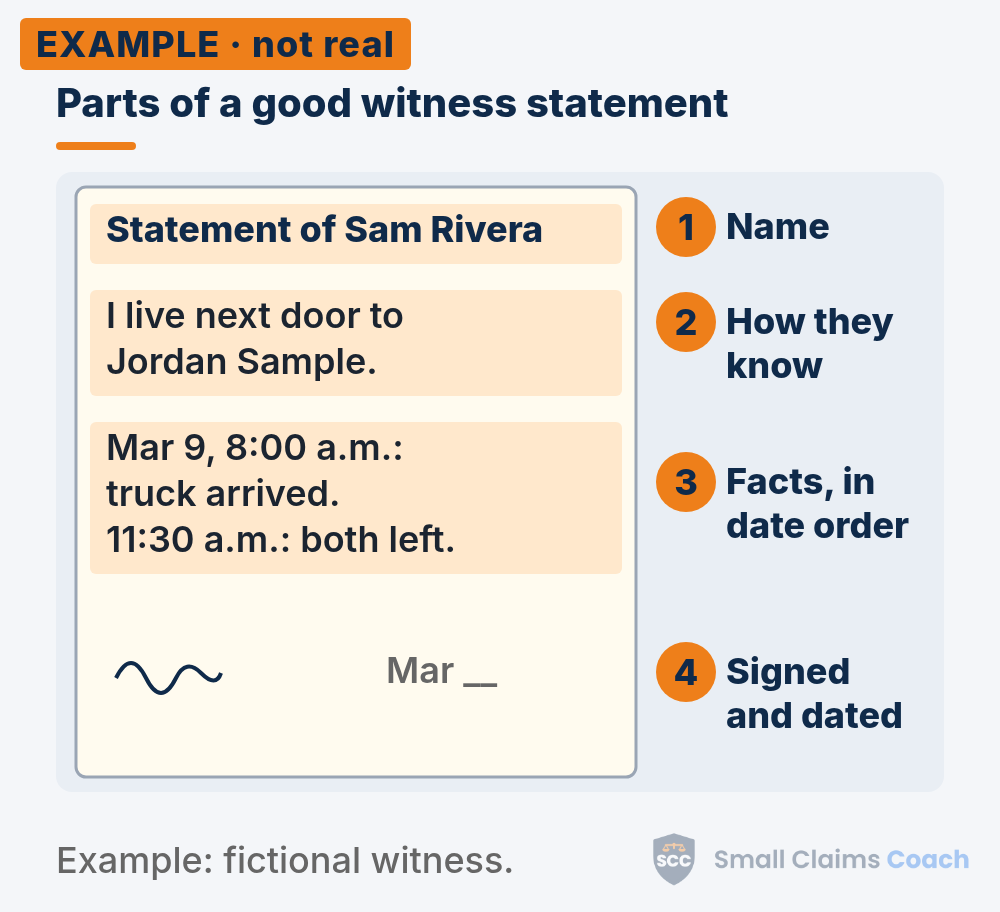
Have the witness write what they personally saw or heard, in their own words, in date order. Include their full name, how they know the facts, the date and place, and only facts, not opinions about who should win. They sign and date it. Some courts want specific wording, a particular form, or a notary. Check your court's rules.
What is a declaration under penalty of perjury?
It's a written statement the witness signs, saying that everything in it is true and that they know they can be punished for lying. Some courts accept one in place of a notarized statement, and some require exact wording at the bottom.
Written statement or live witness: which is better?
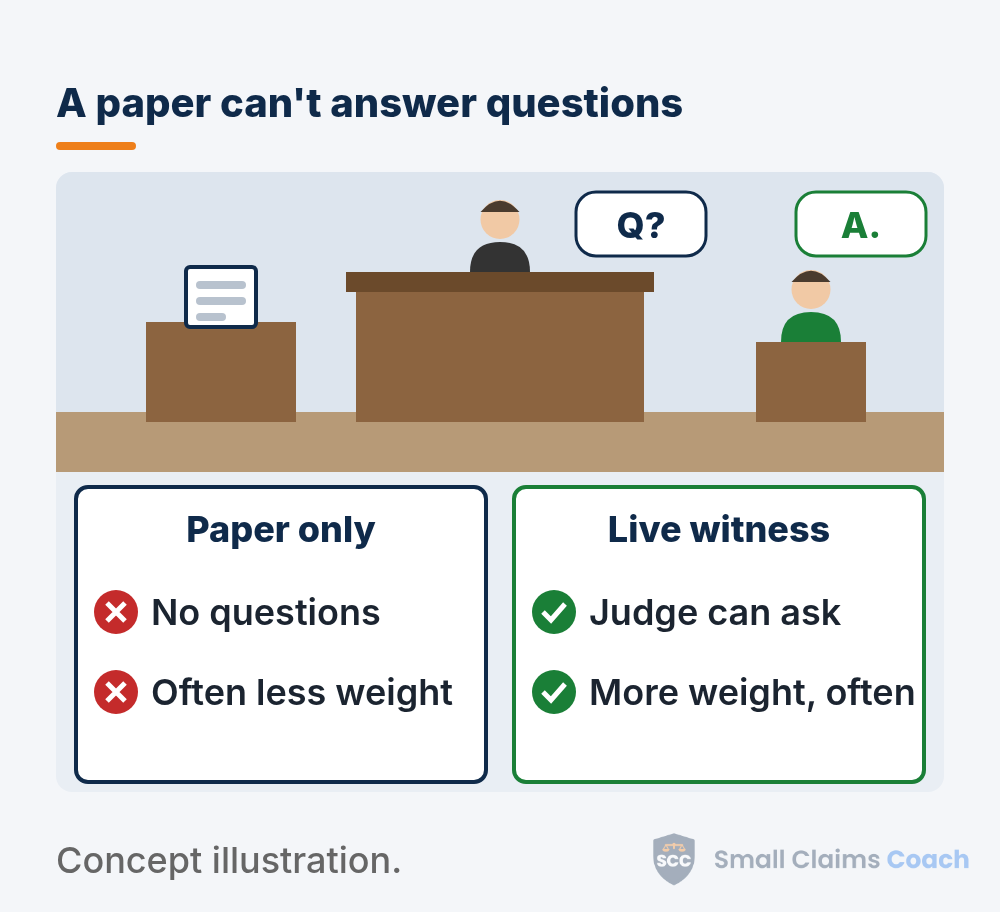
A live witness can answer the judge's questions, and the other side can ask questions too. That makes live testimony more convincing when the fact is central or disputed. A written statement is easier to get but can't be questioned, so a judge may give it less weight. A good rule: get key, disputed witnesses there in person. Use statements for supporting details.
| Live witness | Written statement | |
|---|---|---|
| Judge can ask questions | Yes | No |
| Effort for the witness | A day in court | A page and a signature |
| Weight with the judge | Usually more | Often less |
| Risk | May not show without a subpoena | Court may not accept it |
Subpoenas for documents and phone records
A subpoena duces tecum (say "DOO-chess TAY-kum") is a subpoena for documents. It orders a person or business to bring or send records, such as phone records, store or parking-garage video, or a repair shop's work orders. Many small claims courts use the same subpoena form with a section for documents. Phone carriers and businesses may only keep records for a limited time, so ask early. Some records, such as phone records, may have extra privacy rules. Check your court's rules.

Coach's Tip: Before you subpoena records, ask politely. A business may just give you a copy. If you think records might be deleted, send a preservation letter first. See how to preserve evidence.
Do I even need a witness?
Not always. Many cases are won with documents, photos and texts. A witness helps when the key fact is something a person saw or heard, or when you need someone with know-how, like a mechanic or contractor, to explain the damage. See saving texts as evidence and photos and video.
Not sure who to bring?
The full guide's witness plan worksheet has you list each possible witness, what they saw or know, whether it's disputed, whether they're willing, and which path fits: come on their own, a written statement, or a subpoena. General legal information, not advice about your case.
Frequently asked questions
What is a subpoena duces tecum?
It's a subpoena for documents. Instead of (or as well as) ordering someone to testify, it orders them to bring or send specific records, like phone records, video or work orders, to the court.
What if my witness ignores the subpoena?
Tell the judge at the hearing and show your proof of service. Depending on your state, the judge may postpone, order the witness to appear, or take other steps. Check your court's rules.
Can a witness testify by phone or video?
Some courts allow it, especially for remote hearings. Ask the clerk ahead of time.
Is a repair estimate enough without the repair person as a witness?
Often a written, itemized estimate or invoice on business letterhead is accepted as proof of cost in small claims. Bringing the person helps if the other side disputes it.
How far in advance must a subpoena be served?
It depends on your court. Each state sets its own timing. Check your court's rules and serve as early as you can.
This information is for educational purposes only. It is not legal advice. Rules vary by state and court. We try to keep every page up to date, but local rules, fees, and information change regularly. If you have questions, or our numbers don't match what your court publishes on its website, double-check with your court clerk.
This website and our Playbook are designed to give you the tools and confidence to handle your small claims case yourself, without a lawyer. If you think something is missing, we would like to hear about it so we can keep improving our Playbook. But if your situation is complicated, does not fit the samples we cover, or a filing deadline is close, you may want to call a lawyer.
In the full guide (Playbook members):
- A sample witness statement (made-up names), line by line
- What a document subpoena should list
- A witness plan worksheet: who, what they prove, which path
- A subpoena tracker from issued to served to hearing
- A short script for asking a witness to come
- A witness prep do/don't list and a sample question set
- Common mistakes that sink witness evidence
You do the work. The Playbook hands you the plays.
The full guide covers the list above, step by step. Your membership also includes a filled-in sample of your state's claim form and your state's Playbook section, with prep guides that work in any state: a document checklist, exhibit labels, a prep timeline and a hearing-day outline. One membership covers every state.