
Texas Small Claims Court (Justice Court): Limits, Fees, Forms, and Where to File
Texas small claims go to Justice (JP) Courts: sue for up to $20,000, $54 filing fee plus county service fee. Where to file, forms, and basic steps.
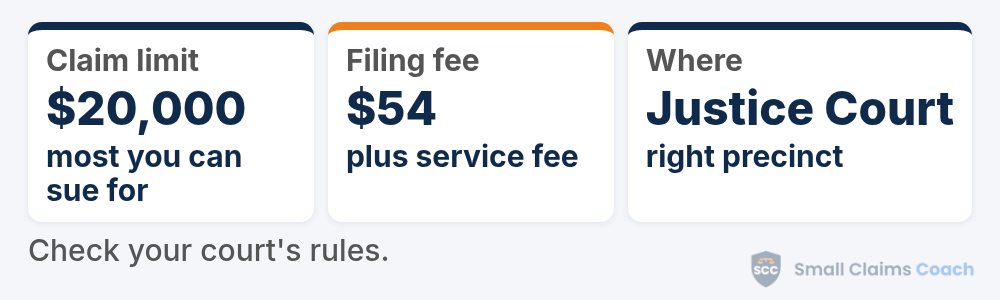
Quick answer: Texas small claims (Justice Court) has a $20,000 limit. The filing fee is $54 statewide, plus the cost of service. No single statewide petition form is required, and you don't need a lawyer.
Filing in Texas? See a filled-in sample first.
Everything on this page is free. The Small Claims Playbook adds a filled-in sample of a Small Claims Petition from the Texas Justice Court Training Center (a model form, not an official court form; Texas has no required statewide form, so ask your court whether it accepts it), using a made-up case, with a box-by-box guide. One membership covers every state. $149 for your first year (introductory offer), then $199 a year. Join now.
How small claims works in Texas
Texas small claims are heard in Justice Courts, also called Justice of the Peace or "JP" courts. The limit, the basic rules and the $54 filing fee are the same statewide. But every county is split into justice precincts, and you have to file in the right county and precinct. Service fees, forms, e-filing rules and local practices differ by county, and sometimes by court. You don't need a lawyer, and the defendant has until the end of the 14th day after service to answer.
Checked on 2026-10-08. Sources: official sources are linked in each section and under Official links below.
What is the small claims limit in Texas?
$20,000. Attorney's fees count toward the limit; statutory interest and court costs don't.
- Not in Justice Court: divorces, defamation, disputes over title to land, or enforcement of a lien on land.
- Money or property: Texas justice court rules let a small claims case seek money or the return of personal property (Tex. R. Civ. P. 500.1(a)); you list the item and its value (Rule 502.2). If you want an order making someone do something else, the Texas State Law Library says you may need a different court. Check your court's rules. For what it means when a court can order only money, or something else, see What Judges Can Actually Order.
How much does it cost to file small claims in Texas?
The filing fee is $54 statewide. You also pay up front for the constable or sheriff to serve the defendant, at a rate set by each county. If you can't afford the costs, file a Statement of Inability to Afford Payment of Court Costs, which the clerk has to give you for free.
Service fees for the 20 largest counties are in the county list below.
Where do I file a small claim in Texas?
File in the county and precinct:
- where the defendant lives,
- where the events behind the claim (or most of them) happened,
- where the contract was supposed to be performed, or
- where the property is, if you're suing to get personal property back.
If the defendant doesn't live in Texas or you don't know where they live, you can file where you live. If a precinct has more than one court (Place 1 and Place 2), you can file in either. Use your county's precinct map or address lookup to find the right one.
How to file in Texas: the basic steps
File a petition in the right county and justice precinct, pay the $54 filing fee plus the county's service fee (or file a Statement of Inability), and get the defendant served.
- Find the right county and precinct.
- File a petition with your name, address, and phone; the defendant's name and address (and phone, if you know it); the amount you want; and the basis of your claim. You can add your consent to service by email.
- Pay the filing fee and the service fee, or file a Statement of Inability.
- Get the defendant served. The clerk issues the citation, but getting it served is up to you.
- The defendant has until the end of the 14th day after service to answer. If they don't, you may be able to get a default judgment.
- If they answer, the court gives at least 45 days' notice of the trial date, unless the judge finds an earlier date is needed.
Ready to do these steps yourself?
Two steps to get right: you have to file in the right county and justice precinct, and getting the defendant served is your responsibility: the clerk issues the citation, and you arrange service and pay the service fee. The steps above are free. The Playbook helps you do each one, with a filled-in sample of the model Small Claims Petition and every box explained, plus your Texas Playbook section: a step-by-step filing walkthrough with a made-up sample filing, the answer, trial-notice, jury and appeal deadlines in order, and a filing and trial checklist with a hearing outline.
You also get prep guides that work in any state: a document checklist, exhibit labels, a prep timeline and a hearing-day outline. $149 for your first year (introductory offer), then $199 a year. Join now.
Small claims court by Texas county
The 20 largest counties, largest first (2020 Census). Every county uses the same $20,000 limit and $54 filing fee. The service fee is what the constable charges per defendant, from each county's official pages, checked October 2026; where a fee was checked at one court, that court is shown. Justice Court counts are listed for the ten largest counties.
| County | Service fee, per defendant | Justice Courts |
|---|---|---|
| Harris | $85 | 16 courts |
| Dallas | $80 | 10 courts |
| Tarrant | $90 | 8 courts |
| Bexar | $92 | 4 courts |
| Travis | $90 (JP 5) | 5 courts |
| Collin | $75 | 4 courts |
| Denton | $80 | 6 courts |
| Hidalgo | $100 (JP 3-1) | 9 courts |
| El Paso | Check your court's rules. | 8 courts |
| Fort Bend | $80 (JP 3-1) | 7 courts |
| Montgomery | $75 (JP 4) | |
| Williamson | $80 | |
| Cameron | Check your court's rules. | |
| Brazoria | $80 (JP 3-1) | |
| Bell | $85 | |
| Nueces | Check your court's rules. | |
| Galveston | Check your court's rules. | |
| Lubbock | $80 | |
| Webb | $100 | |
| McLennan | $90 |
Texas county guides
Know your precinct? Next, get your proof in order.
You can present your own case. The Playbook's exhibit-label guide and hearing-day outline help you put your documents in order and explain them clearly, step by step. General legal information, not advice about your case.
Texas small claims FAQ
What is the small claims limit in Texas?
$20,000. Attorney's fees count toward the limit; statutory interest and court costs don't.
How much does it cost to file small claims in Texas?
The filing fee is $54 statewide. You also pay the constable or sheriff to serve the defendant, at a rate set by each county. If you can't afford the costs, you can file a Statement of Inability to Afford Payment of Court Costs.
Is there a required small claims form in Texas?
No single statewide petition form is required. Courts can offer forms but can't make you use them; many counties post a Small Claims Petition based on the Supreme Court-approved forms.
Do I need a lawyer for small claims in Texas?
No. You can represent yourself or hire a lawyer. For good cause, the court may let an unpaid family member or other person help you. A business can be represented by a non-lawyer employee, owner, officer, or partner.
How long does the defendant have to answer in Texas small claims?
Until the end of the 14th day after service. If they don't answer, you may be able to get a default judgment.
Official links
- Texas Rules of Civil Procedure (Texas Judicial Branch)
- Justice Court civil cases and fees (Office of Court Administration, PDF)
Related guides: Ready to sue · Just got sued · Small claims court basics · 10 things to do before you sue · How to save text messages as evidence · Sued in small claims? What to do next
Other states: pick your state on the map. Free: the Small Claims Starter Kit (basic timeline and checklists). Go deeper: preview the Playbook.
What's in the Texas Playbook section
- Can a business sue and Texas small claims forms
- How to file a small claim in Texas, step by step (made-up sample filing)
- Texas small claims timeline: answer, trial notice, jury and appeal deadlines in order
- How much to ask for and how to back up your number
- Checklist for filing and for trial, plus a hearing outline
You do the work. The Playbook hands you the plays.
This page covers the Texas rules. The Playbook coaches you from filing to hearing day: a filled-in sample of the model Small Claims Petition, your Texas Playbook section, and step-by-step prep guides. Every state and DC has a filled-in sample claim (for Mississippi, Oklahoma and Wyoming it's a sample layout we made, so you'd get the real form from the court clerk). One membership covers every state.
Small Claims Coach is built to help you handle your case yourself, without a lawyer — but if your situation is complicated, does not fit our samples, or a deadline is close, you may want to call a lawyer.
Small Claims Coach uses public information to build the Playbook, which coaches you as you organize and present your own case. We are not your lawyer, there is no attorney-client relationship, and we don't want the details of your case.
This information is for educational purposes only. It is not legal advice.