How to Serve Small Claims Papers (and What to Do If Service Fails)
Filed your small claim? Next the other side must be served. Who can serve, common methods, proof of service, serving a business, and what to do if service fails.
You filed. Now comes the step that trips up a lot of people: making sure the other side officially gets the papers.
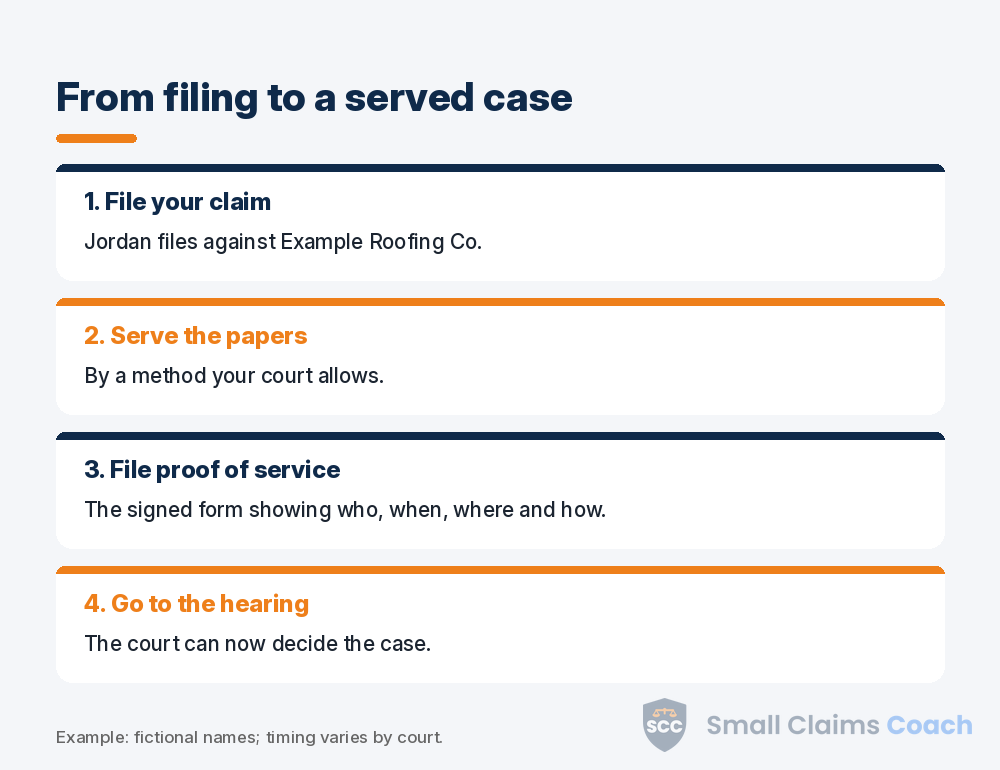
We'll follow one fictional case: Jordan Sample has filed against Example Roofing Co. over a roof repair that still leaks. The court can't hear Jordan's case until Example Roofing Co. is properly served. If you're the one who was served, see Got Sued.
The quick answer: how do you serve small claims papers?
After you file, the other side must get official copies of your claim. That's called service. Depending on your court, the clerk may mail them, or a sheriff, a process server or another adult who isn't in the case delivers them. Then a signed proof of service is filed with the court by the deadline. If service fails, document every attempt and ask the clerk about more time or another method.
Serving papers? Get the full guide.
The full guide is for Playbook members: a service-method chooser, instructions to hand your server, what to say when you call the clerk, and a tracker for every service attempt. The Playbook also gives you a filled-in sample of your state's claim form (every state and DC has one; for Mississippi, Oklahoma and Wyoming it's a sample layout we made, so you'd get the real form from the court clerk) and your state's Playbook section. One membership covers every state. $149 for your first year (introductory offer), then $199 a year. Join now.
Why does service matter?
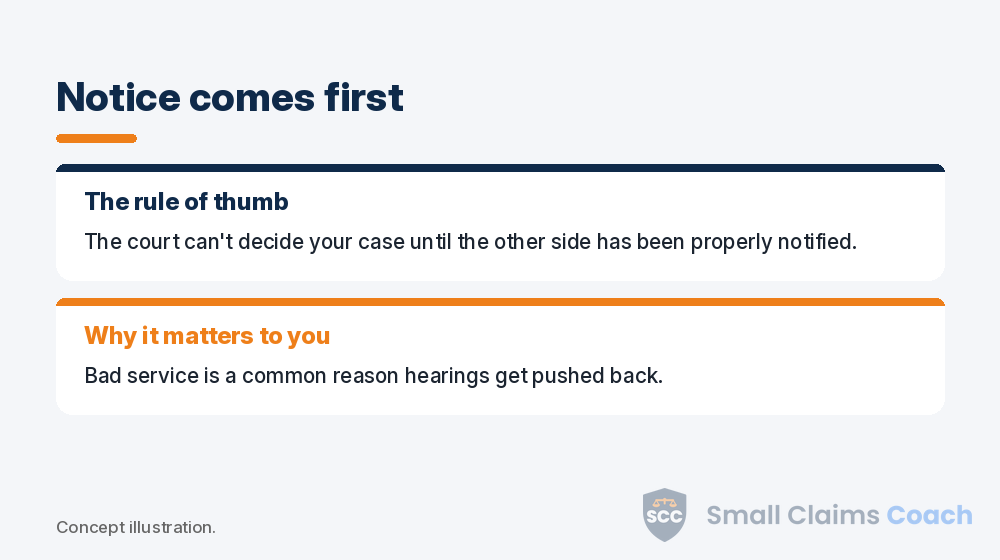
The court can't decide your case until the other side has been properly notified. Bad service is one of the most common reasons hearings get postponed or dismissed.
Who can serve small claims papers?
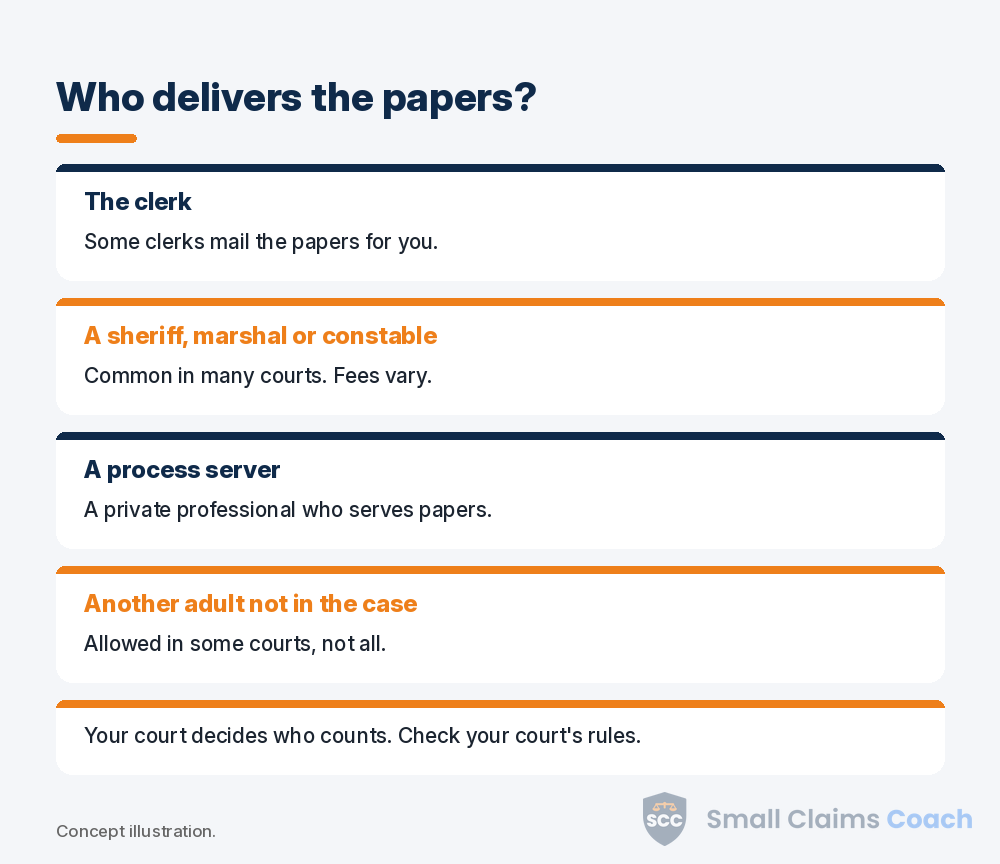
Who delivers the papers depends on your court. Some clerks mail them for you; in other courts you have to arrange it. For example, in California you can't serve the papers yourself, so another adult, a sheriff or a process server must do it (California Courts). Check your state page (New York, California, Texas) or ask the clerk.
What are the common ways to serve?
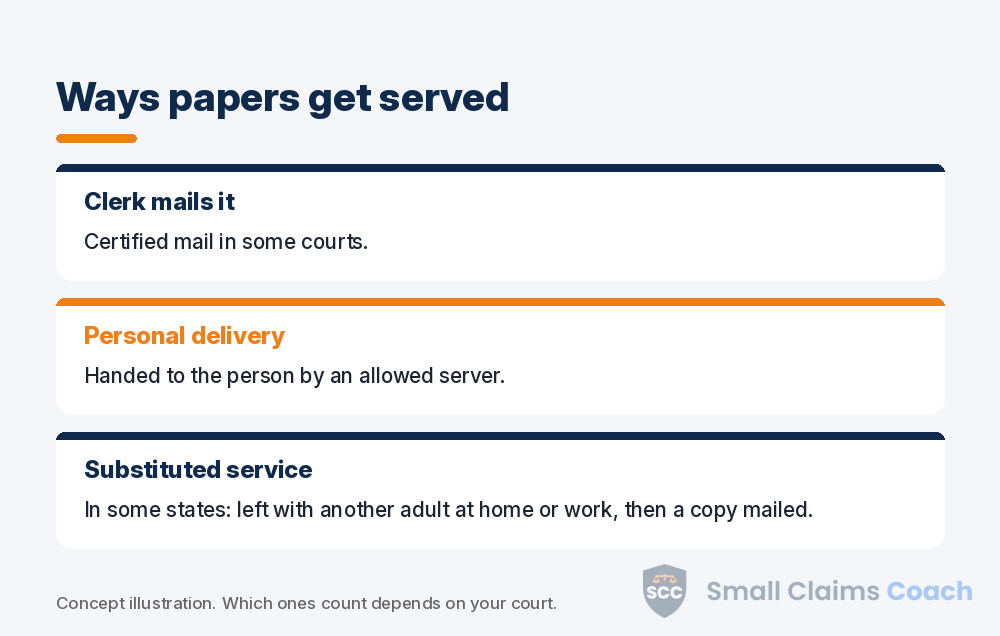
- Clerk mails it: in some courts, the clerk sends the papers by certified mail; service may count only if the defendant signs.
- Sheriff, marshal or constable: an officer serves for a fee.
- Professional process server: a private company serves for a fee.
- Personal service by another adult: where allowed, an adult who isn't in the case hands over the papers.
- Substituted service: in some states, leaving papers with another adult at the home or workplace and then mailing a copy.
Which methods does your court allow?
Which methods are allowed depends on your state. See your state on the states hub.
Whichever method you use, keep a record of every attempt. The Service Tracker gives you an attempts log and a proof-of-service checklist.
In the full guide (Playbook members):
- When service has to be done
- How to serve a business
- What proof of service is
- What to do if service fails
- Common questions
- A service-method chooser
- Instructions to hand your server
- What to say when you call the clerk
- How to track every attempt with the service tracker
This website and our Playbook are designed to give you the tools and confidence to handle your small claims case yourself, without a lawyer. If you think something is missing, we would like to hear about it so we can keep improving our Playbook. But if your situation is complicated, does not fit the samples we cover, or a filing deadline is close, you may want to call a lawyer.
This information is for educational purposes only. It is not legal advice. Rules, deadlines, fees and forms vary by state and court. Check your court's rules or self-help center before you act.
You do the work. The Playbook hands you the plays.
The full guide covers the list above, step by step. Your membership also includes a filled-in sample of your state's claim form and your state's Playbook section, with prep guides that work in any state: a document checklist, exhibit labels, a prep timeline and a hearing-day outline. One membership covers every state.