How to Tell Your Story on a Small Claims Form: Who, What, When, How Much, and Why
The space on the form is small for a reason. Here's how to tell your story in a few clear sentences: who, what, when, how much, and why they owe it.
When you sit down with the claim form, it's tempting to tell the whole saga. Every broken promise, every unanswered call. But the box is small for a reason. The form's job is to tell the court and the other side what your claim is, not to win the case on paper.
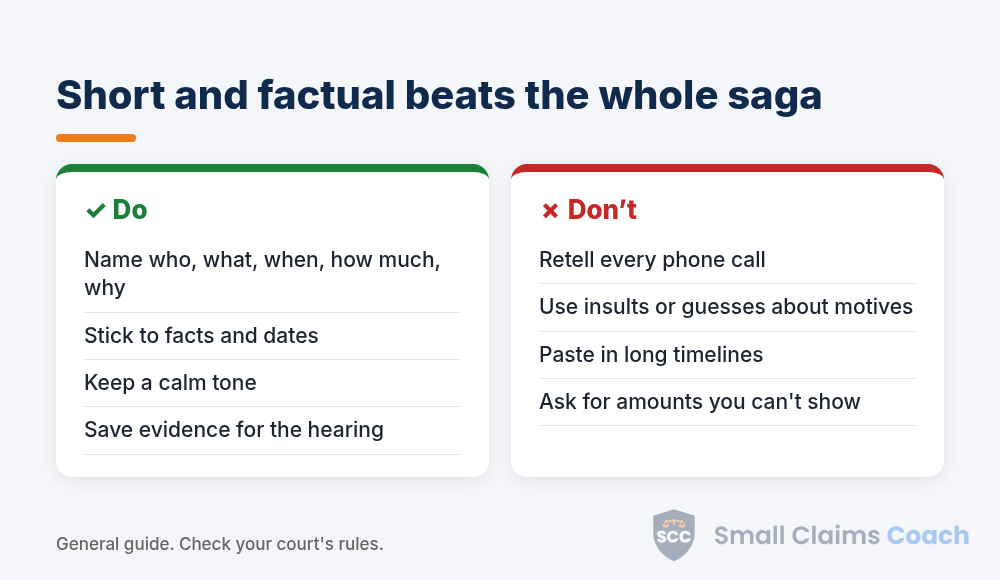
The quick answer: five things your statement needs
- Who: the person or business you're suing, named correctly, and your relationship (customer, tenant, buyer).
- What: what was agreed and what went wrong, in one or two sentences.
- When: the key dates (when you agreed, paid, and when it went wrong).
- How much: the total you're asking for, and briefly how you got it.
- Why they owe it: the plain reason (they took payment and didn't do the work; they kept the deposit without a reason).
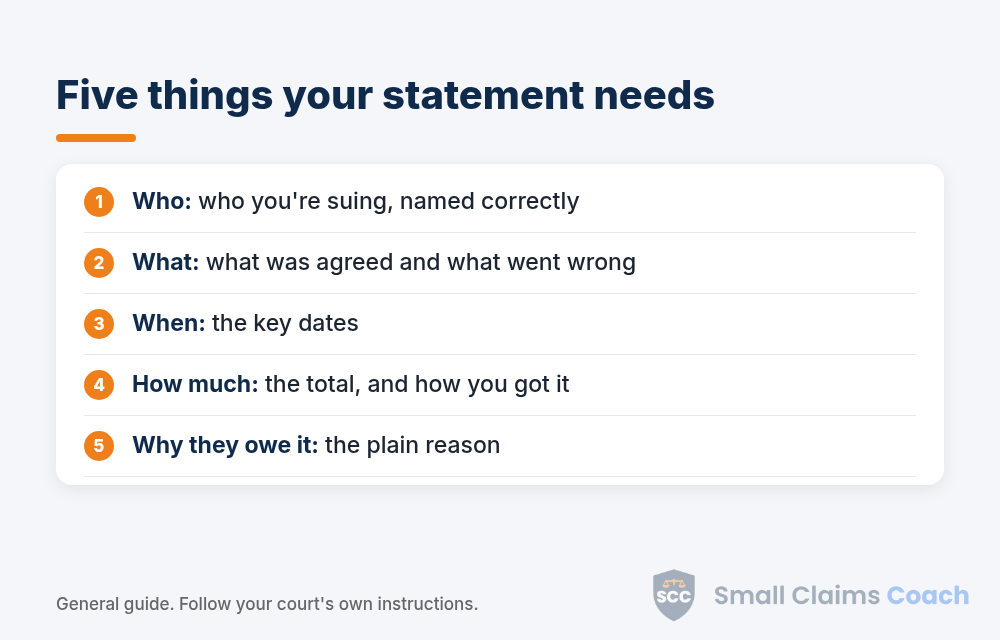
Keep it short, factual, and calm. Save the details and evidence for the hearing. Follow your court's instructions for what goes where, and check your court's rules for any length limits or required attachments.
Not sure your number is right yet? Read How Much Can I Sue For in Small Claims? first.
Writing your statement? Get the full guide.
The full guide is for Playbook members: a fill-in-the-blank statement template, before-and-after examples for contractor, deposit, refund and car repair cases, a final read-through checklist, and a short outline for telling your story at the hearing. The Playbook also gives you a filled-in sample of your state's claim form (every state and DC has one; for Mississippi, Oklahoma and Wyoming it's a sample layout we made, so you'd get the real form from the court clerk) and your state's Playbook section. One membership covers every state. $149 for your first year (introductory offer), then $199 a year. Join now.
How do I write my small claims statement?
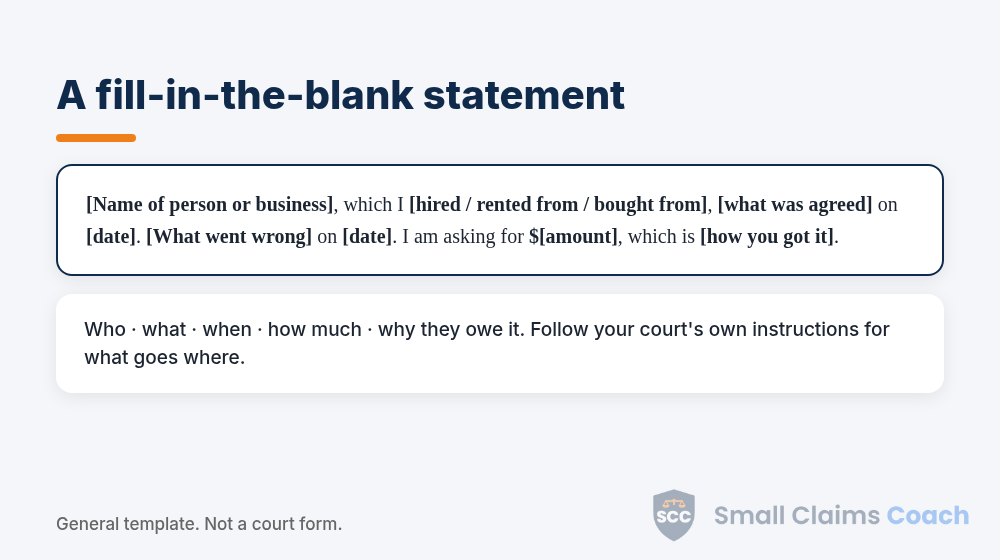
Write it like a short summary for someone who knows nothing about your situation. In a few sentences, say who you're suing, what was agreed, what went wrong and when, how much you're asking for, and why they owe it. Use names, dates, and dollar amounts. Leave out opinions and the backstory.
How long should a small claims statement be?
Usually short. Many claim forms give you a small box, and a few clear sentences often fit. If your court allows an attachment or extra pages, you can add more, but the core statement should still stand on its own. Check your court's instructions for any length limits or required attachments.
What should I include in my small claims claim?
- The other side's correct name, as it appears on your contract, invoice, or records
- Your relationship: customer, tenant, buyer, or seller
- The agreement: what they were supposed to do or pay
- What went wrong, with key dates
- The amount and a short note on how you got it
- The plain reason they owe it
What should I leave out of my small claims complaint?
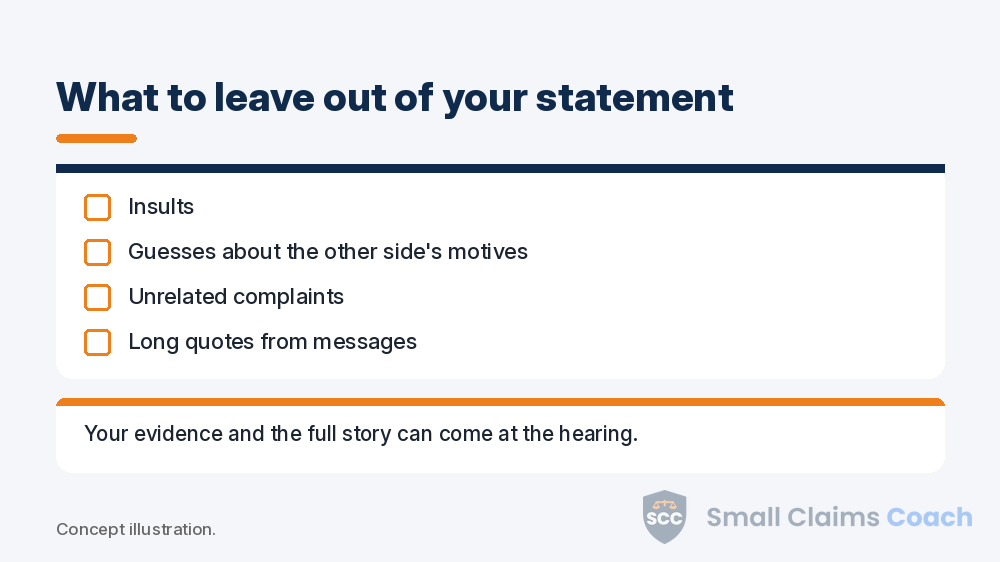
Leave out insults, guesses about motives, unrelated complaints, and long quotes from messages. They make the statement harder to follow and can make you look less credible. Your evidence and the full story can come at the hearing.
Do I need legal words or to cite laws?
Generally, no. Small claims courts are designed for people without lawyers, and plain language is usually best. If a specific law matters to your claim, your court's self-help pages may explain how to mention it. Check your court's instructions.
How do I describe the amount I'm asking for?
Give the total and a short explanation, like "the $1,500 deposit I paid" or "the cost to repair the work, based on two written estimates." For help building the number, see How Much Can I Sue For in Small Claims?
Want a head start on yours?
The full guide has a fill-in-the-blank statement template and shows how to turn your timeline into a statement. General legal information, not advice about your case.
What does a good small claims statement look like?
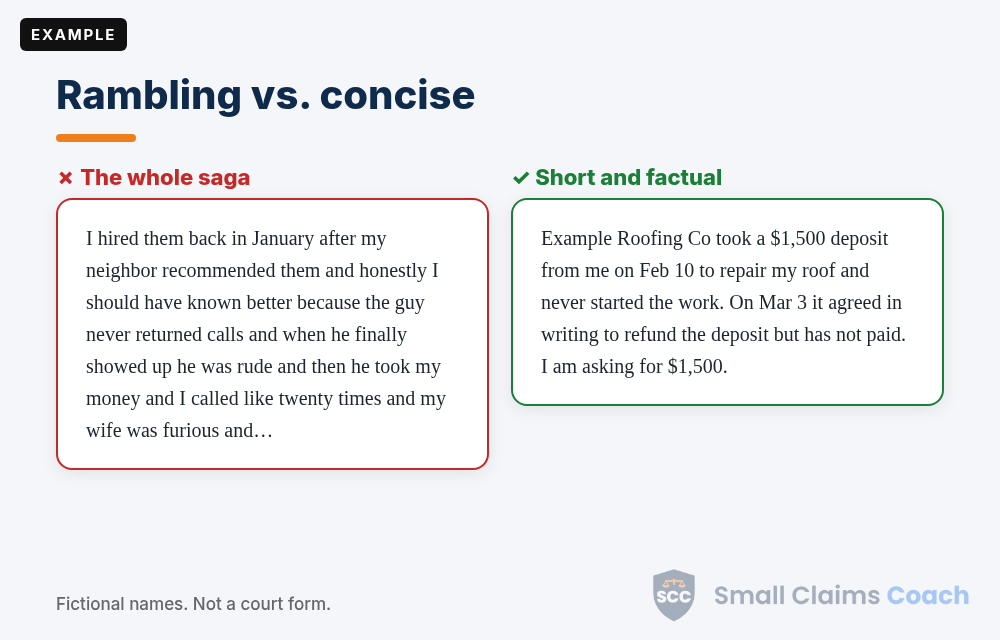
Here's a fictional example for a deposit dispute:
Example Roofing Co, which I hired to repair my roof, took a $1,500 deposit on Feb 10 and never started the work. On Mar 3 it agreed in writing to refund the deposit but has not paid. I am asking for $1,500, the amount of the unreturned deposit.
It's three sentences. It names the business, the relationship, the dates, the amount, and the reason. Anyone reading it knows what the case is about.
Should my statement match my evidence?
Yes. Every fact in your statement should be something you can back up at the hearing with a document, a photo, a message, or your own testimony. If your statement says you paid $1,500 on Feb 10, bring the receipt or bank record. Mismatched dates or amounts give the other side an easy point to argue, so double-check your numbers against your documents before you file.
What if I'm the one being sued?
If you were sued, the same habits help when you respond or prepare for the hearing: be short, factual, and calm, and focus on what was agreed, what happened, and why you don't owe what's claimed (or owe less). Some courts have a form for responding or for filing a claim of your own. Check your court's rules and deadlines.
Where do I write my statement?
Usually on the claim form your court provides, in the section that asks you to describe your claim. Some courts let you file online. Use your court's own form and instructions, and keep a copy of everything you file.
Frequently asked questions
What is a small claims statement of claim?
It's the short description on your claim form of what happened and what you're asking for. Courts use different names for it, and the form tells you what to put where.
Can I attach documents to my small claims claim?
Some courts allow or ask for attachments, and others want evidence brought to the hearing instead. Check your court's instructions.
Should I write my statement in the first person?
Usually, yes. Plain first-person sentences like "I paid" and "they agreed" are clear and easy to follow.
What if I don't know the other side's exact business name?
Look at your contract, receipts, check images, invoices, and your state's business records. Getting the name right matters, so check your court's guidance on naming a business.
Can I change my statement after I file?
Some courts allow changes, sometimes with a form or a deadline. Check your court's rules or ask the clerk.
Will the other side see my statement?
Generally, yes. The other side usually gets a copy of the claim, so keep it factual and calm.
What if my story is complicated?
Stick to the main agreement, what went wrong, and the amount. Put the details in a timeline you bring to the hearing.
In the full guide (Playbook members):
- A fill-in-the-blank statement template
- Before-and-after examples for contractor, deposit, refund, and car repair cases
- How to name the other side correctly
- What to leave out (and why)
- A final read-through checklist
- Common mistakes
- Turning your timeline into a statement
- A short outline for telling your story at the hearing
This website and our Playbook are designed to give you the tools and confidence to handle your small claims case yourself, without a lawyer. If you think something is missing, we would like to hear about it so we can keep improving our Playbook. But if your situation is complicated, does not fit the samples we cover, or a filing deadline is close, you may want to call a lawyer.
This information is for educational purposes only. It is not legal advice. Rules, deadlines, fees and forms vary by state and court. Check your court's rules or self-help center before you act. We try to keep every page up to date, but local rules, fees, and information change regularly. If you have questions, or our numbers don't match what your court publishes on its website, double-check with your court clerk.
You do the work. The Playbook hands you the plays.
The full guide covers the list above, step by step. Your membership also includes a filled-in sample of your state's claim form and your state's Playbook section, with prep guides that work in any state: a document checklist, exhibit labels, a prep timeline and a hearing-day outline. One membership covers every state.