You Won Small Claims Court. Now How Do You Actually Get Paid?
Won in small claims but haven't been paid? The usual 5-step path to collecting a judgment: written demand, debtor exam, garnishment, bank levies and liens.
The judge ruled your way. Weeks later, nothing's arrived. That's more common than people expect, and there's a path.
We'll follow one fictional case the whole way through: Jordan Sample won a small claims judgment against Example Roofing Co. after a roof repair that still leaked. Jordan has the judgment. Now Jordan wants the money.
The quick answer: how do you collect a small claims judgment?
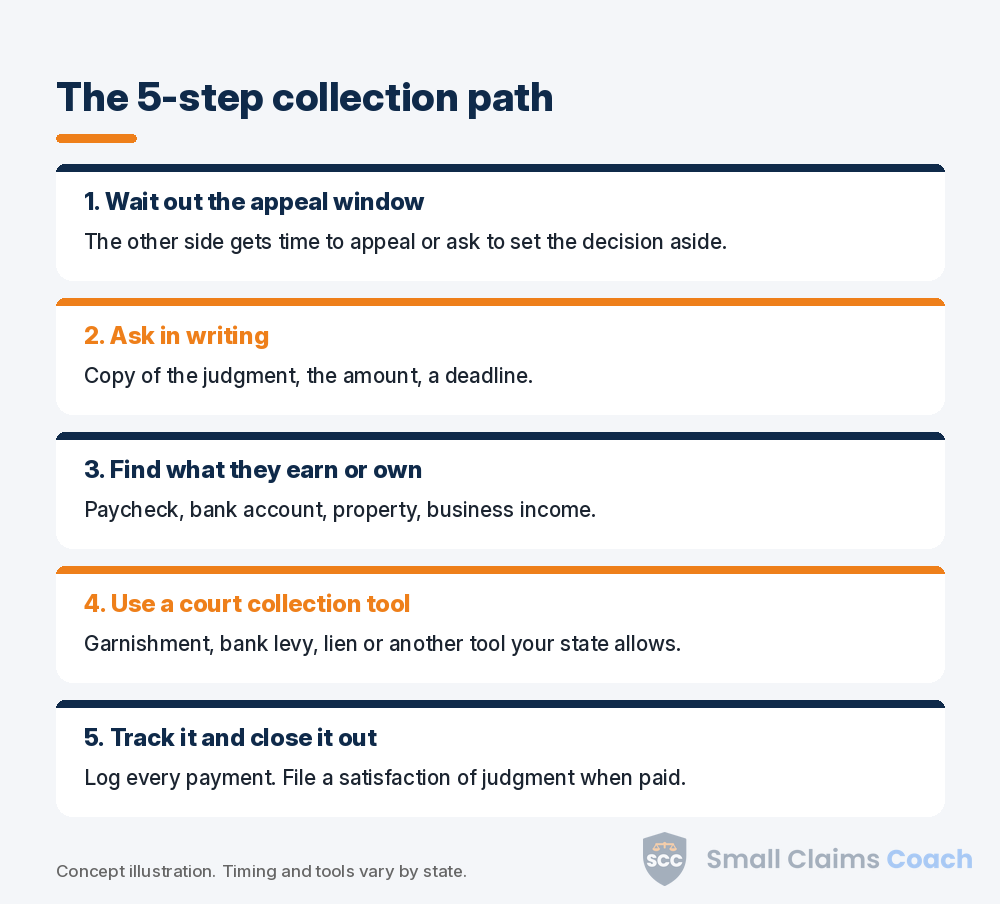
Winning gets you a judgment, not a check. If the other side doesn't pay, you usually: (1) wait out the appeal period, (2) ask for payment in writing, (3) find out what they own or earn, often through a debtor's examination, (4) use a court tool such as wage garnishment, a bank levy or a property lien, and (5) track payments and file a satisfaction of judgment (the form that tells the court you've been paid) when you're paid. The court generally won't collect for you.
Collecting a judgment? Get the full guide.
The full guide is for Playbook members: which collection tool to use first, a payment-demand letter and payment-plan agreement, a debtor-exam question list, and a collection tracker for payments and costs. The Playbook also gives you a filled-in sample of your state's claim form (every state and DC has one; for Mississippi, Oklahoma and Wyoming it's a sample layout we made, so you'd get the real form from the court clerk) and your state's Playbook section. One membership covers every state. $149 for your first year (introductory offer), then $199 a year. Join now.
Step 1: When can I start collecting?
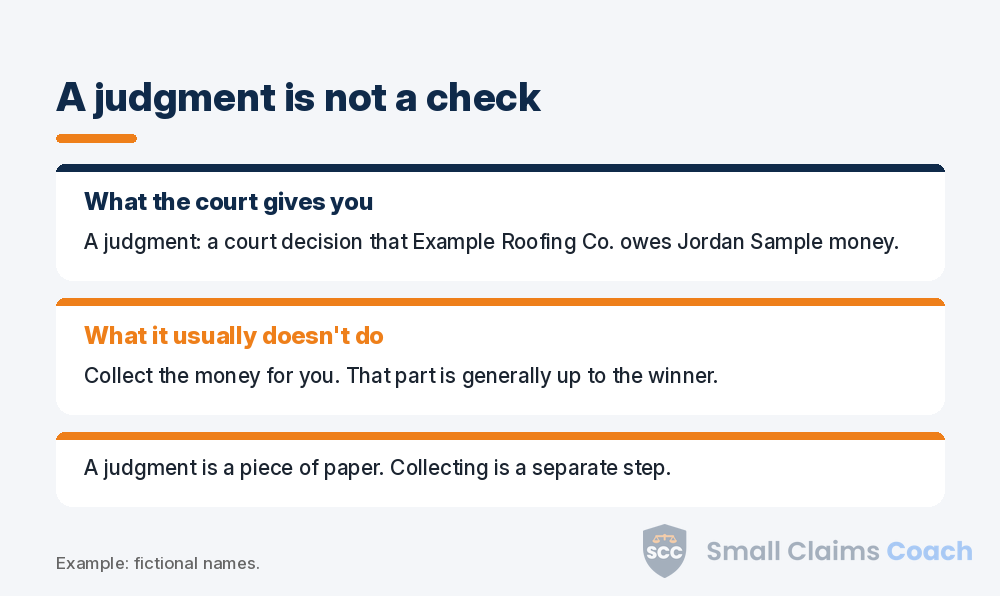
You usually have to wait a short time before collecting, because the other side gets a window to appeal or ask the judge to cancel (set aside) the decision. Find your state's window on your state page, such as California or Florida.
Step 2: Ask for payment in writing
What goes in the payment request?
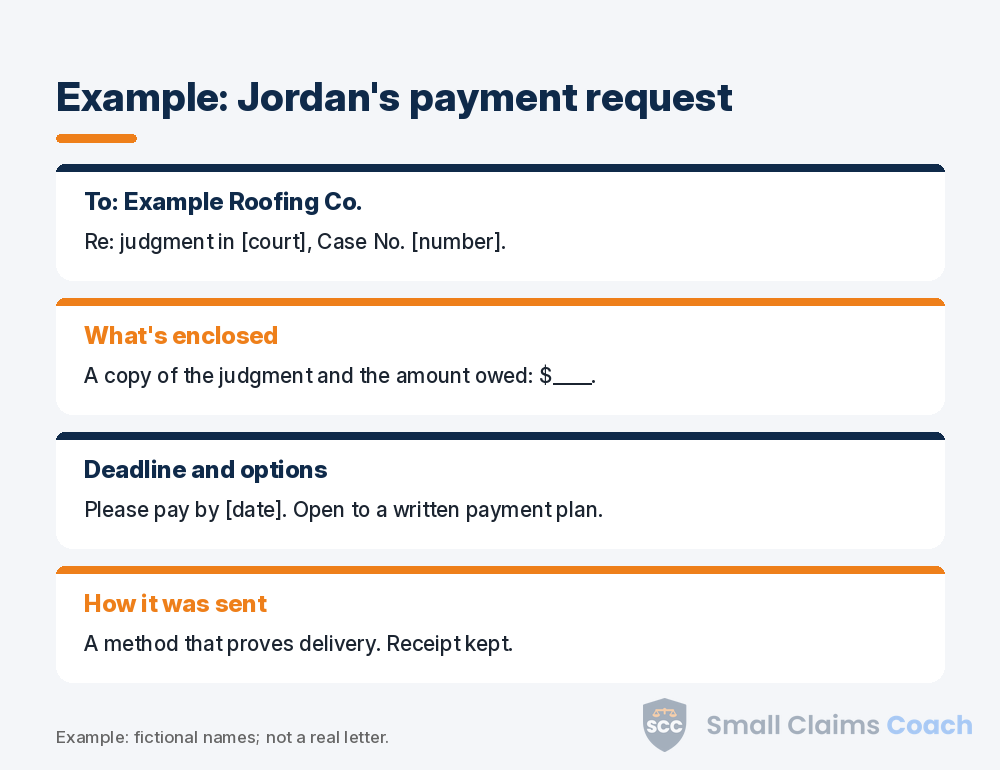
Send a short, polite letter with a copy of the judgment, the amount, and a payment deadline. Offer a payment plan if that makes payment more likely. Send it in a way that proves delivery.
In our example, Jordan mails Example Roofing Co. a one-page request with a copy of the judgment and a reply date, and keeps the delivery receipt.
Step 3: What do they earn or own?
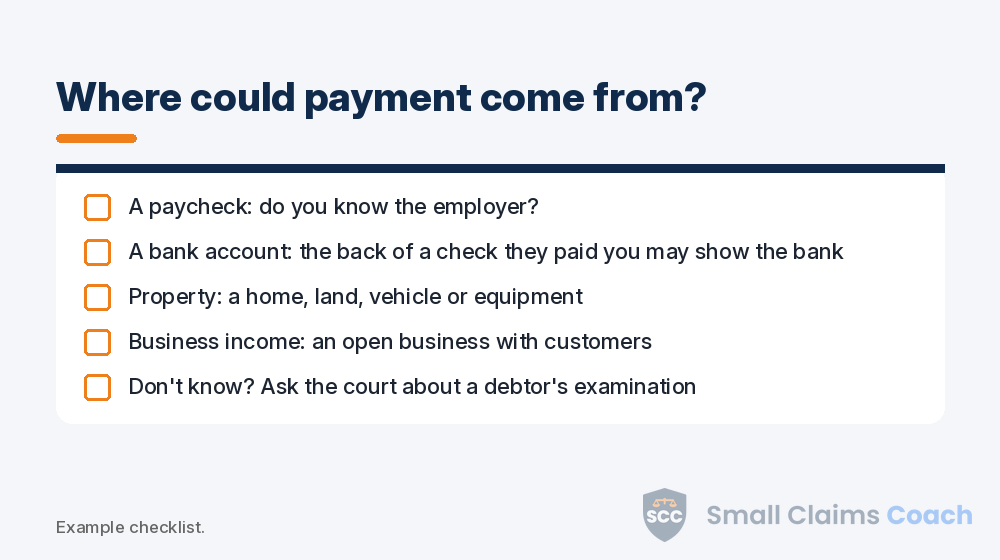
You can only collect from something real: a paycheck, a bank account, property, or business income. Tip: the back of a check they paid you may show their bank. If you don't know, many courts let you request a debtor's examination (names vary: "judgment debtor exam," "supplementary proceedings," "post-judgment discovery"). If they've moved, check your court's rules on where and how to request one.
Step 4: Use a collection tool
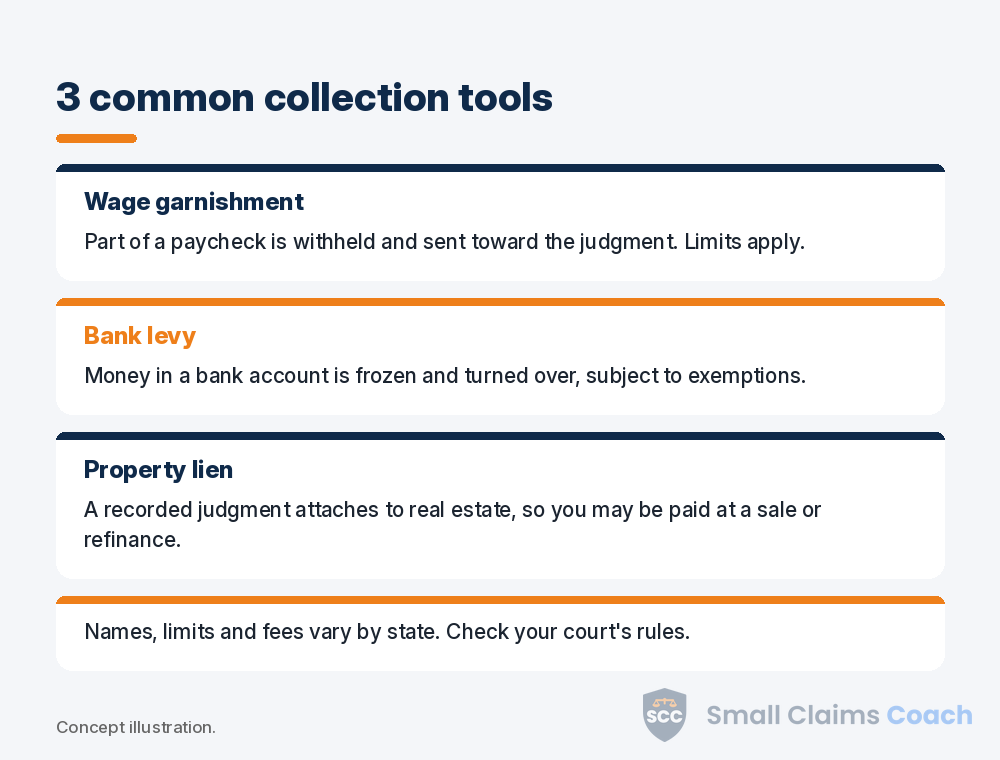
- Wage garnishment: part of their paycheck is withheld and sent toward your judgment. Federal and state limits apply.
- Bank levy: money in their bank account is frozen and turned over, subject to exemptions.
- Property lien: a recorded judgment attaches to real estate, so you may be paid when it's sold or refinanced.
- Other tools: some states allow levies on business receipts, rental income or vehicles.
How does a collection tool get started?
Most of these start with a court paper, often called a writ of execution, that you give to a sheriff, marshal or constable. Expect fees; some can be added to what you're owed. Check your court's rules.
Choosing a collection tool?
The full guide covers which collection tool to use first, with a debtor-exam question list and what to do if they skip the exam. General legal information, not advice about your case.
Step 5: Track everything and close it out
Keep a log, then file the satisfaction
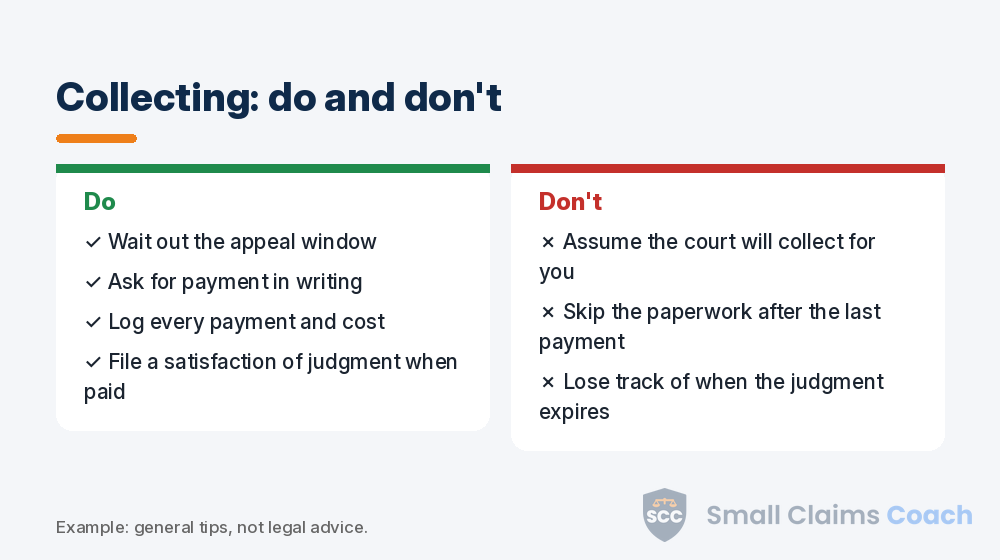
Keep a log of every payment and every cost. When you're paid in full, file a satisfaction of judgment. If you skip it, the judgment can still show as unpaid, and some courts can penalize you. In California, for example, you must let the court know within 14 days of being paid (California Courts). Elsewhere, check your court's rules.
Can they pay in installments?
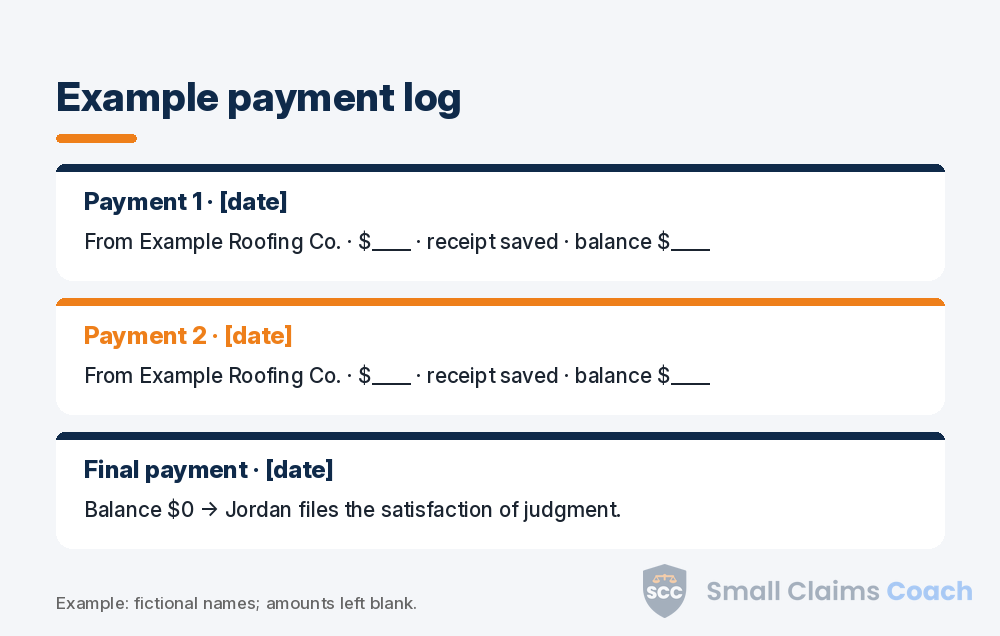
Sometimes the fastest way to get your money is in pieces. You can agree to a payment plan yourself, and some courts can also order installment payments. Check your court's rules. Keep a record of every payment, and file the satisfaction of judgment after the last one clears. If you're the one who owes, ask for a dated receipt for each payment and confirm the satisfaction was filed. Playbook members: use the payment log.
In the full guide (Playbook members):
- Which collection tool to use first
- State examples: how long a judgment lasts, interest, renewal and debtor exams
- Common questions
- Before your next case: can they pay?
- A payment-demand letter and payment-plan agreement
- What to do if they skip the debtor's exam
- A debtor-exam question list
- The "Can they pay?" worksheet with scoring
- A collection tracker for payments and costs
- What to do when they're "judgment proof"
This website and our Playbook are designed to give you the tools and confidence to handle your small claims case yourself, without a lawyer. If you think something is missing, we would like to hear about it so we can keep improving our Playbook. But if your situation is complicated, does not fit the samples we cover, or a filing deadline is close, you may want to call a lawyer.
This information is for educational purposes only. It is not legal advice. Rules, deadlines, fees and forms vary by state and court. Check your court's rules or self-help center before you act.
You do the work. The Playbook hands you the plays.
The full guide covers the list above, step by step. Your membership also includes a filled-in sample of your state's claim form and your state's Playbook section, with prep guides that work in any state: a document checklist, exhibit labels, a prep timeline and a hearing-day outline. One membership covers every state.