How Much Can I Sue For in Small Claims? What's Recoverable and What's Not
The number that matters isn't how much it hurt. It's how much you can show it cost you. Here's how to build a number you can stand behind.
If you're reading this, someone probably let you down. Maybe a contractor walked off the job, a landlord kept your deposit, or a seller never delivered. Those feelings are real.
Here's the part that's hard to hear: in small claims, the number that matters isn't how much this hurt. It's how much you can show it cost you. The good news is that this number is often clearer than you think.
Tool: add up your losses with the free quick total in our damages estimate calculator. Playbook members get the itemized version with a state limit check.
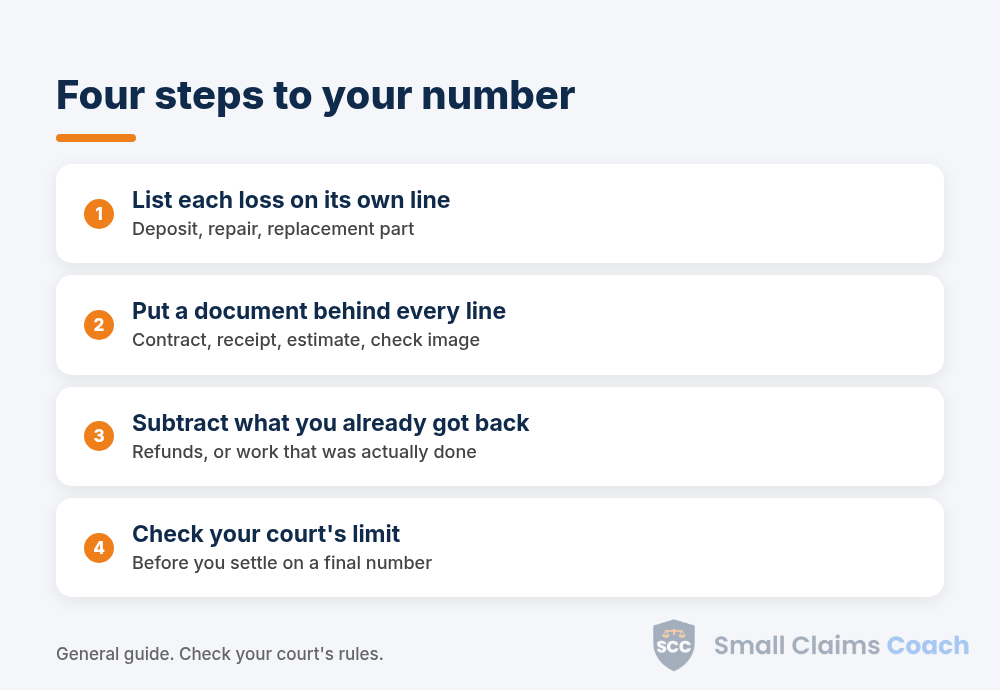
The quick answer: how to figure out your number
- List each loss on its own line. Deposit, repair, replacement part. Don't lump them together.
- Put a document behind every line: contract, invoice, receipt, written estimate, check image, or statement.
- Focus on direct losses (money paid for work not done, repair costs, unreturned deposits). These are usually the easiest to show.
- For contractor work, get more than one written estimate, and have a contractor explain in writing what was done wrong or left unfinished.
- Save pricing proof (screenshots or PDFs of prices for parts, materials, or replacements) with the date showing.
- Subtract anything you already got back or any work that was actually done.
- Be careful with extras. Your own time, time off work, stress, and side costs are often not recoverable. Check your court's rules.
- Check your court's limit on how much you can ask for before you settle on a number.
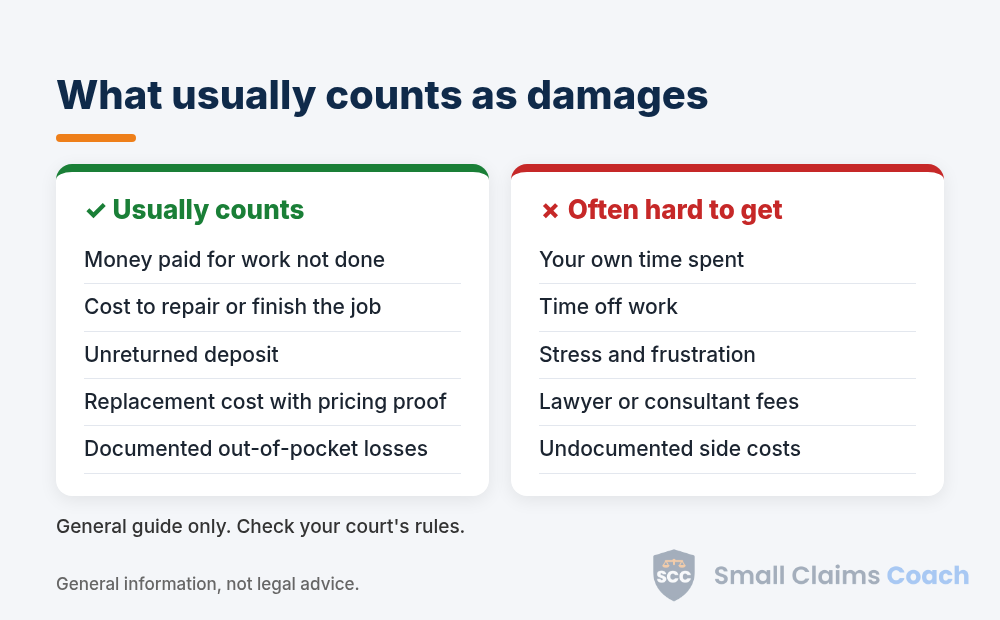
Pulling your paperwork together first? See how to preserve evidence and how to save text messages as evidence.
Working out your number? Get the full guide.
The full guide is for Playbook members: a damages worksheet template, the contractor-case method for estimates and pricing proof, a request-for-estimate script, and a fictional worked example. The Playbook also gives you a filled-in sample of your state's claim form (every state and DC has one; for Mississippi, Oklahoma and Wyoming it's a sample layout we made, so you'd get the real form from the court clerk) and your state's Playbook section. One membership covers every state. $149 for your first year (introductory offer), then $199 a year. Join now.
What damages can I sue for in small claims?
In general, damages in a small claims case are meant to put you back where you would have been if the other side had done what they were supposed to do. They aren't meant to punish the other side or reward you for the hassle. That one idea explains most of what does and doesn't count.
Courts generally look for three things:
- A real loss. Money you paid, money you had to spend, or value you lost.
- Caused by the other side. The loss has to come from what they did or didn't do, not from something else.
- A provable amount. You need to show the number with documents, not just estimate it from memory or feelings.
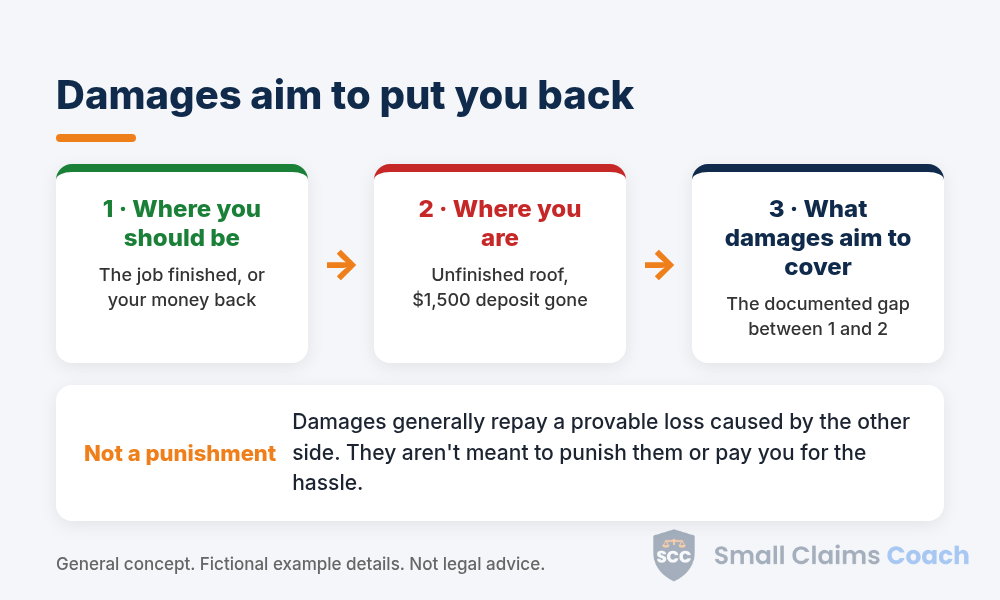
Losses that fit all three, like an unreturned deposit, money paid for work that wasn't done, or the cost to repair faulty work, are usually the most straightforward. Losses that are hard to measure, uncertain, or only loosely connected to what the other side did are much harder.
Can I sue for the full contract price?
Not automatically. If you paid in full and got nothing, the full amount may be your loss. But if some of the work was done, or you got something of value, that's usually subtracted. The question is generally what it takes to put you where you should have been, not what the contract cost.
Can I sue for more than the repair estimate?
Usually the repair or completion cost is the measure, because that's what it takes to fix the problem. You might have other documented losses on top of it, like a deposit for something never delivered, but each one needs its own proof. Be careful not to count the same loss twice, for example asking for both a full refund and the full cost to redo the same work.
Can I sue for pain and suffering in small claims?
Pain and suffering usually comes up in injury cases. It's hard to put a number on and hard to prove, and many injury cases end up outside small claims. For the typical money dispute in small claims, like a contractor, a deposit, or a refund, it generally isn't part of the claim. If you were injured, check your court's rules and consider getting legal advice about whether small claims is the right place.
What about emotional distress or inconvenience?
Stress, frustration, and inconvenience are real, but in most small claims money disputes they generally aren't recoverable on their own. They're hard to measure and to tie to a specific dollar amount. Focus your claim on the losses you can document. Some specific laws or situations may allow more, so check your court's rules if you think one applies.
Can I get my time or lost wages back?
Generally, the time you spend dealing with the dispute, preparing your case, or going to court isn't recoverable as damages. Lost wages are sometimes possible when they were directly caused by the other side's conduct, not by the lawsuit itself, and you can document them. It depends on the facts and your state. Check your court's rules.
Can I recover court costs and filing fees?
Possibly. In many courts, a winning party may be able to ask for certain costs, like the filing fee or the cost of serving papers. What's allowed, and how to ask for it, varies. Check your court's rules or self-help pages. Lawyer and consultant fees are a different question and are often not recoverable in small claims.
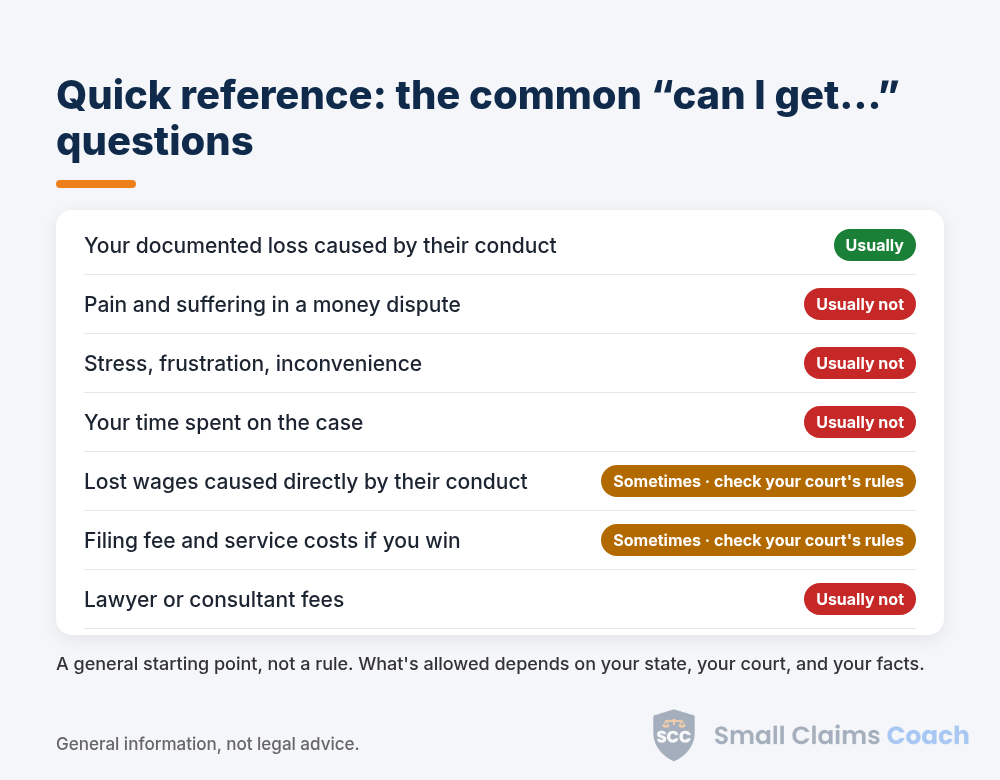
Backing up the amount is the hard part.
The full guide has a damages worksheet template and a request-for-estimate script you can send a contractor. General legal information, not advice about your case.
How do I prove the amount?
Put a document behind every number: a contract, invoice, receipt, written estimate, check image, bank or card statement, or a dated screenshot of a price. The judge only knows what you can show. A short worksheet that lists each loss, its amount, and the document that supports it makes your number easy to follow. Our guide to preserving evidence covers how to save each kind of document.
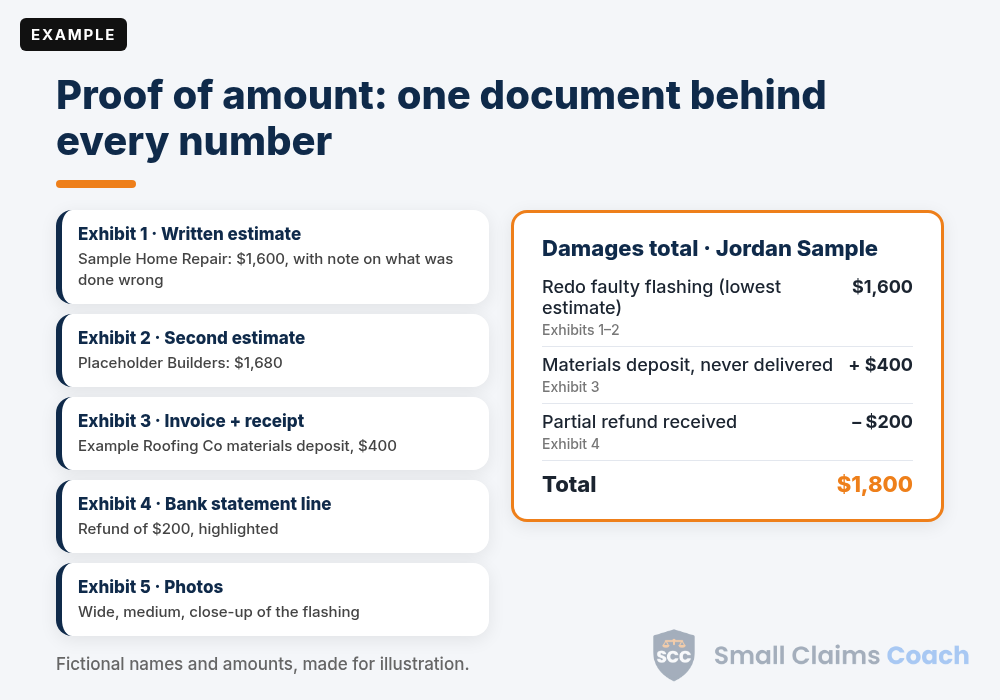
What if I have only one estimate?
One written estimate is better than none, and some cases are decided with one. More than one helps show the price is reasonable and not inflated. If you can't get another, consider saving pricing for the materials or parts, and ask the contractor who gave the estimate to explain in writing what was wrong and what the work involves.
Frequently asked questions about small claims damages
How much can you sue for in small claims court?
Each state sets its own small claims limit, and some courts have different limits for different kinds of cases. Within that limit, the amount you can ask for is generally the loss you can document. Check your state's page or your court's website for the current limit.
Need the dollar limit for your state? See the maximum amount for small claims by state.
Can I sue for punitive damages in small claims?
Punitive damages are meant to punish rather than repay a loss, and they are generally not the focus of small claims cases. Some laws allow extra damages in specific situations. If you think one applies to you, check your court's rules or your state's self-help resources.
Can I add interest to my small claims claim?
In some situations, interest may be allowed, for example if a contract provides for it or a law allows it. Whether and how to ask for it depends on your state. Check your court's rules.
Do I need receipts for everything?
You need some proof for each amount. Receipts are best, but invoices, written estimates, bank or card statements, check images, and dated screenshots of prices can also help show the amount.
Can I ask for more than I actually lost to leave room to negotiate?
It's better to ask for what you can support. An inflated number can hurt your credibility with the judge, and you may have to explain every line.
What if my damages are more than the small claims limit?
You may be able to give up the amount over the limit and stay in small claims, or file in a different court. The rules on this vary, so check your court's rules before you file.
Not sure where your state stands? Start with your state's page on our states hub, and grab the free Starter Kit to organize your numbers.
This information is for educational purposes only. It is not legal advice. Rules vary by state and court. We try to keep every page up to date, but local rules, fees, and information change regularly. If you have questions, or our numbers don't match what your court publishes on its website, double-check with your court clerk.
In the full guide (Playbook members):
- What usually counts, what usually doesn't, and the gray areas
- The contractor-case method: estimates, written explanations, and pricing proof
- A worked example: Jordan Sample v. Example Roofing Co.
- A damages worksheet template
- A request-for-estimate script you can send a contractor
- Common mistakes that shrink your credibility
This website and our Playbook are designed to give you the tools and confidence to handle your small claims case yourself, without a lawyer. If you think something is missing, we would like to hear about it so we can keep improving our Playbook. But if your situation is complicated, does not fit the samples we cover, or a filing deadline is close, you may want to call a lawyer.
You do the work. The Playbook hands you the plays.
The full guide covers the list above, step by step. Your membership also includes a filled-in sample of your state's claim form and your state's Playbook section, with prep guides that work in any state: a document checklist, exhibit labels, a prep timeline and a hearing-day outline. One membership covers every state.