How to Preserve Evidence for Small Claims Court
The text that proves your point is the one you didn't delete. Here's how to preserve evidence, ask others to keep theirs, and label exhibits for court.
Updated on October 27, 2026
The text that proves your point is the one you didn't delete.
To preserve evidence for small claims, keep the original untouched, save a copy that shows who, when and what, back it up in two places, and write it in a simple log. If someone else holds proof, like camera footage, ask them in writing to keep it. Then label each item as an exhibit before your hearing.
Here's the running example we'll use. Jordan Sample paid Typical Roofing Co. to fix a leak. The leak came back. Jordan has texts, a voicemail from the owner, an invoice, photos, and a neighbor's doorbell camera that may have caught the crew leaving early. None of that helps unless it still exists, and still looks trustworthy, on hearing day.
The quick answer: how do I preserve evidence for small claims court?
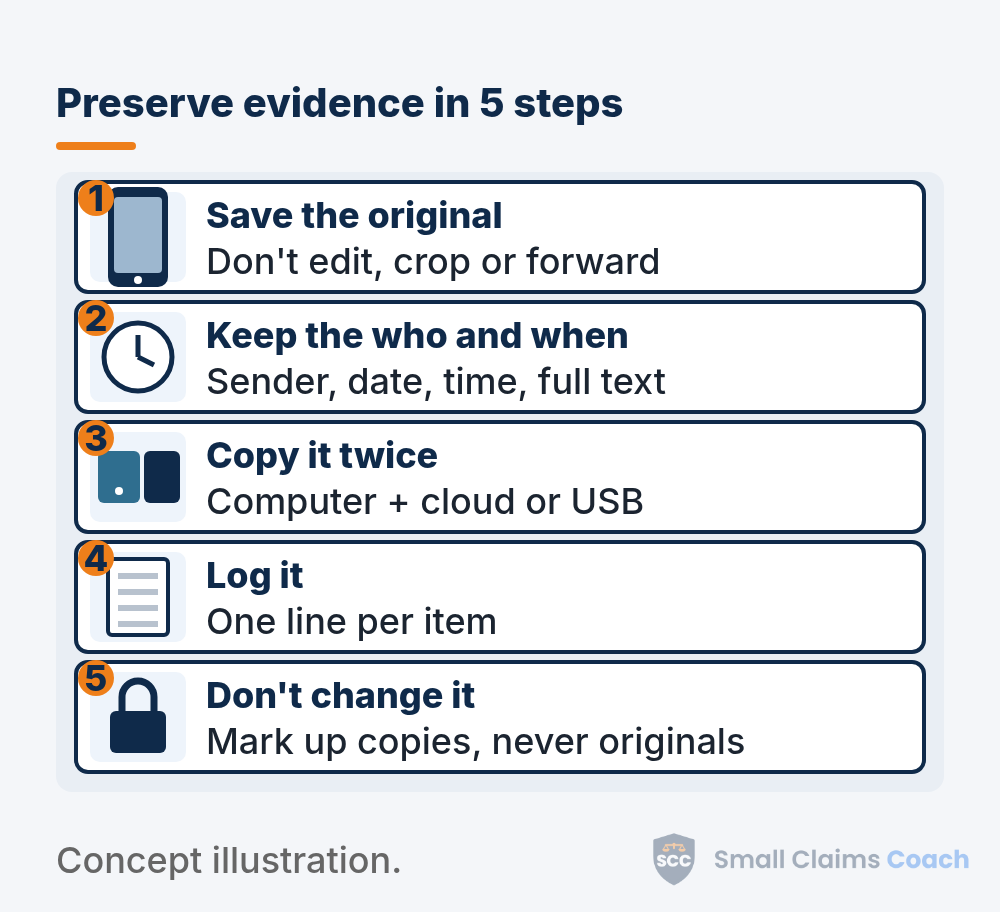
- Save the original. Don't edit, crop or forward it. Leave it where it is.
- Keep the who and when. Your copy should show the sender, the date and time, and the full message or page.
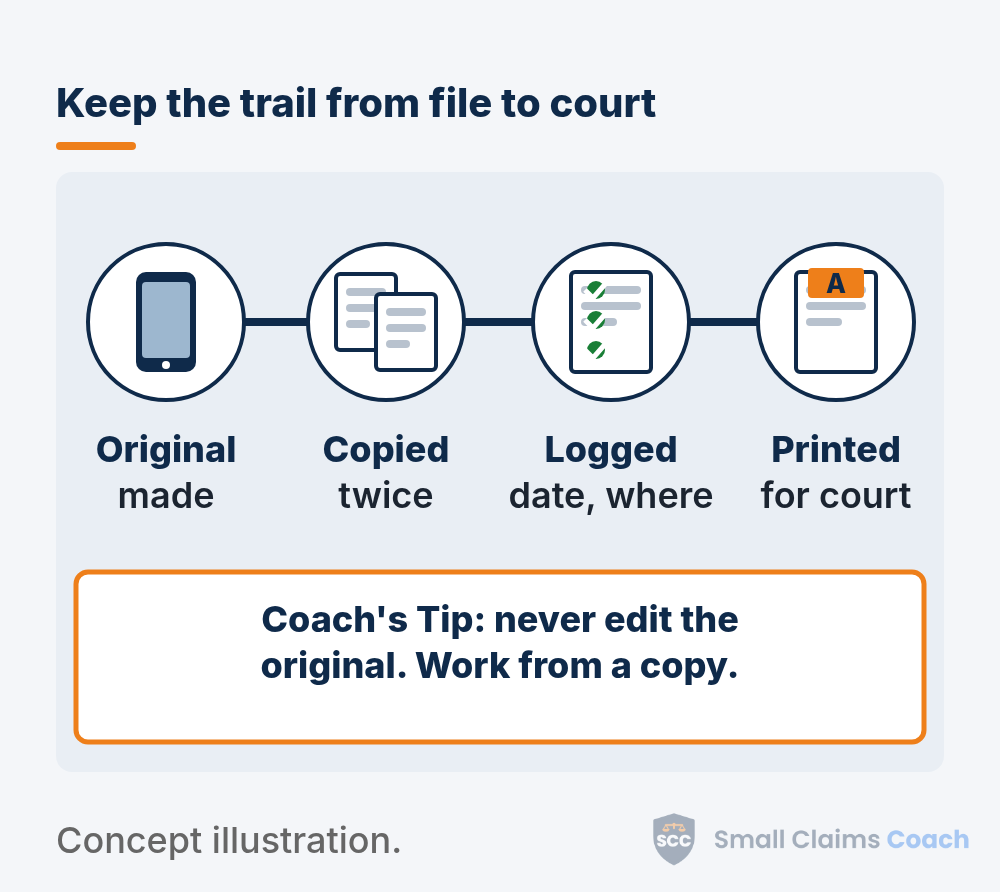
- Copy it twice. One copy on your computer, one in a cloud account or on a USB drive.
- Log it. One line per item: what it is, its date, where you got it, where you saved it.
- Don't change it. Mark up copies, never the original.
Saving evidence? Get the full guide.
The full guide is for Playbook members: a sample evidence preservation letter (made-up names), a one-page evidence log filled in as a sample, a sample exhibit list, how to save voicemails and text threads step by step, and a 7-day preservation checklist. The Playbook also gives you a filled-in sample of your state's claim form (every state and DC has one; for Mississippi, Oklahoma and Wyoming it's a sample layout we made, so you'd get the real form from the court clerk) and your state's Playbook section. One membership covers every state. $149 for your first year (introductory offer), then $199 a year. Join now.
What does "preserve evidence" mean in plain English?
It means keeping proof safe and unchanged from the moment you think a dispute might go to court. A judge wasn't there. They only know what you can show them. If your proof is cropped, undated or "cleaned up," the other side can say it isn't the full picture, and the judge may give it less weight.
What counts as evidence in small claims?
Almost anything that helps show what happened or how much you lost: contracts, receipts, invoices, estimates, emails, texts, voicemails, photos, videos, web pages, bank records and canceled checks. Small claims courts are often more relaxed about evidence than other courts, but how relaxed varies. Check your state's rules.
How do I save a voicemail as evidence?
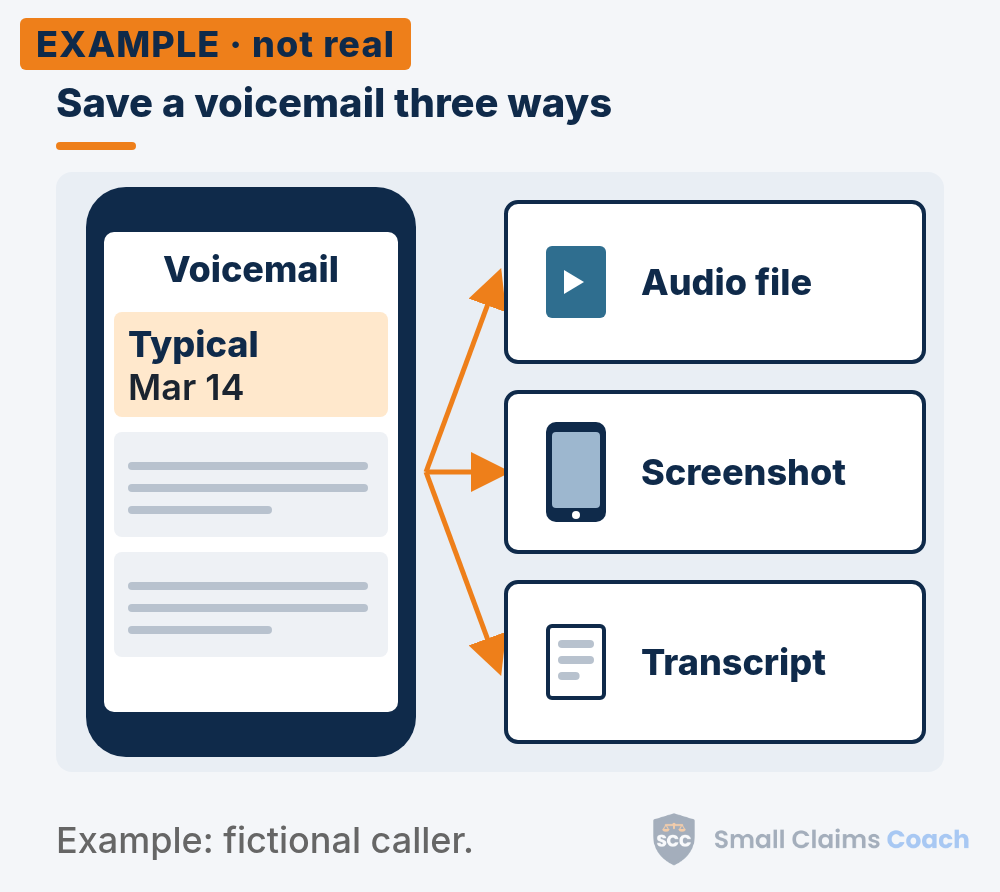
Save the voicemail itself, not just your memory of it. Most phones let you share or export a voicemail as an audio file. Send it to yourself, save it in two places, and take a screenshot of the voicemail list showing the caller's number, the date and the length. Then write out what was said, word for word, as your own transcript.
What about call logs?
A call log shows that a call happened, when, and how long it lasted. It doesn't show what was said. Screenshot the log entries that matter, and pair them with your notes made right after each call. Your phone carrier may also have a call history in your online account.
Coach's Tip: Some phones and carriers delete old voicemails automatically. Save the ones that matter today, not the week before your hearing.
How do I save a text thread with dates?
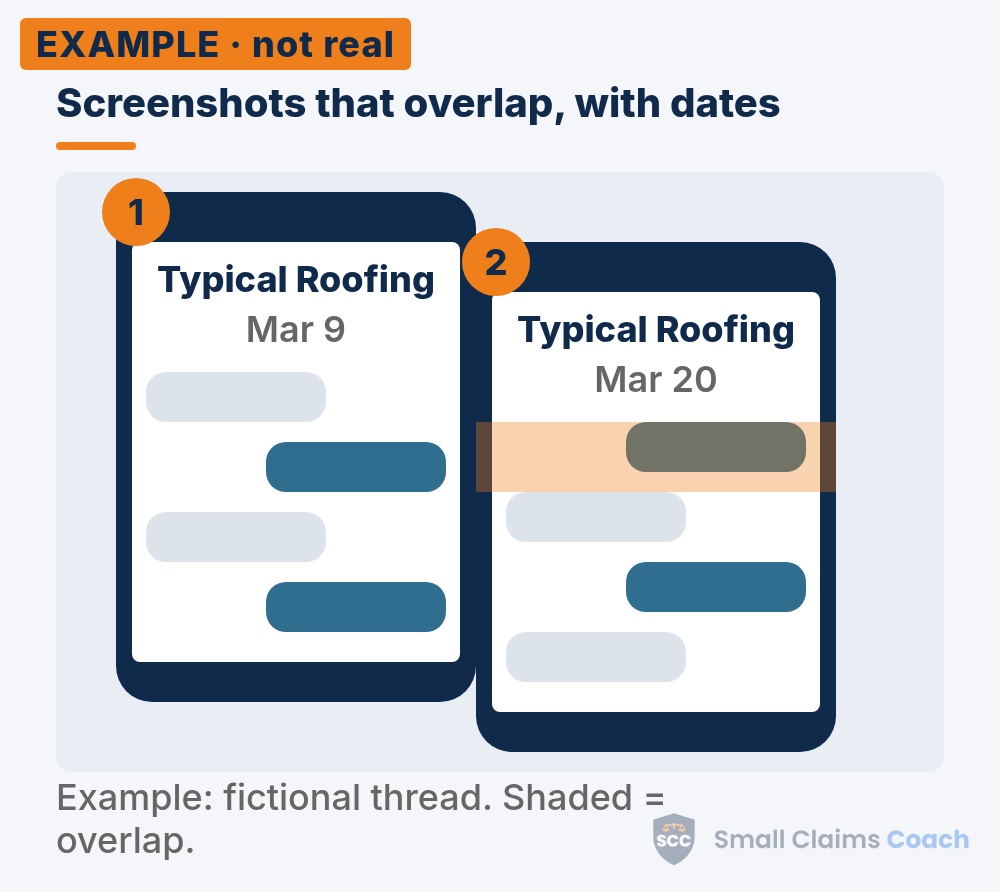
Scroll so each screenshot shows the other person's name or number and the date and time stamps, and take screenshots in order with a little overlap so nothing is skipped. Many phones hide times until you swipe or tap, so reveal them first. For the full step-by-step, see our guide on how to save text messages as evidence.
Emails, web pages and receipts
- Emails: print or save as PDF with the sender, every recipient, the date and the subject showing. Expand collapsed parts of a thread first. Don't forward it to yourself as your "copy."
- Web pages, ads and listings: print the full page to PDF with headers and footers turned on, so the web address and date print. Pages change, so capture them now.
- Contracts: keep every page, including add-ons and change orders. If you signed online, download the completed signed copy.
- Receipts: some paper receipts fade. Scan or photograph them flat and in full, and back them up.
- Checks: get images of the front and back from your bank. The back shows who deposited it.
For photos and video, see how to take photos and video for small claims.
Should I send an evidence preservation letter?
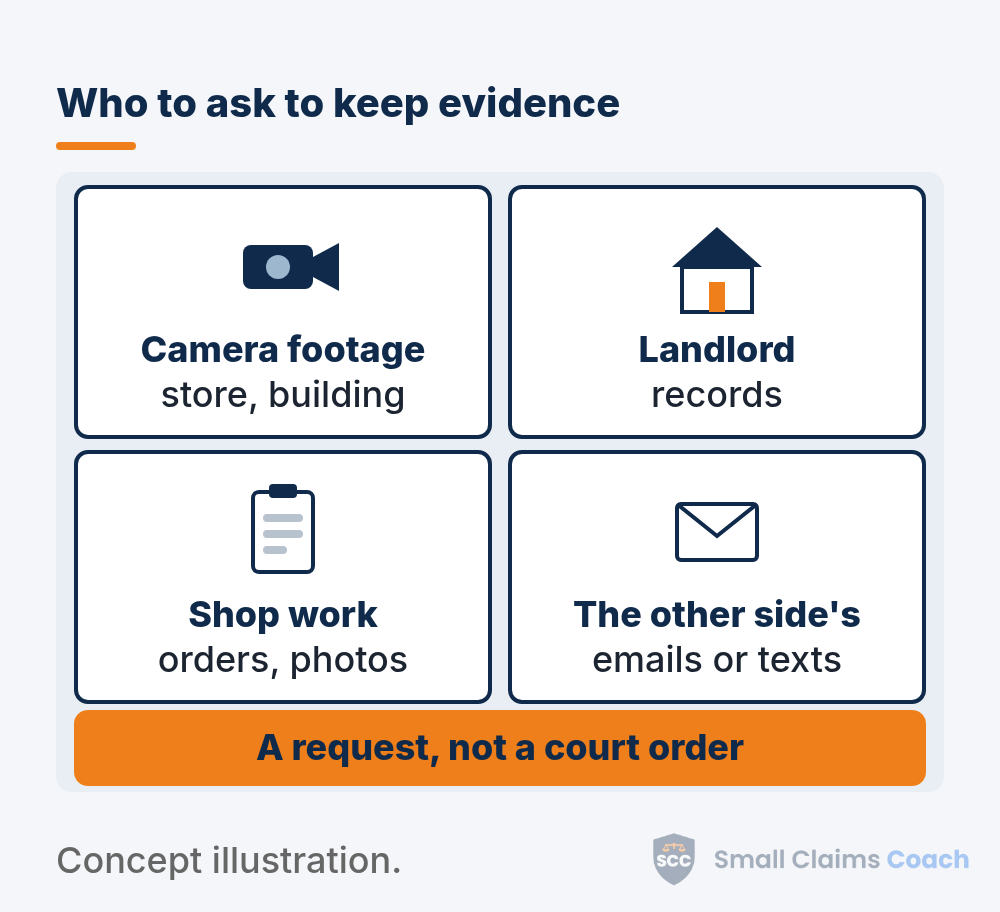
Often, yes, if someone else holds proof that might disappear. An evidence preservation letter (also called a preservation letter) is a short, polite letter asking a person or business to keep specific records, like camera footage, work orders or emails. It is a request, not a court order. But it creates a record that they knew the evidence mattered.
How do I ask a store, landlord or shop to keep footage and records?
Ask early, ask in writing, and be specific. Name the date and time range, the place (which camera, which unit, which job), and the exact records you want kept. Send it to the manager, the property manager or the records department, keep a copy, and follow up if you hear nothing. Many cameras only keep footage for a limited time, and businesses may clear old records on a routine schedule, so a few days can matter. You don't have to explain your whole case. One or two sentences on why is enough.
When is a preservation letter worth sending?
- A store, building or neighbor has camera footage.
- A landlord or property manager holds inspection records or move-out notes.
- A repair shop holds work orders, parts records or photos.
- The other side has emails or texts you no longer have.
Send it as early as you can, keep a copy, and use a method that shows it was delivered. Whether a court can do anything if the evidence is lost afterward varies. Check your state's rules.
Thinking about a preservation letter?
The full guide has a sample evidence preservation letter with made-up names, and covers what to say if the other side deleted something. General legal information, not advice about your case.
How do I label exhibits for court?
An exhibit is any piece of evidence you hand to the judge. Give each one a letter or number (Exhibit A, B, C, or 1, 2, 3, whichever your court prefers), put a small label on the first page, and list them all on one page called an exhibit list. Bring enough copies for the judge, the other side and you, unless your court says otherwise. Check your court's rules.
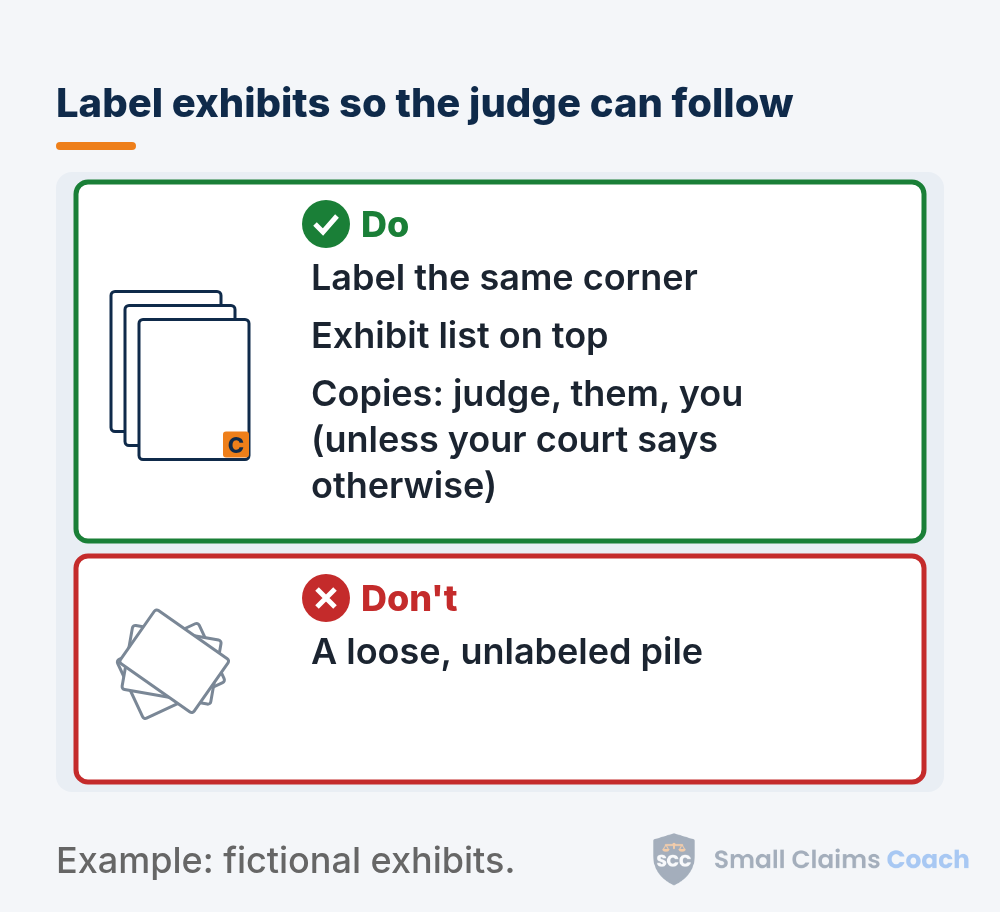
What is an exhibit list?
An exhibit list is a one-page table of contents for your evidence: the exhibit label, a short description, its date, and what it proves. It lets the judge find things fast, and it keeps you from fumbling. Our members Evidence guide walks through building one for your case.
Why does the "chain" of a file matter?
You may hear "chain of custody." In plain English, it means being able to say where a piece of evidence came from and that nobody changed it along the way. In small claims, you rarely need anything formal. A simple log that shows when you saved each item, and where, usually answers the question.
Frequently asked questions
What is spoliation of evidence?
Spoliation (say "spoh-lee-AY-shun") means destroying, deleting or losing evidence after a lawsuit is expected. If a judge finds the other side did it on purpose, the judge may assume the missing evidence would have hurt them. What a small claims judge can do varies by state.
What if the other side deleted evidence?
Tell the judge what existed, when you last saw it, and any proof that you asked them to keep it, such as your preservation letter. Bring whatever copies you have. Check your court's rules for what the judge can do.
How do I submit evidence in small claims court?
Usually you bring labeled copies to the hearing and hand them up when you talk about them. Some courts want evidence sent ahead of time, especially for remote hearings. Check your court's rules.
Can I play a video from my phone at the hearing?
Sometimes. Some courts ask you to bring your own device to play it, and some may keep a device that's entered as evidence. A safer plan is to bring a copy on a USB drive plus a still image printed as an exhibit. Check your court's rules.
Do I need the original or is a copy OK?
Copies are often accepted in small claims, but bring originals too when you have them, in case the judge or the other side asks.
Can I edit a photo or screenshot to make it clearer?
Don't edit the original. If you crop or highlight, do it on a copy, label it as marked up, and bring the untouched version too.
This information is for educational purposes only. It is not legal advice. Rules vary by state and court. We try to keep every page up to date, but local rules, fees, and information change regularly. If you have questions, or our numbers don't match what your court publishes on its website, double-check with your court clerk.
This website and our Playbook are designed to give you the tools and confidence to handle your small claims case yourself, without a lawyer. If you think something is missing, we would like to hear about it so we can keep improving our Playbook. But if your situation is complicated, does not fit the samples we cover, or a filing deadline is close, you may want to call a lawyer.
In the full guide (Playbook members):
- A sample evidence preservation letter (made-up names)
- A one-page evidence log, filled in as a sample
- A sample exhibit list for Jordan Sample v. Typical Roofing Co.
- How to save voicemails and text threads step by step, with a backup routine
- A file-timeline worksheet that answers "is this the original?"
- What to say if the other side deleted something
- A 7-day preservation checklist and common mistakes
You do the work. The Playbook hands you the plays.
The full guide covers the list above, step by step. Your membership also includes a filled-in sample of your state's claim form and your state's Playbook section, with prep guides that work in any state: a document checklist, exhibit labels, a prep timeline and a hearing-day outline. One membership covers every state.