Sued in Small Claims Court? What to Do Next (Step by Step)
Been sued in small claims court? Don't panic. Read the papers, calendar the hearing, gather your proof and prepare calmly, one step at a time.
The short answer: if you've been sued in small claims court, don't ignore the papers. Read every page, put the hearing date and any response date on your calendar, check the basic details, gather your documents, and prepare a short, organized version of your side. Small claims court is built for regular people, and you can take this one calm step at a time.
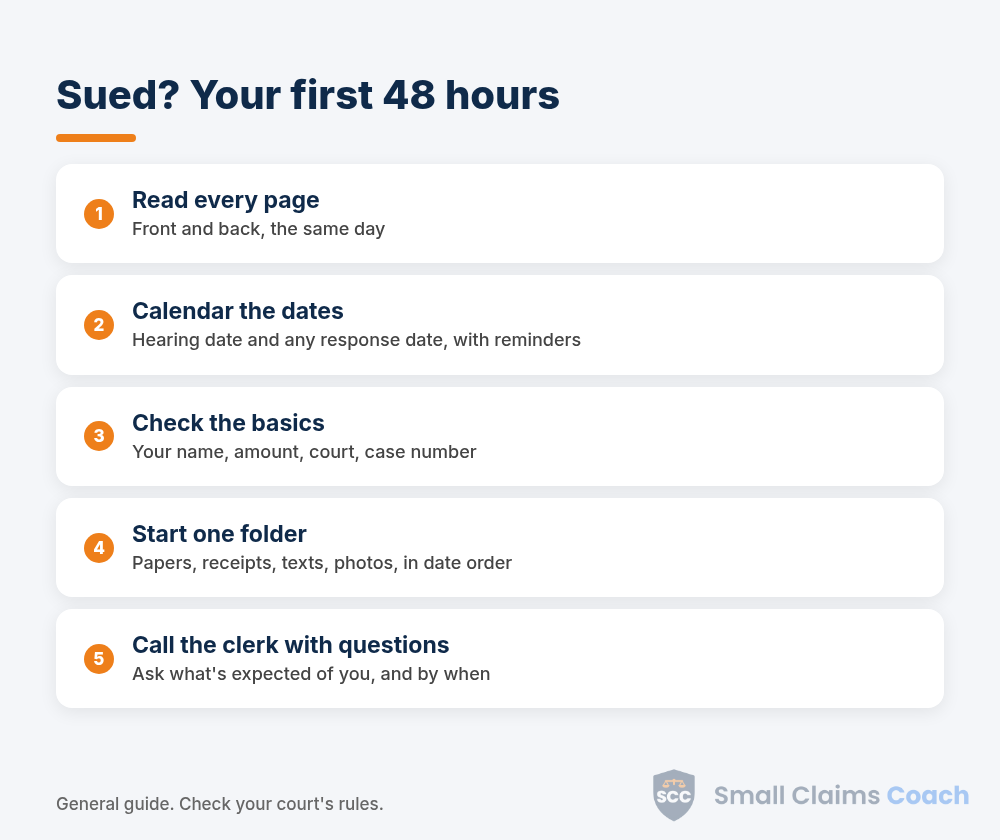
What should I do first if I'm sued in small claims court?
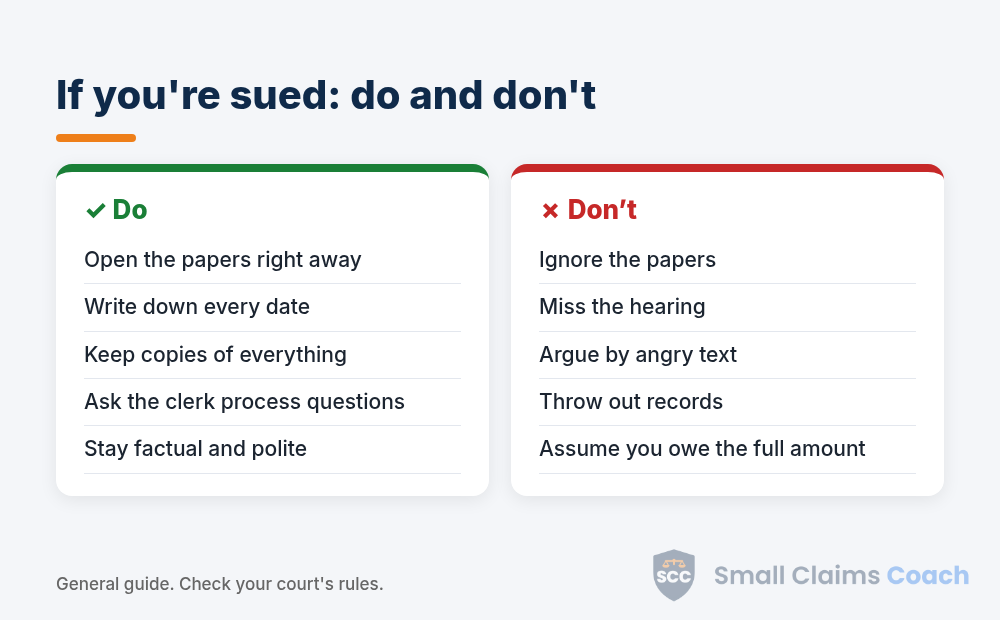
Don't ignore it. Read every page, put the hearing date and any response date on your calendar, check the basic details, and ask the clerk what's expected of you.
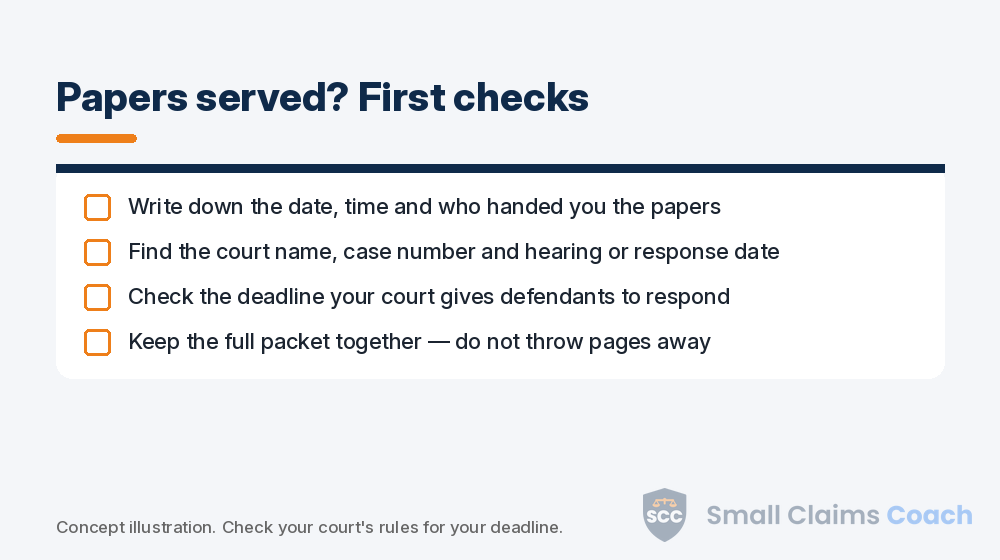
- Don't ignore it. The way to tell your side is through the court process.
- Read every page, front and back. Write down the hearing date, time, place, case number, and any response instructions.
- Put it on your calendar with reminders a week, a few days, and a day before.
- Check the basics: your name, the amount, the court, and the description.
- Consider talking to the other side. If you agree on anything, put it in writing.
- Gather your documents and screenshots.
- Write a one-page timeline.
- Ask whether you have a claim of your own.
- Prepare for the hearing.
- Can't attend? Contact the court right away.
- After the decision, make sure you understand it and keep copies.
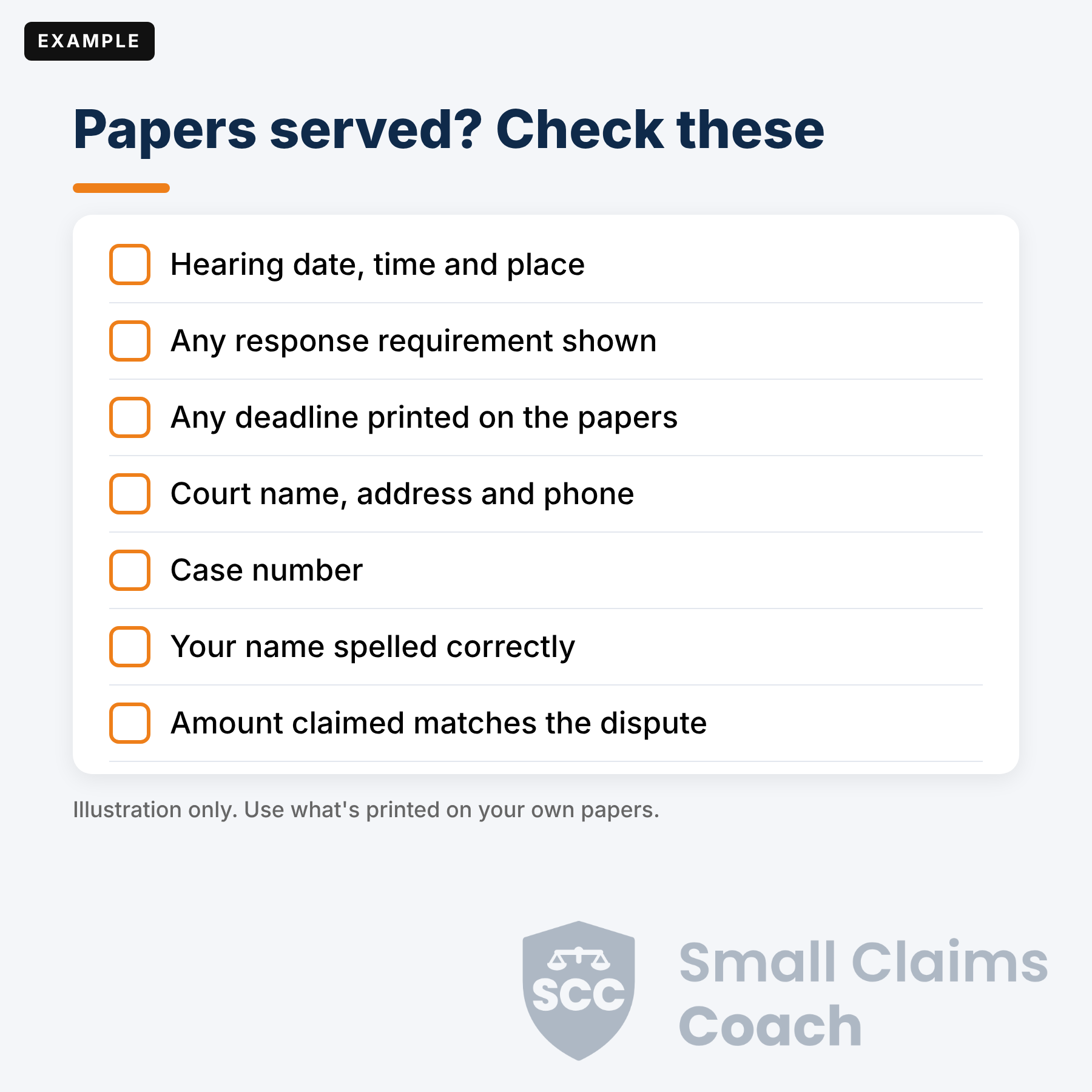
Been served? Get organized, step by step.
The full guide is for Playbook members: a fill-in "papers served" worksheet, a claim-by-claim response organizer, a defendant's one-page timeline template, and a hearing-day checklist of what to bring. The Playbook also gives you a filled-in sample of your state's claim form (every state and DC has one; for Mississippi, Oklahoma and Wyoming it's a sample layout we made, so you'd get the real form from the court clerk) and your state's Playbook section. One membership covers every state. $149 for your first year (introductory offer), then $199 a year. Join now.
How do you respond to a small claims lawsuit?
It depends on your court. Some courts expect a written response, and others only expect you to show up at the hearing. Look for words like "answer," "response," "appear," or "file" on your papers. If you see them, ask the clerk exactly what you need to do and by when. Clerks can't give legal advice, but they can explain the process.
What happens if I don't go to small claims court?
Missing the hearing can mean the court decides without hearing your side. If you truly can't attend, contact the court as soon as you know and ask what your options are. Don't just skip it. Check your court's rules.
Can I countersue in small claims court?
If the other side owes you something too, ask the clerk whether your court allows a counterclaim, how it's filed, and whether there's a time limit or cost. Keep it separate in your notes from your response to their claim.
Can I settle a small claims case before the hearing?
Often, yes. A calm, factual conversation sometimes clears things up. You don't have to settle, but if you agree on anything, put it in writing and ask the clerk what the court needs to see.
Talking about settling?
The full guide has settlement talking points and a written-agreement checklist, so any deal you reach is clear and in writing. General legal information, not advice about your case.
What evidence should a defendant bring?
Bring the records that show your side, such as contracts, receipts, payment records, messages, photos and witness names, labeled in the order you'll mention them.
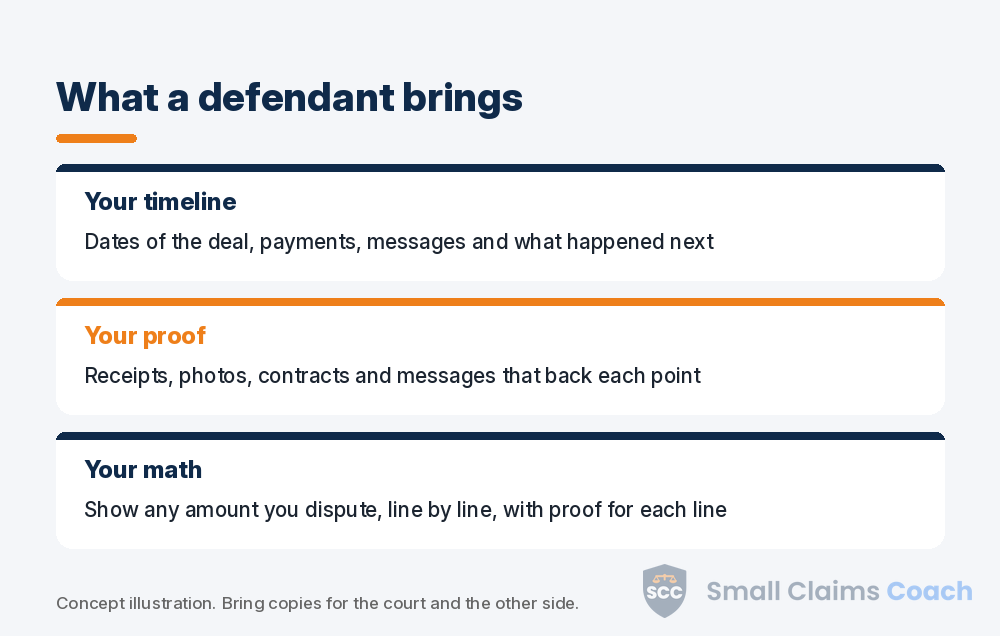
Contracts, receipts, payment records, emails, texts, photos, and witness names. Label them in the order you'll mention them. Our guides on preserving evidence, saving text messages, and photos and video show how to save each type so it holds up. If the amount claimed looks inflated, our guide on what damages usually count explains how amounts are generally built.
Free: the Small Claims Starter Kit
A simple checklist and organizer to get your papers in order.
Get the Starter KitFrequently asked questions
What do I do if I'm sued in small claims court?
Don't ignore it. Read every page, put the hearing date and any response date on your calendar, check the basic details, gather your documents, write a short timeline, and prepare a calm, organized version of your side. Ask the clerk what's expected of you.
Do I have to file an answer in small claims court?
It depends on your court. Some courts expect a written response; others only expect you to appear at the hearing. Read your papers for words like answer, response, or appear, and check your court's rules or ask the clerk.
What happens if I don't show up to small claims court?
Missing the hearing can mean the court decides without hearing your side. If you can't attend, contact the court right away and ask what your options are. Check your court's rules.
Can I countersue in small claims court?
Many courts allow a counterclaim if the other side owes you something, but the rules, timing, and cost vary. Ask the clerk or check your court's rules.
Can I settle a small claims case before court?
Often, yes. If you agree, put the terms in writing and ask the clerk what the court needs to see so the case is handled properly.
Do I need a lawyer if I'm sued in small claims?
Small claims court is designed for people to represent themselves, and some courts limit lawyers. Whether you want legal advice depends on your situation. Check your court's rules.
Sued by a debt collector in small claims? First checks
Start with the papers themselves, not with assumptions about what a debt case means. Read who is named as the plaintiff, what amount is claimed, which court issued the papers, and every date on them — a response date, a hearing date, or both, depending on your court. Do not ignore the papers while you check: deadlines in small claims can be short, and the exact deadline and what you must file, if anything, come from your papers and your court's rules, not from a national article. Find your court through your state page, then work through Just Got Sued.
Next, gather what you already have: any agreement, statements, payment records, and messages about the amount claimed, so you can see what matches and what does not. Write down questions for the clerk or the court's self-help resources about how to respond in that court. This is general information about first checks, not a defence strategy, and it does not predict any outcome in a debt case — check your court's rules or ask the clerk what your court expects.
Find your state on our state guides, or start at Got Sued.
In the full guide (Playbook members):
- Each step in depth, with exactly what to do
- A fill-in "papers served" worksheet
- A claim-by-claim response organizer
- A defendant's one-page timeline template
- Settlement talking points and a written-agreement checklist
- A full worked example: Jordan Sample v. Typical Roofing Co.
- A hearing-day checklist of what to bring
- Common mistakes to avoid
- AI prompts for building your defense timeline
This website and our Playbook are designed to give you the tools and confidence to handle your small claims case yourself, without a lawyer. If you think something is missing, we would like to hear about it so we can keep improving our Playbook. But if your situation is complicated, does not fit the samples we cover, or a filing deadline is close, you may want to call a lawyer.
This information is for educational purposes only. It is not legal advice. Rules, deadlines, fees and forms vary by state and court. Check your court's rules or self-help center before you act. We try to keep every page up to date, but local rules, fees, and information change regularly. If you have questions, or our numbers don't match what your court publishes on its website, double-check with your court clerk.
You do the work. The Playbook hands you the plays.
The full guide covers the list above, step by step. Your membership also includes a filled-in sample of your state's claim form and your state's Playbook section, with prep guides that work in any state: a document checklist, exhibit labels, a prep timeline and a hearing-day outline. One membership covers every state.