What to Say in Small Claims Court: Hearing-Day Guide
The night before a hearing, most people's minds go blank. Here's what to say, in what order, and how to let your exhibits do the arguing.
Updated on Oct 26, 2026
Most people lose sleep the night before a small claims hearing. You've gone over it a hundred times. The contractor who walked off the job. The landlord who kept your deposit. The buyer whose check bounced. Then you picture standing in front of a judge, and your mind goes blank.
Here's the part that's hard to hear. The judge usually won't have time for the whole story. The good news is that you don't need the whole story. You need the right parts, in the right order, with your proof ready to hand over.
The quick answer: what do you say at a small claims hearing?
Say who you are, what was agreed, what went wrong (with dates), how much you lost and how you got that number, then point to each exhibit and say what you're asking for. Call the judge "Your Honor," and don't interrupt.
- Lead with one sentence. Say what you want and why, in one breath. The judge now knows what to listen for.
- Tell it in date order. Jumping around is the fastest way to lose the judge. Dates make your story easy to follow and hard to argue with.
- Hand over proof as you mention it. Name the exhibit at the moment you talk about it, not in a pile at the end.
- Show how you got your number. A total with no math behind it invites the judge to cut it.
- Answer the question you're asked, then stop. Short answers sound confident. Long ones sound like you're covering for something.
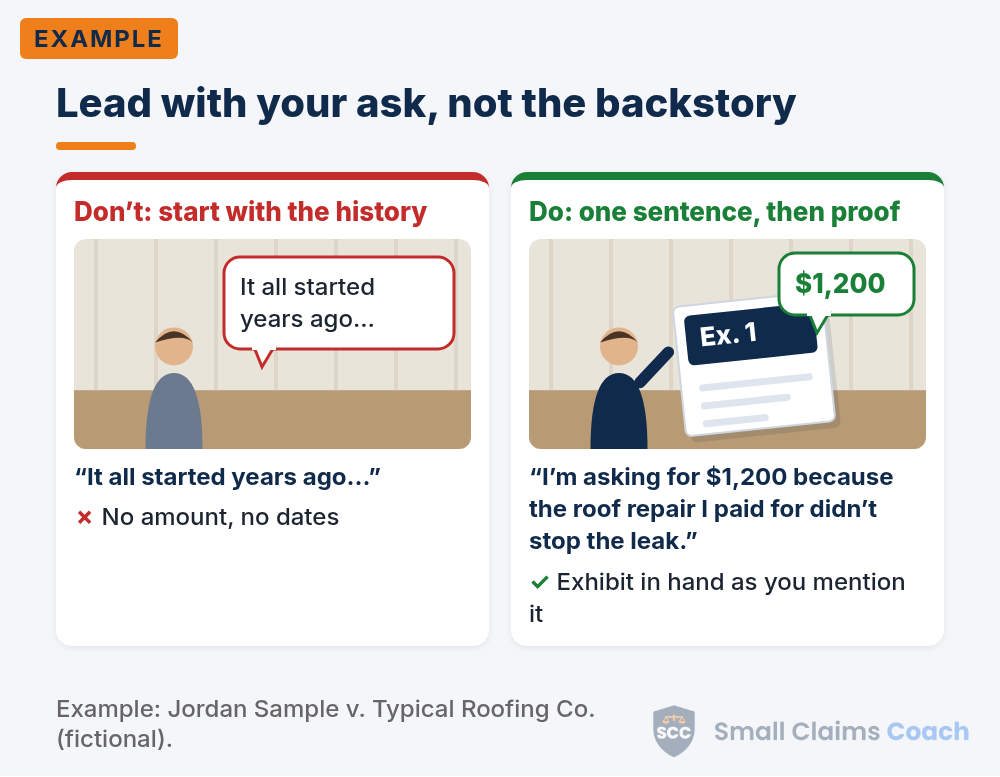
Example (fictional): Don't start with "It all started years ago…". Do say: "I'm asking for $1,200 because the roof repair I paid for didn't stop the leak," with Exhibit 1 in hand.
Getting ready for hearing day? Get the full guide.
The full guide is for Playbook members: fill-in outlines for plaintiffs and defendants, a judge-question drill, a rebuttal planner, and a hearing-day packing list. The Playbook also gives you a filled-in sample of your state's claim form (every state and DC has one; for Mississippi, Oklahoma and Wyoming it's a sample layout we made, so you'd get the real form from the court clerk) and your state's Playbook section. One membership covers every state. $149 for your first year (introductory offer), then $199 a year. Join now.
What happens at a small claims hearing?
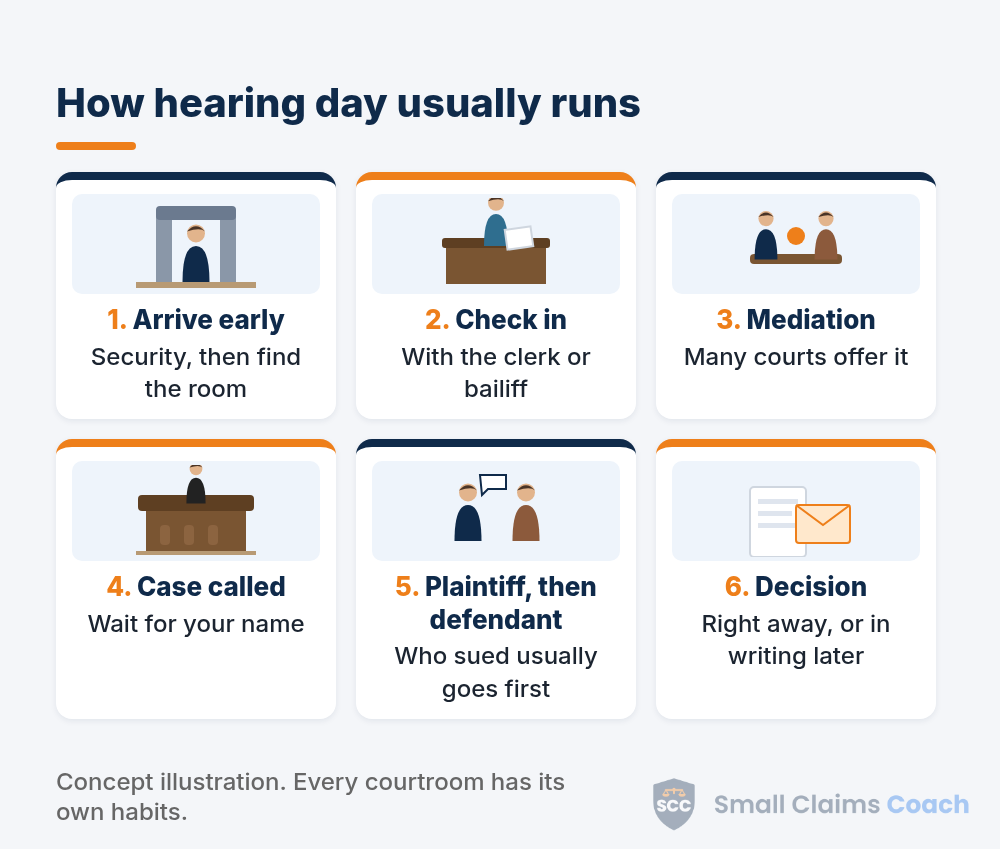
Most hearings follow the same basic pattern, even though every courtroom has its own habits.
Arrive early. Security lines and finding the right room take longer than you think. Check in with the clerk or bailiff so they know you're there. Many courts offer mediation that day, which is a chance to settle before you ever see the judge.
When your case is called, the person who sued usually goes first. Then the other side responds. The judge asks both of you questions, and may cut in to get to the point. That's normal. It doesn't mean you're losing. At the end, the judge may decide right there or send a written decision later.
If you can, sit in on a few cases before yours. You'll see where people stand, how this judge likes exhibits handed up, and how short most presentations really are. Ten minutes of watching is the best rehearsal you'll get.
How do you organize what you say?
Use six parts, in this order. Each one answers a question the judge is already asking.
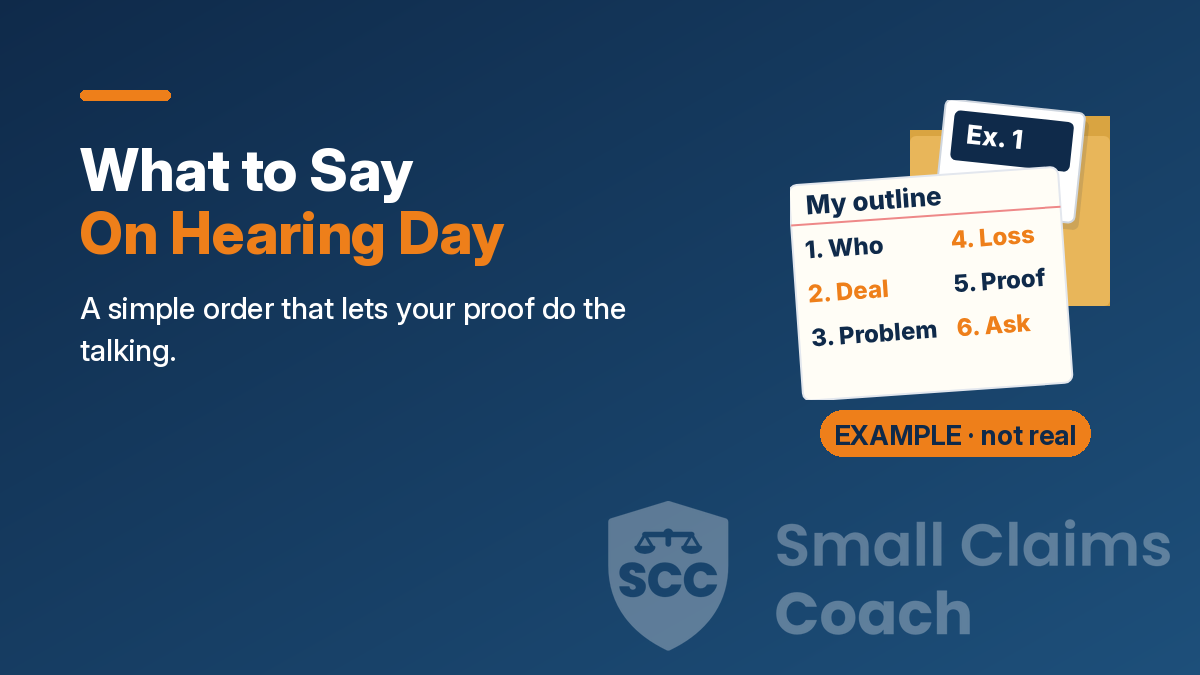
- Who you are and what you want. "I'm [name], the plaintiff. I'm asking for $[amount] because [one sentence]." The judge now knows which side you're on and what to listen for.
- The deal. What was agreed, when, and for how much. If there's a contract, text or invoice, this is where it goes.
- The problem. What went wrong, with dates. Stick to what happened, not how it made you feel.
- The loss. The dollar amount and where it comes from: the invoice, the estimate, the receipt.
- The proof. Name each exhibit as you reach it. "Exhibit 1 is the signed estimate."
- The ask, again. "I'm asking the court for $[amount]." Say the number out loud. The judge can't give you what you never asked for.
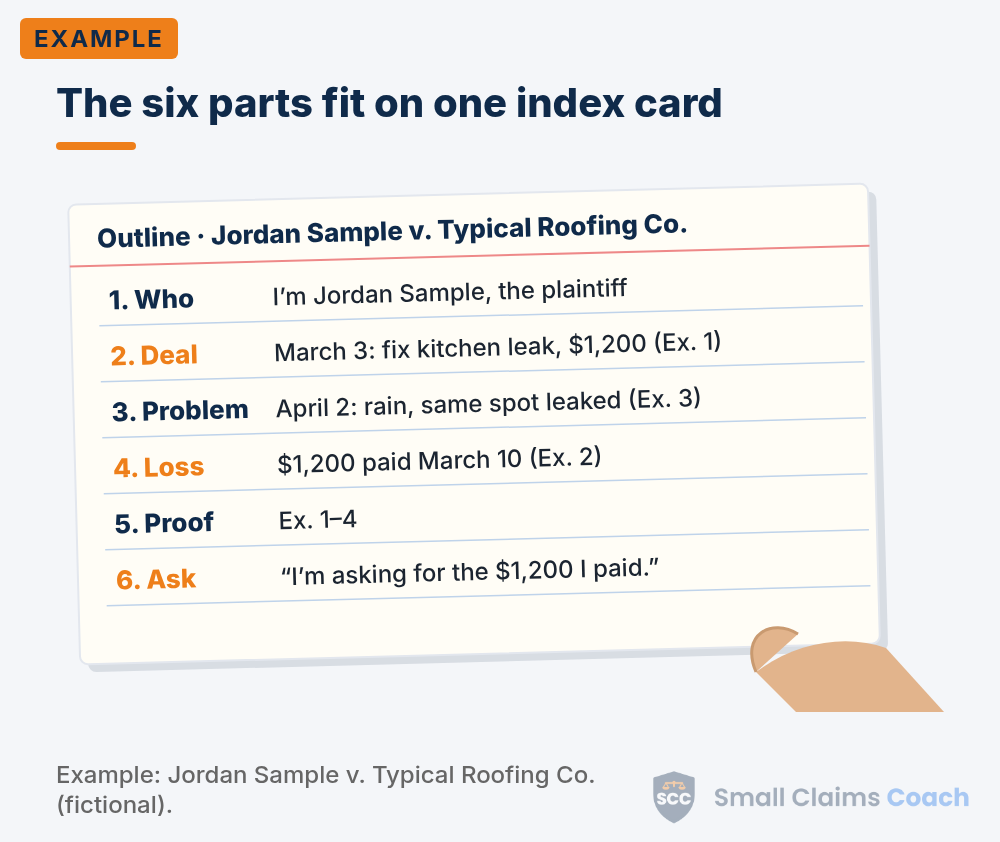
Example (fictional), Jordan Sample v. Typical Roofing Co.: 1. Who: I'm Jordan Sample, the plaintiff. 2. Deal: March 3, fix kitchen leak, $1,200 (Ex. 1). 3. Problem: April 2, same spot leaked (Ex. 3). 4. Loss: $1,200 paid March 10 (Ex. 2). 5. Proof: Ex. 1–4. 6. Ask: "I'm asking for the $1,200 I paid."
If you're the one being sued, the same structure works in reverse: who you are, what you agree with, what you disagree with and why, your proof, and what you're asking the judge to do. For the bigger picture, see what to do if you're sued.
How do you present your evidence?
Number your exhibits before you get there. Bring enough copies for the judge, the other side, and you. Some courts set their own rules on copies and on when exhibits must be turned in, so check your court's rules.
Put a small label on each page with the exhibit number and a few words about what it is. When you mention it, hold it up, say the number, and hand it over the way your court does it. Some judges want everything at once. Others take each page as you go.
Keep your exhibits in the same order as your outline. If the judge asks, "Do you have a receipt for that?", you want to find it in seconds, not dig through a folder while everyone waits.
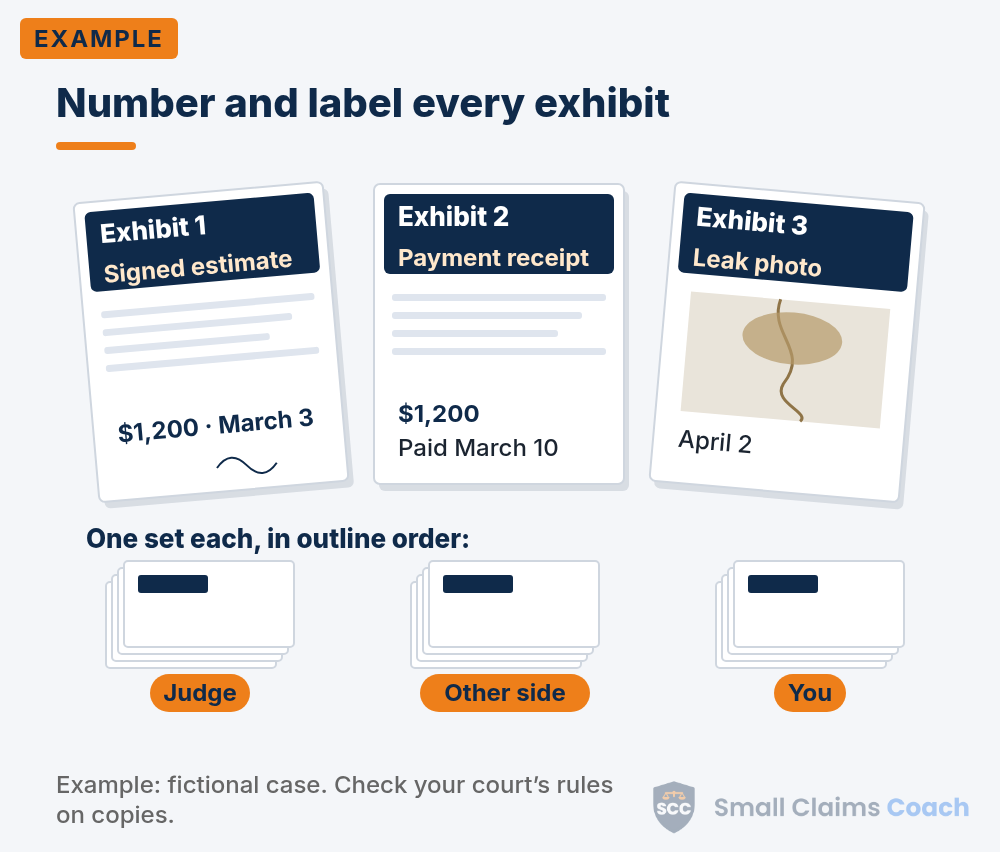
Example (fictional): Exhibit 1, signed estimate, $1,200, March 3. Exhibit 2, payment receipt, $1,200, paid March 10. Exhibit 3, leak photo, April 2. Bring copies for the judge, the other side and you; check how many your court wants.
For getting your proof into shape, see how to save text messages as evidence and how to take photos and video as evidence.
So nothing gets left at home, check your bag against the Hearing Packing List the night before.
Labels make your exhibits easy to follow.
The Playbook's exhibit-label guide and hearing-day outline help you put your documents in order and explain them clearly, step by step. General legal information, not advice about your case.
How should you act in the courtroom?
Silence your phone before you walk in, not when it rings. Speak to the judge, not the other side, even when they're looking right at you. In many courtrooms people stand when they speak to the judge. Watch the cases before yours and do what they do.
If the other side says something wrong, write it down and answer it when it's your turn. Interrupting almost always hurts the person who does it.
Stay calm, even if you're angry. Judges see angry people all day. The calm person with dates and paper usually comes across as the more believable one.
What if the other side doesn't show up?
Tell the clerk you're there and ready. The judge may rule for you by default, but you may still have to prove your amount, so bring all your evidence anyway. Don't assume a no-show means an easy win.
If they show up and you don't, you can lose too: your case may be dismissed. If a judgment was entered because someone missed the hearing, there may be a short window to ask the court to set it aside. The deadline and the steps vary by state, so check your court's rules right away.
Can you settle on hearing day?
Yes. Many cases settle in the hallway or in a mediation room that day. A handshake deal is easy to forget or dispute later, so put it on paper before you leave: who pays whom, how much, by when, and what happens to the case.
Ask the clerk or mediator how your court records a settlement. Some courts can turn it into an order or judgment. Others dismiss the case once you report it. Don't let the case be dismissed until you know what happens if they don't pay.
Frequently asked questions
How should I address the judge?
Call the judge "Your Honor," and speak to the judge, not to the other side.
How long does a small claims hearing take?
The hearing itself is often short. The wait for your case to be called can take much longer, so plan to be there for the whole session.
What should I wear to small claims court?
Clean, neat clothes, the kind you'd wear to a job interview. You don't need a suit. The goal is to look like you take the court seriously.
Can I read from notes at my hearing?
Usually, yes. A one-page outline keeps you on track. Glance at it rather than reading it word for word, and keep looking up at the judge.
What if I can't make it to my hearing?
Call the clerk as early as you can and ask how to request a new date. If you simply don't show, you can lose: if you sued, your case may be dismissed, and if you were sued, the judge may rule against you by default. How to ask, and how early, varies by court, so check your court's rules.
Who decides my case?
Usually a judge. In some courts the hearing is run by a commissioner, magistrate, referee or temporary judge, and you may be asked to agree to that first. It varies by state, so check your state guide.
Can I bring a lawyer or a witness?
Some states don't let lawyers appear at small claims hearings, and others allow it. A witness who saw what happened can help, but whether a written statement can replace a live witness varies. Check your court's rules.
How do remote hearings work?
Some courts hold hearings by video or phone. Your notice should explain how to join, and you may need to send evidence ahead of time. Read the notice the day it arrives, not the night before.
Can I appeal if I lose?
It depends on your state. Some states allow an appeal or a new hearing, some limit who can appeal, and the deadline is often short. Check your state guide right after the decision.
This information is for educational purposes only. It is not legal advice. Rules vary by state and court. We try to keep every page up to date, but local rules, fees, and information change regularly. If you have questions, or our numbers don't match what your court publishes on its website, double-check with your court clerk.
This website and our Playbook are designed to give you the tools and confidence to handle your small claims case yourself, without a lawyer. If you think something is missing, we would like to hear about it so we can keep improving our Playbook. But if your situation is complicated, does not fit the samples we cover, or a filing deadline is close, you may want to call a lawyer.
What Playbook members get in the full guide:
- Fill-in outlines for plaintiffs and defendants
- A full mock hearing you can read out loud (fictional)
- A judge-question drill with short answer patterns
- A rebuttal planner for what the other side will say
- A no-show plan and a witness plan
- A remote-hearing tech checklist
- A closing script that asks for your costs
- A hearing-day packing list and common mistakes
The rest of this guide is for Playbook members: the fill-in outlines, the mock hearing, the judge-question drill and every checklist listed above. One yearly membership opens every members guide. See the Playbook