How to Take Photos and Video as Evidence for Small Claims Court
A photo can be your strongest evidence or almost useless. The difference is whether someone who wasn't there can tell what, where, how big and when.

Updated on Oct 26, 2026
A photo can be the strongest evidence you have. It can also be almost useless. The difference usually isn't the camera. It's whether someone who wasn't there can look at the picture and tell what it shows, where it was taken, how big the problem is, and when.
The most common problem is the zoomed-in shot: a close-up of a crack or a dent with nothing around it. Later, nobody can tell which wall or which car, or how big it is. And once the repair is done or you've moved out, you can't go back and retake it.
The quick answer: how do you take photos for small claims court?
Take photos a judge can understand without you there to explain. Shoot wide, then medium, then close-up. Put a tape measure or a common object in the frame for scale. Take several angles and include a landmark. Keep the original files, and narrate short videos.
- Wide, medium, close. The wide shot shows where. The close-up shows what. You need both.
- Something for scale. Without it, a crack can look tiny or huge.
- Walk around it. One angle can hide a problem or exaggerate it.
- Keep the originals. They often store the date and time the photo was taken.
- Narrate your video. Say the date and where you are, then pan slowly.
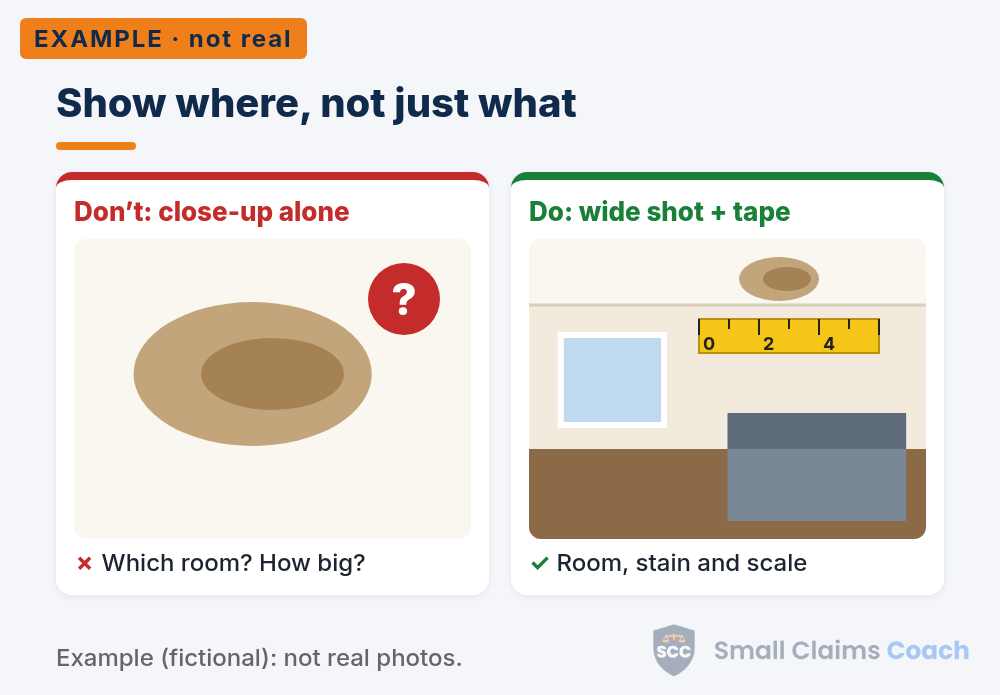
Example (fictional): a zoomed-in water stain with no context, next to a wide shot of the room with a tape measure on the wall.
Taking photos for court? Get the full guide.
The full guide is for Playbook members: how to show a photo is real, how to shoot video, before, after and progress photos, a photo log, and a shoot-day checklist. The Playbook also gives you a filled-in sample of your state's claim form (every state and DC has one; for Mississippi, Oklahoma and Wyoming it's a sample layout we made, so you'd get the real form from the court clerk) and your state's Playbook section. One membership covers every state. $149 for your first year (introductory offer), then $199 a year. Join now.
How does the wide, medium, close method work?
Think of it as telling the story in three frames.
- Wide. The whole room, the whole car, the whole side of the house. Include something that makes the place obvious: a window, a door, the house number.
- Medium. Step closer so the damage fills most of the frame, with something recognizable still at the edge.
- Close-up. The detail: the crack, the gap, the stain. Keep your scale object in the shot.
Take more than one of each. It's much easier to pick the best later than to wish you'd taken more.
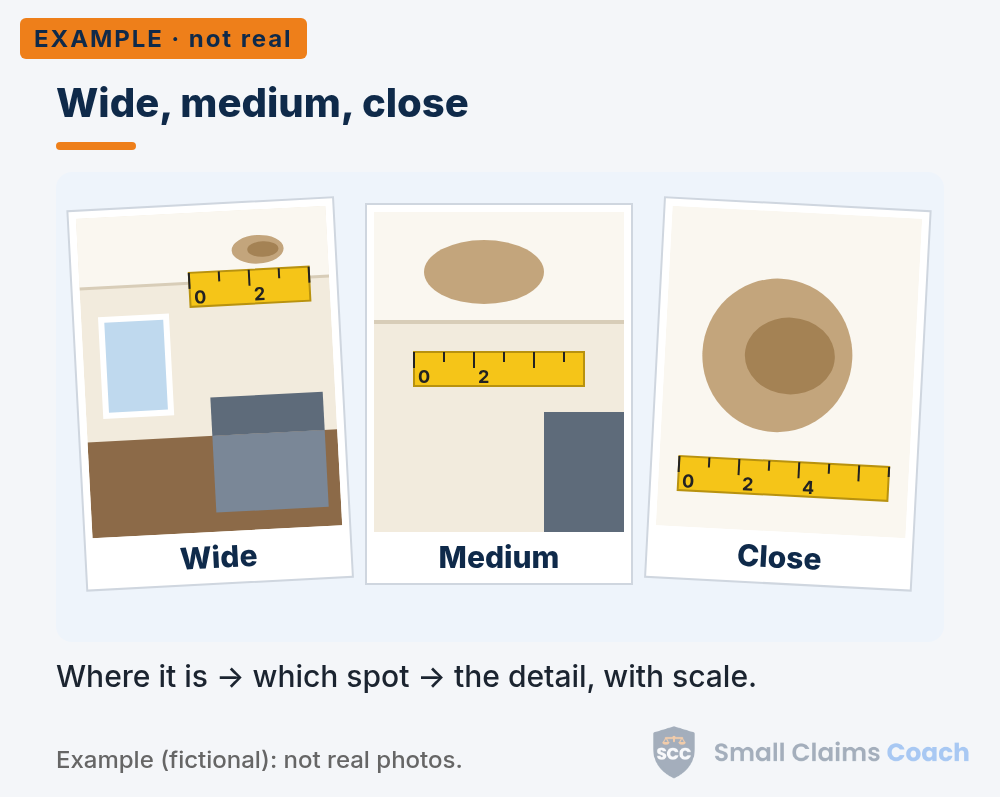
Example (fictional): wide shows the room, medium shows the spot, close shows the stain with a tape measure.
How do you show size in a photo?
A tape measure or ruler is best. Lay it flat right next to the damage, so it isn't closer to the camera than the damage is. Make sure the numbers are readable. Measure what matters: run the tape along a long crack, or across a gap.
No ruler? Use something everyone knows, like a soda can or a sheet of printer paper. It's less exact, so write down what you used. Then take one shot without it, so nobody can say it hides something.
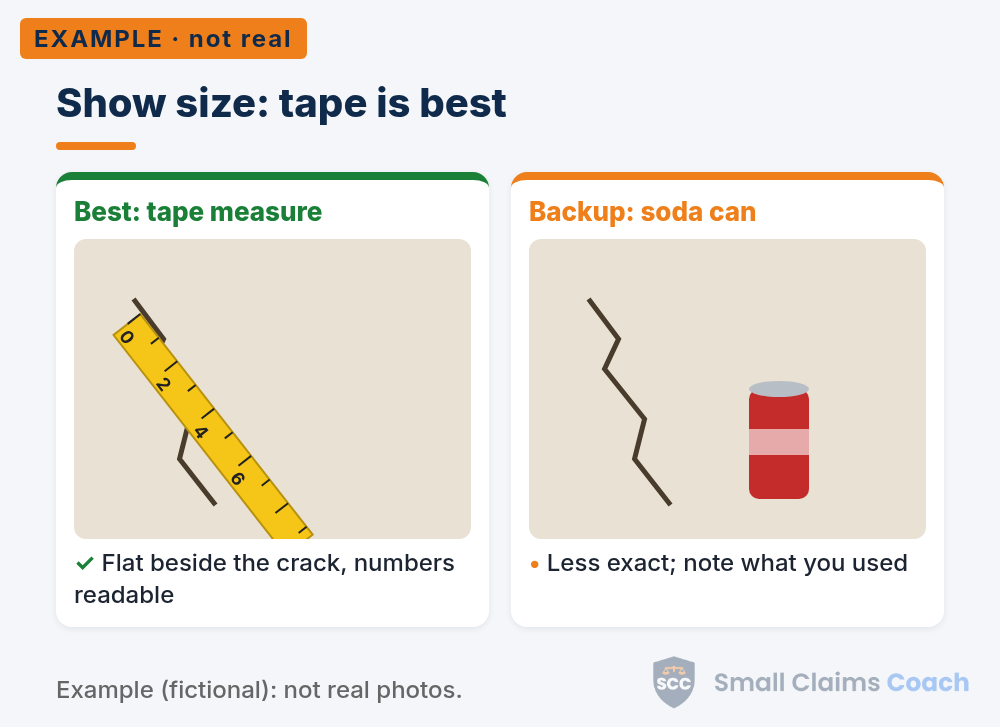
Example (fictional): best, a tape measure flat beside the crack with readable numbers; backup, a soda can, less exact, so note what you used.
Keep the originals.
The full guide covers why to keep the original files, how to show a photo is real, and how to bring photos to the hearing, with a photo log you can fill in. General legal information, not advice about your case.
Why do angles and landmarks matter?
Light and shadow can make a dent vanish from one side and look huge from another. Walk around what you're photographing. For a car, shoot the front, back and both sides, plus the damage straight on and at an angle.
Outdoors, one stretch of fence looks like another. Include things that don't move: a tree, the corner of the house, a mailbox, a street sign. These show where you stood and which way you faced, so someone could stand in the same spot and see the same view.
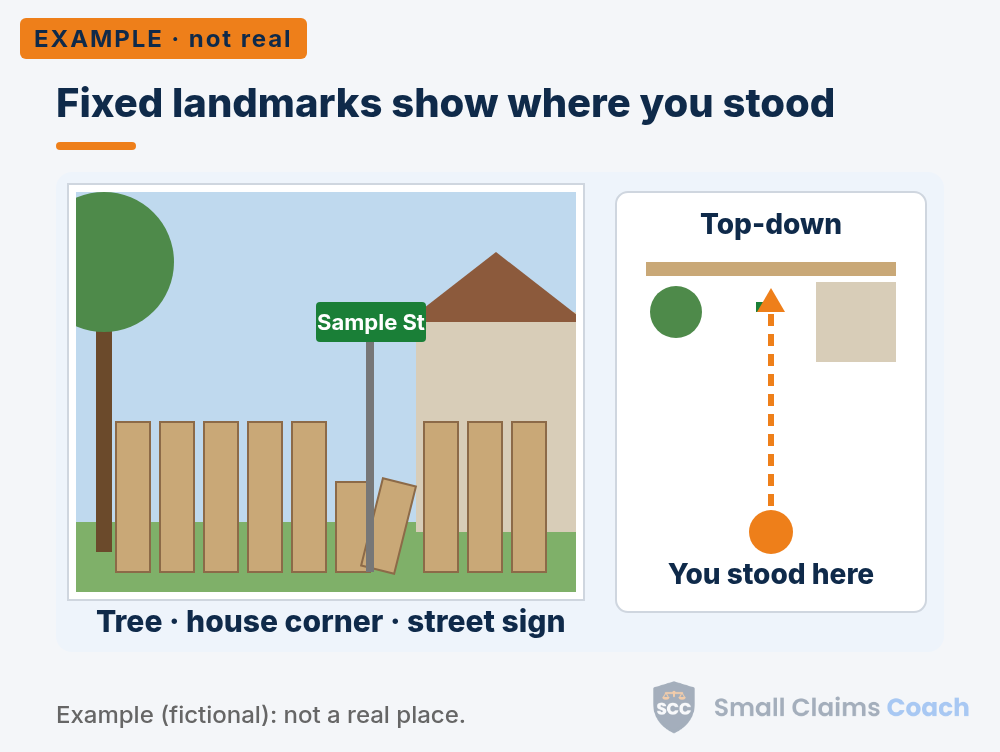
Example (fictional): a tree, the house corner and a street sign are in the frame. The top-down sketch marks where you stood.
Frequently asked questions
Do photos need a date stamp on them?
Not necessarily. Many phones save the date and time inside the original file. Keep the originals, log when you took each one, and check what your court expects.
How many photos should I take?
More than you think. Photos are free and you can't go back. Then bring only the clearest few for each problem.
Can I crop or edit my evidence photos?
Keep the original exactly as it is. If you want a cropped or marked-up version, make a copy, label it as a copy, and keep the original handy.
Should I take photos or video?
Often both. Photos are easy to print and label. Short clips can show what photos can't, like a leak in action.
Can I play a video at my hearing?
It depends on the court. Some allow it, and some have rules about devices, file types or sharing copies ahead of time. Ask the clerk before your hearing whether you can play a video and how to submit it.
Rules vary by state and court. This information is for educational purposes only. It is not legal advice. We try to keep every page up to date, but local rules, fees, and information change regularly. If you have questions, or our numbers don't match what your court publishes on its website, double-check with your court clerk.
This website and our Playbook are designed to give you the tools and confidence to handle your small claims case yourself, without a lawyer. If you think something is missing, we would like to hear about it so we can keep improving our Playbook. But if your situation is complicated, does not fit the samples we cover, or a filing deadline is close, you may want to call a lawyer.
What Playbook members get in the full guide:
- Why should you keep the original files?
- How do you show a photo is real?
- How do you take before, after and progress photos?
- How should you shoot video?
- How do you bring photos to the hearing?
- Worked examples (fictional)
- Your photo log
- Shoot-day checklist
- Common mistakes
The rest of this guide is for Playbook members. One yearly membership covers it. See the Playbook