Small Claims Court Near Me: How to Find Your Exact Court First
A map pin isn't a court. Here's a calm, step-by-step way to find the exact small claims court for your case before you file anything.
If you're here, someone probably let you down. Work was left unfinished, money wasn't paid back, or a deposit never came home. Now a search box wants you to pick a court before you've had a chance to breathe.
Take that breath. Finding your court is a checking job, not a guessing job, and you can do it one check at a time. In the full guide, we follow a made-up case, Jordan Sample v. Typical Roofing Co., from search result to the exact court.
The quick answer: how do I find my small claims court?
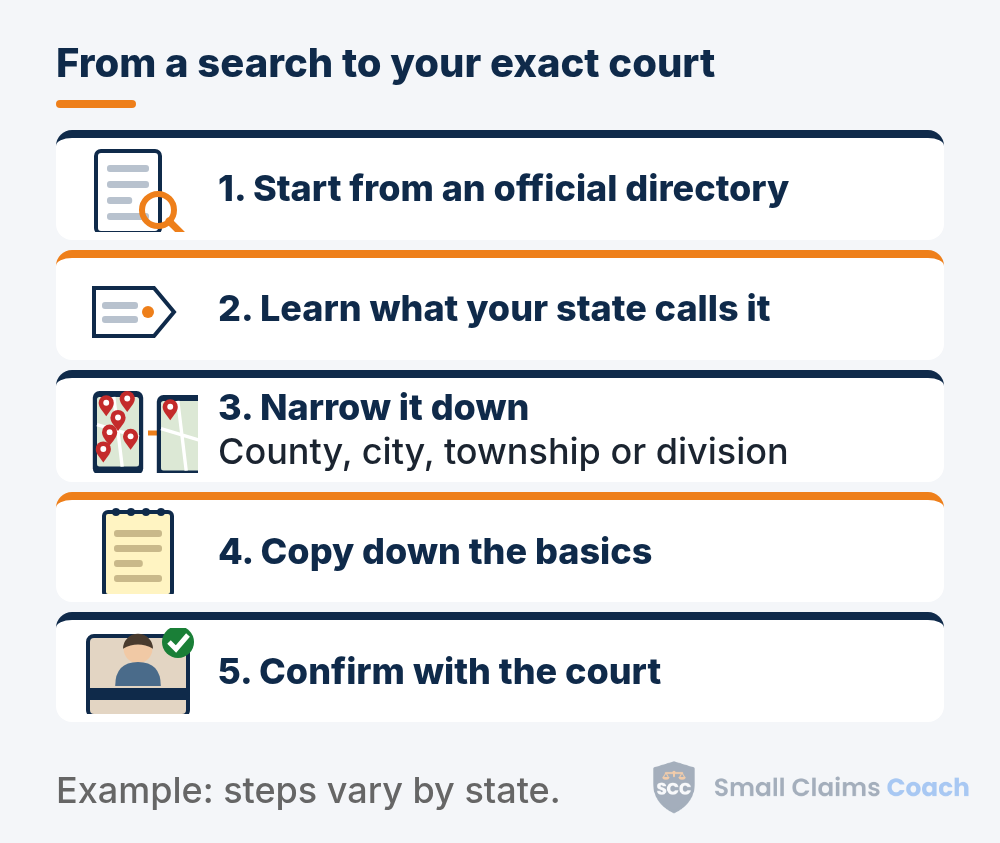
- Start from an official directory, not a search ad or a map pin. Your state judiciary website usually has a "Find your court" or court locations tool. Then cross-check with the Small Claims Coach state guides.
- Learn what your state calls it. The same kind of case can go to a differently named court in another state.
- Narrow it down to the county, city, township or division your state uses. This varies by state.
- Copy down the basics: the court's exact name, where filings are taken, and where it posts its forms and local rules.
- Confirm with the court where small claims filings go and whether it uses an online portal.
If you were served with papers instead, start with the court named on those papers and the Got Sued path. Don't pick a new court from a search.
Not sure which court is yours?
The full guide is for Playbook members. It includes a court identity card you fill in, how to confirm the filing counter or portal with the clerk, the wrong-court mistakes that waste a filing, and a made-up example worked end to end. The Playbook also gives you a filled-in sample of your state's claim form (for Mississippi, Oklahoma and Wyoming it's a sample layout we made, so you'd get the real form from the court clerk) and your state's Playbook section. One membership covers every state. General legal information, not advice about your case.
$149 for your first year (introductory offer), then $199 a year. Join now.
What does "near me" actually have to match?
A "small claims court near me" search is good at finding buildings. It isn't good at telling you whether that building should hear your case. Those are two different questions.
Which place matters (where you live, where the other side is, or where the work, purchase or agreement happened) depends on your state's rules. Many courts call this "venue." It's something you check, not assume.
Coach's Tip: Facts first, court's rule second. Write down the places connected to your dispute before you look anything up, then let the court's rules tell you which one counts.
Why does the same case have a different court name in another state?
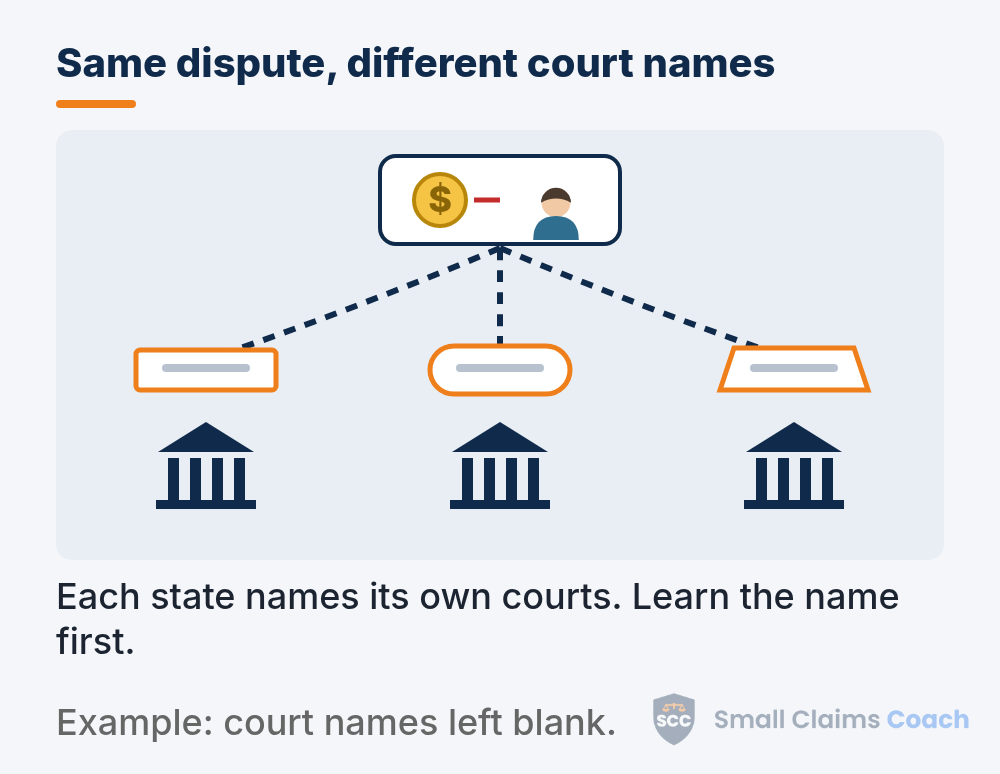
States set up their own court systems, so a small money dispute doesn't go to the same kind of courtroom everywhere. A few naming examples:
- In Texas, small claims cases are heard in Justice Court (also called Justice of the Peace, or JP, court).
- In Minnesota, the name to look for is Conciliation Court.
- In Pennsylvania, small money claims usually go to a Magisterial District Court, but Philadelphia has its own setup: its Municipal Court hears small claims.
These are naming examples only, not instructions to file in any of those courts. Forms, counters and local instructions are listed under the court's real name, so learning the name first points every later check (limits, fees, forms, deadlines) at the right place.
County, township or division: which level decides mine?
Under the state level, states sort cases differently. In some places the county matters. In others, a city, township or division of a larger court does the sorting. There's no single national answer: it's whichever level your state guide and your court's rules name.
If two courts both look plausible, don't just pick the closer one. Note both names and check with the court which one takes a case like yours before you file.
What should I copy down before I file?
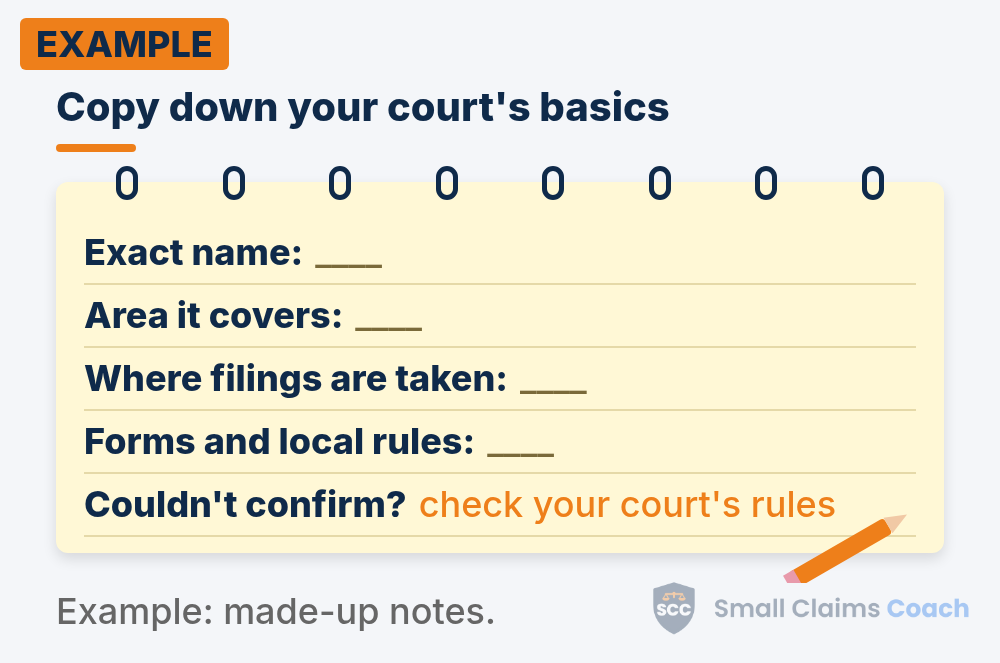
- The court's exact name, spelled the way the court spells it
- The county, city, township or division it covers
- Where filings are taken, as the court lists it
- Where the court posts its forms and local rules
- Anything you couldn't confirm, left blank and marked "check your court's rules"
A blank is information, not a failure. Don't fill it from another state's page, another county's page or a search snippet. Numbers and forms don't travel between courts.
Frequently asked questions
Is the closest small claims court always the right one?
Not necessarily. Which court should hear a case can depend on where the dispute happened, where the parties are, and your state's rules. Check your state guide and your court's rules before you file.
Can I just use the first result for "small claims court near me"?
Use it as a lead, not as the answer. A search result can show you a building. Only your state's court information and your court's own rules can confirm it's the court for a case like yours.
What if my state calls it something else?
That's normal. States name these courts differently. Your state guide uses the name your courts use.
What if there's no county page for where I live?
Work from your state guide and check your court's rules directly. A missing county page on this site doesn't change which court hears your case.
What if I was the one who got sued?
Start with the court named on your papers, not a new one from a search. Response rules and deadlines vary by state, so check your court's rules promptly.
This information is for educational purposes only. It is not legal advice. Rules vary by state and court. We try to keep every page up to date, but local rules, fees, and information change regularly. If you have questions, or our numbers don't match what your court publishes on its website, double-check with your court clerk.
Small Claims Coach uses public information to coach you as you organize and present your own case. We are not your lawyer, there is no attorney-client relationship, and we don't want the details of your case. Check your state's rules.
In the full guide (Playbook members):
- A court identity card you fill in from your own state guide
- How to confirm the filing counter or portal with the clerk
- The wrong-court mistakes that waste a filing
- How to use county pages where they exist
- Venue questions to check, in order, before you file
- A made-up example worked end to end: Jordan Sample v. Typical Roofing Co.
- A five-point check before you file