Using AI Safely for Small Claims: Fake Citations, Court AI Rules, and Your Evidence
AI can speed up small claims prep. It can also invent cases, miss your court's rules, and tempt you to touch your evidence. Here's how to use it safely.
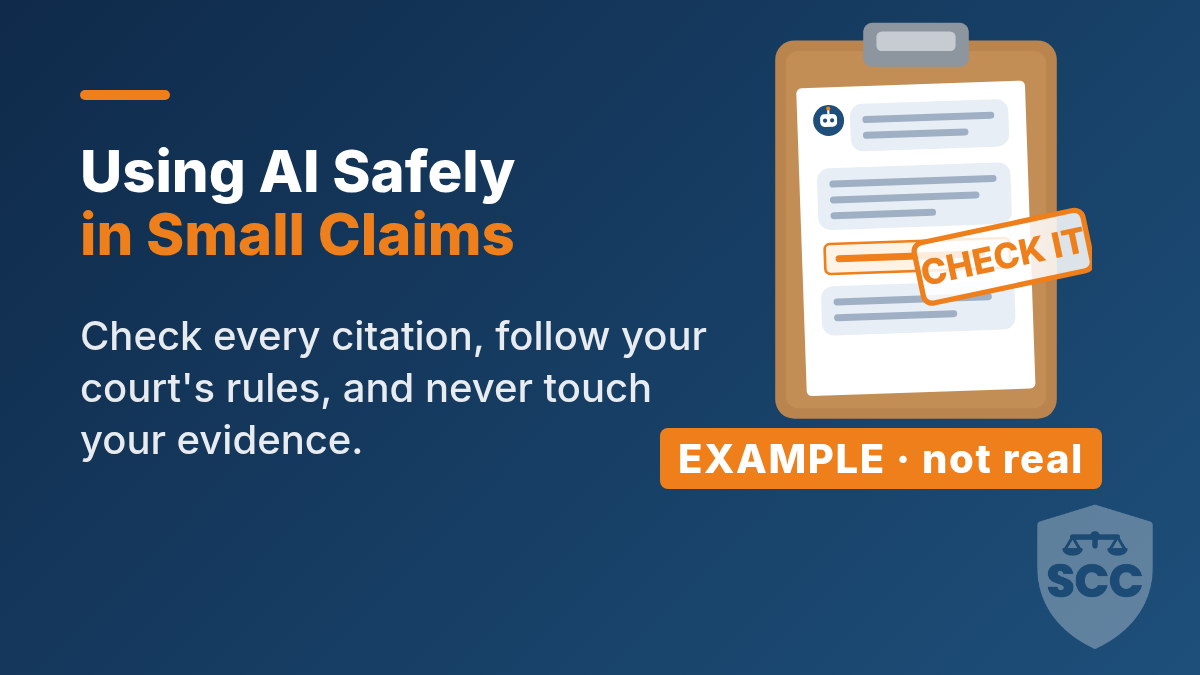
AI can help you get a messy case in order in an evening. It can also hand you a court case that never existed, written so confidently you'd never doubt it. Some people only find out when the judge asks where it came from.
Maybe you asked a chatbot to "find the law" on your deposit, or thought about cleaning up a blurry screenshot. Both can backfire. Here are the three places AI goes wrong (made-up law, your court's rules, your evidence), plus how to keep your private details safe.
The quick answer: how to use AI safely for small claims
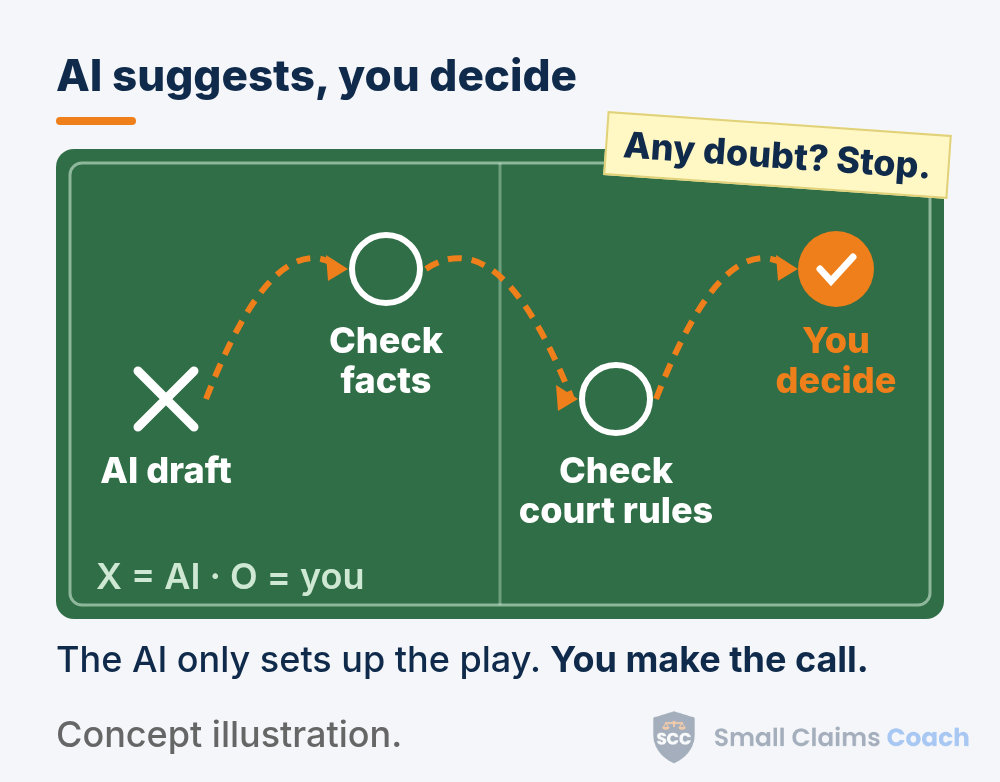
- Treat every case name and law it gives you as fake until you check it. AI tools can invent cases, statutes and quotes that look real. If you can't find it on an official court or government site, don't use it.
- Check your court's rules on AI before you file anything. Rules vary. For example, the Illinois Supreme Court has an AI policy, and a federal court in North Texas requires lawyers to disclose generative AI use in their filings. Check your court's rules.
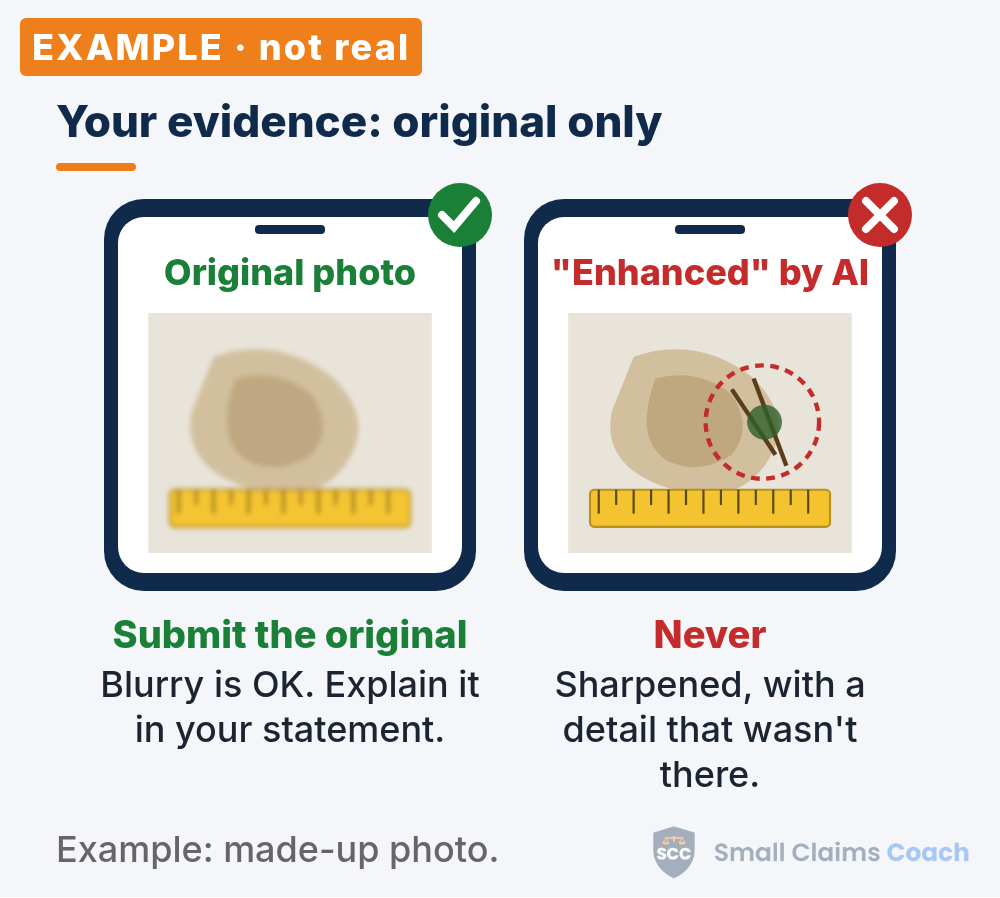
- Never use AI to create or change evidence. No edited screenshots, no "enhanced" photos, no AI-written receipts. Your evidence has to be what actually happened, exactly as it was.
- Keep your private details out and your facts your own. More on that below.
Using AI for your case? Get the full guide.
The full guide is for Playbook members: a 5-question pre-check, a citation check log, a placeholder sheet and a worked example. The Playbook also gives you a filled-in sample of your state's claim form (every state and DC has one; for Mississippi, Oklahoma and Wyoming it's a sample layout we made, so you'd get the real form from the court clerk) and your state's Playbook section. One membership covers every state. $149 for your first year (introductory offer), then $199 a year. Join now.
Can AI make up court cases and laws?
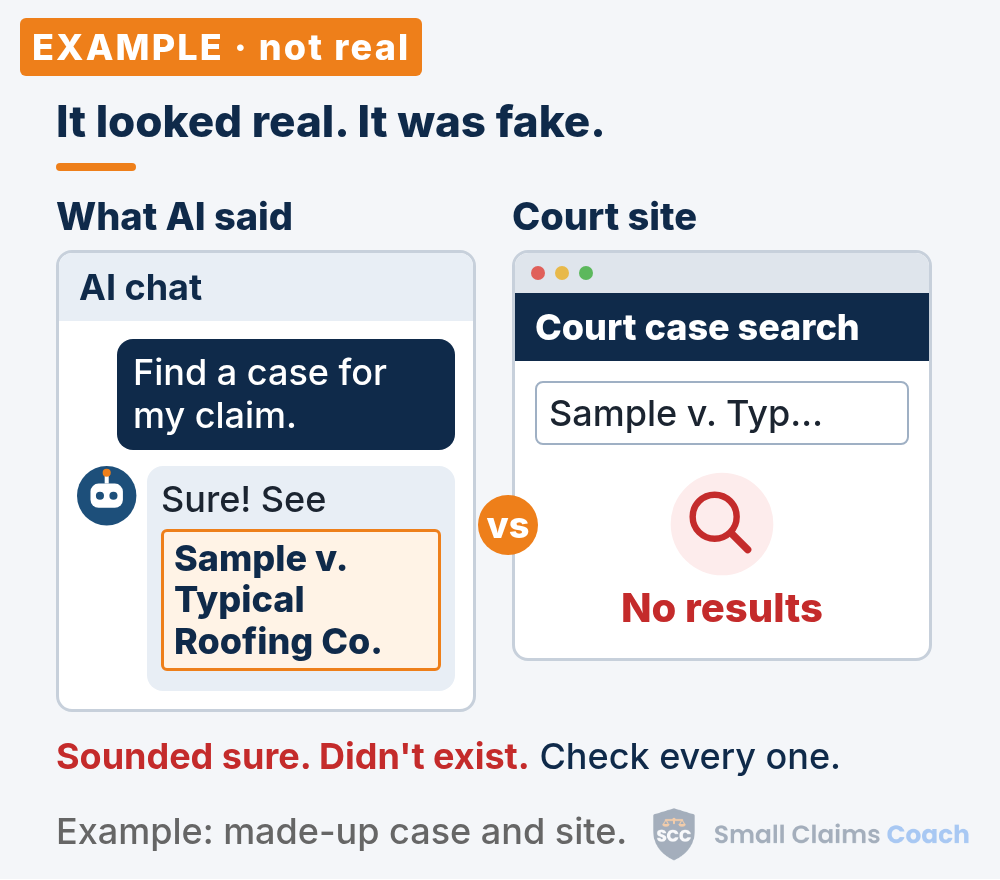
Yes. These tools produce text that sounds right; they don't look things up. Ask for "a case that says my landlord owes me double the deposit," and you may get a case name, a year and a neat quote. None of it has to be real.
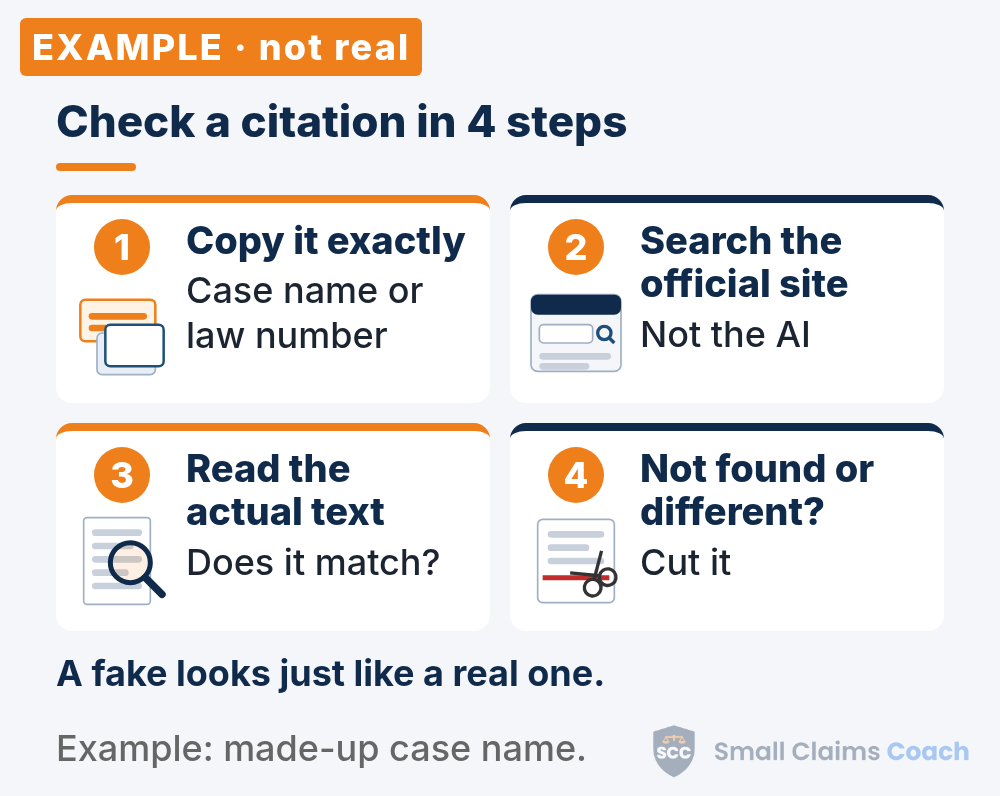
Here's how to check one:
- Copy the exact case name or law number.
- Search for it on your state's official court or legislature website, not on the AI tool.
- Read the actual text. Does it say what the AI said it says?
- If you can't find it, or it says something different, cut it.
Here's what it looks like when a case the AI gave you doesn't exist.
Do I even need case citations in small claims?
Often not. Small claims is designed for people to handle their own cases, and in some states, such as California, lawyers can't represent you in court. Your proof of what happened, what it cost you, and your documents are the core of your case. Check your court's rules.
That's why a citation you can't verify is pure risk. If it's real, it may add little. If it's fake, the judge may start doubting everything else you said. Our statement guide shows how to build your case around your proof and documents instead.
Does my court have rules about using AI?
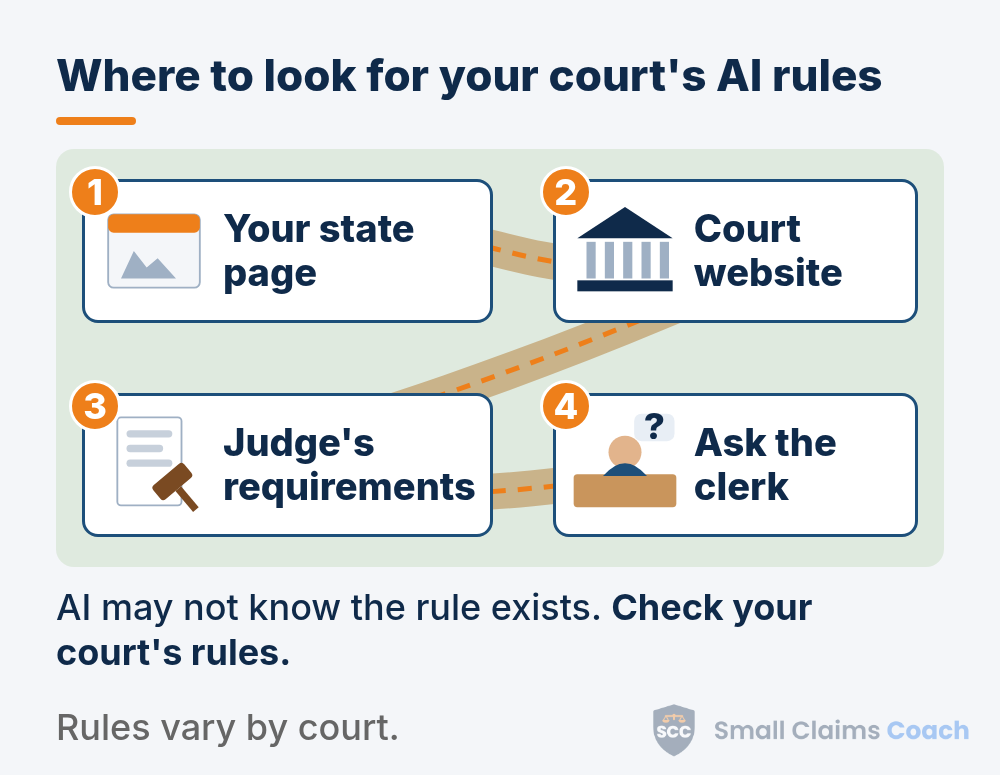
It might. Rules on AI in court are new and still changing. They can come from a state's highest court, a court's local rules, or an individual judge's own requirements. Some apply only to documents prepared by lawyers. Some require you to say whether you used AI on what you file, while others say disclosure isn't required. Check your court's rules.
Look at your court's website and any requirements from your judge, or ask the clerk.
If a rule asks you to disclose AI use, follow it.
Can I use AI to fix up my photos or screenshots?
No. This is the one rule with no gray area. Don't use AI to sharpen, brighten, crop out, fill in, "restore" or recreate any piece of evidence. Don't let it rebuild a deleted thread or a lost receipt.
If the other side says you faked it, you need to be able to say, truthfully, that it's exactly what your phone captured. Our guides on saving text messages and taking photos and video show how to get it right the first time.
Check before you use it.
The full guide has a 5-question pre-check and a citation check log, so you check every case or law an AI tool gives you before it goes anywhere near the court. General legal information, not advice about your case.
What about privacy and keeping the facts mine?
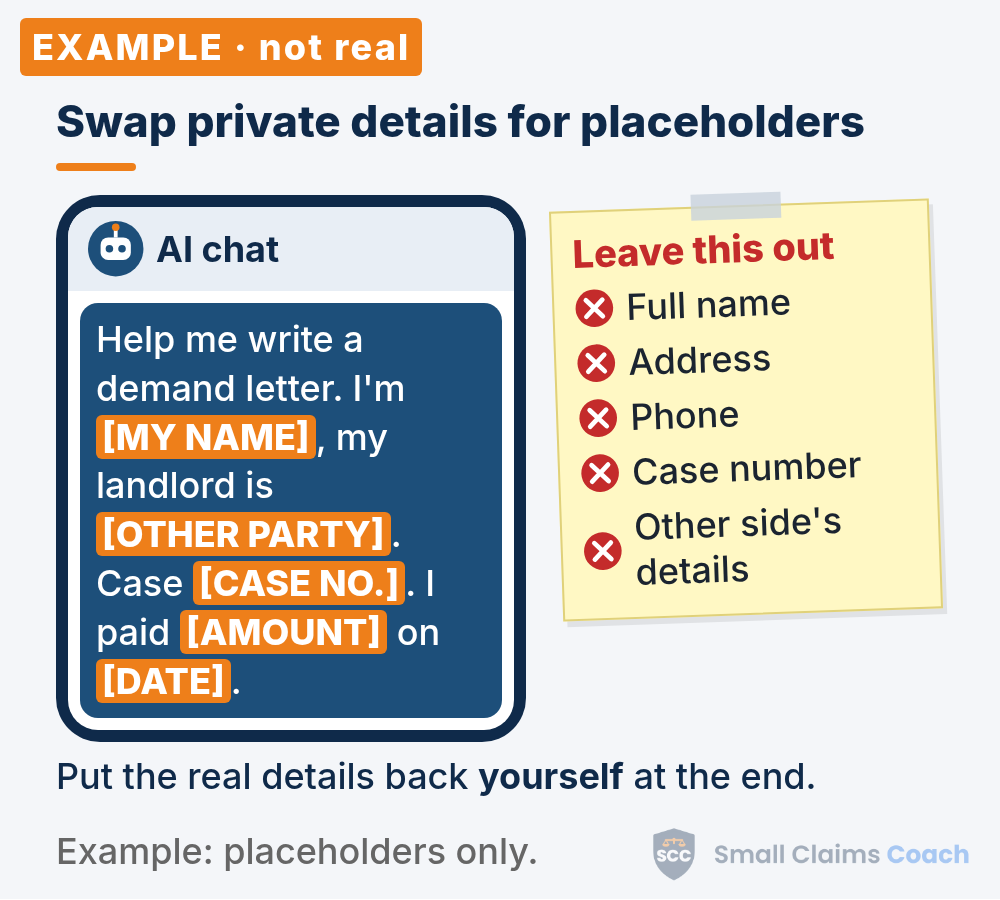
Don't paste your full name, address, phone, case number, or the other side's personal details into a chat tool. Use placeholders like [MY NAME], [OTHER PARTY], [CASE NO.], [AMOUNT] and [DATE] instead, and put the real details back yourself at the end. And every fact in your draft should come from you, not from the AI. Our free AI prompt guide has a "Use AI safely" box in every section.
Frequently asked questions
Can AI give me legal advice for small claims?
No. It can be wrong about rules, deadlines and fees, so check every one with your court.
Do I have to tell the court I used AI?
It depends on your court and judge. Ask the clerk if you're unsure.
Can AI write my statement for me?
It can help turn your own facts into a draft. Every fact must be true and yours, and read every word.
Can AI tell me my filing fee or deadline?
Don't rely on it. AI can be wrong or out of date. Get them from your court's website or the clerk.
Is it OK to use AI to translate my documents?
A translation can miss meaning, and courts may have their own rules on translations. Ask the clerk before relying on one.
Can I use AI to organize my exhibits?
Yes, for the exhibit list and labels, from your own notes. The exhibits themselves stay untouched.
Should I ask the AI whether its citation is real?
No. It may just say yes. Check it yourself on an official site.
Can AI help me get ready for my hearing?
It can help you outline and practice what to say. Every point must be true and backed by your evidence.
Where to go next
In the full guide (Playbook members): a 5-question pre-check, a citation log, a placeholder sheet and a worked example, and your state's checklists and timeline.
You do the work. The Playbook hands you the plays.
The full guide walks you through all of this, step by step. Your membership also includes a filled-in sample of your state's claim form and your state's Playbook section, with prep guides that work in any state: a document checklist, exhibit labels, a prep timeline and a hearing-day outline. One membership covers every state.
Next step: write your statement or find your state's rules.
This information is for educational purposes only. It is not legal advice. We try to keep every page up to date, but local rules, fees, and information change regularly. If you have questions, or our numbers don't match what your court publishes on its website, double-check with your court clerk.