Settling a Small Claims Case: Agreements, Stipulated Judgments and Payment Plans
Settling isn't losing. It trades some of your claim for certainty, without the risk of a hearing. Here's how settlement negotiation, stipulated judgments, releases and payment plans work.
Updated on October 28, 2026
Settling isn't losing. It trades some of your claim for certainty, without the risk of a hearing.
A small claims settlement agreement is a written deal where both sides agree on what gets paid, when, and what happens to the case. A good one says how the case ends, through a stipulated judgment or a dismissal, and what you can do if the payments stop.
Our running example: Jordan Sample is suing Typical Roofing Co. over a leak that came back after a paid repair.
The quick answer: how should I approach settlement?
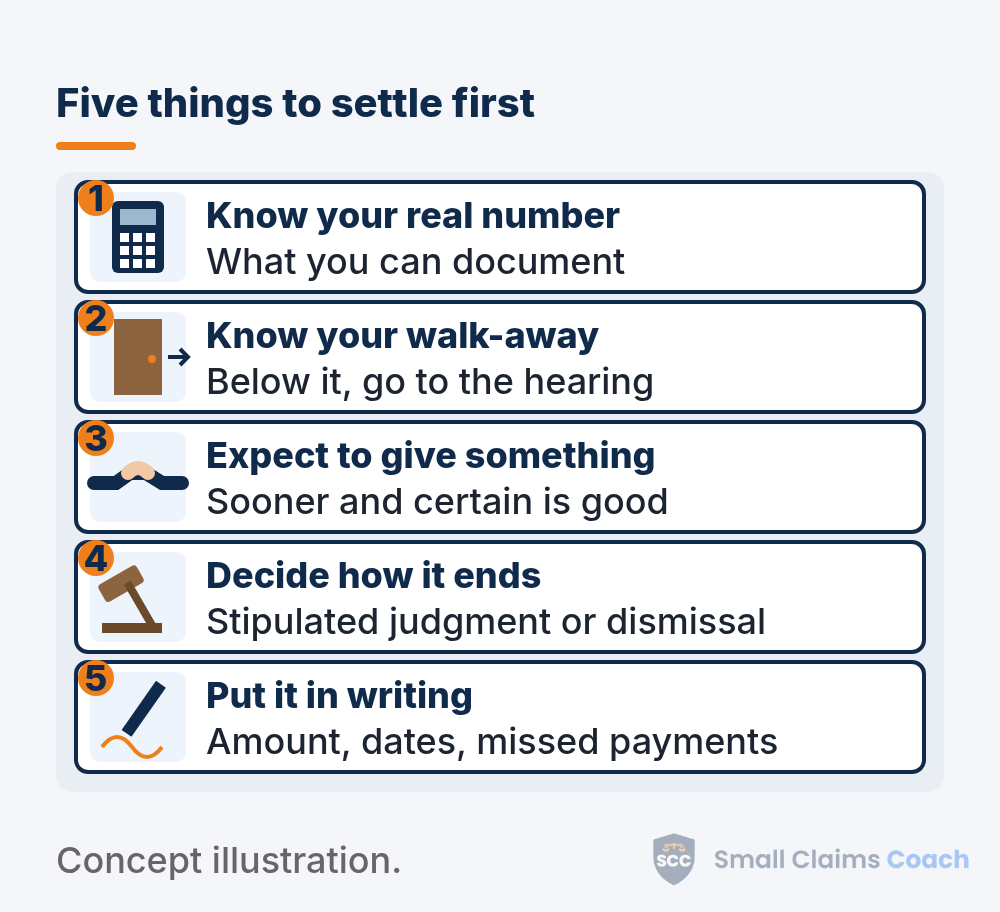
- Know your real number: what you can document, not what you hope for.
- Know your walk-away: the result below which you'd rather go to the hearing.
- Expect to give something. Less than 100%, sooner and certain, can be a good result.
- Decide how the case ends: a stipulated judgment or a dismissal. It matters if they stop paying.
- Put it in writing. Amount, dates, what happens to the case, and what happens if they miss a payment.
Thinking about settling? Get the full guide.
The full guide is for Playbook members: a labeled sample settlement agreement with made-up names, a settlement worksheet for your walk-away number, email and hearing-day scripts, a release-of-claims checklist, and a pre-signing checklist. The Playbook also gives you a filled-in sample of your state's claim form (every state and DC has one; for Mississippi, Oklahoma and Wyoming it's a sample layout we made, so you'd get the real form from the court clerk) and your state's Playbook section. $149 for your first year (introductory offer), then $199 a year. Join now.
Should I settle my small claims case?
It depends. At a hearing you might win, lose, or win less than you asked for, and winning doesn't guarantee you'll be paid. A settlement trades some of the amount for certainty, speed and control. Weigh how strong your proof is, what a hearing costs you, and whether the other side can pay.
Why would they pay 100% to settle?
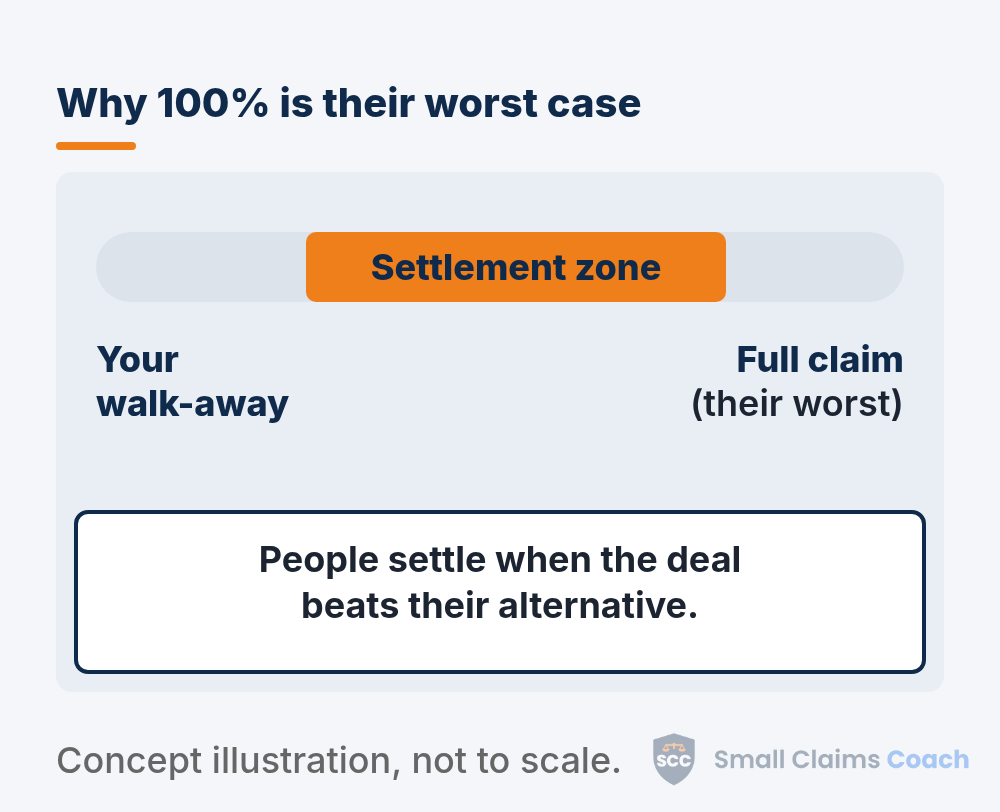
Usually they wouldn't. If your full demand is the most they could lose at a hearing, paying it now gives them nothing. People settle when the deal beats their alternative.
How does settlement negotiation work in small claims?
Start from your documented number, ask what the other side cares about (money, time, a payment plan, a quiet ending), and keep every offer calm and in writing. Many courts offer free or low-cost mediation, where a neutral person helps both sides talk. Check your court's rules.
What if they have a counterclaim?
A counterclaim is when the other side says you owe them. Then your worst case isn't zero. In a made-up example, if you claim $3,000 and they counterclaim $1,500, outcomes range from you being paid $3,000 to you owing $1,500 plus your own costs. A settlement that looks low against your best case can look much better against that range.
Setting your walk-away number?
The full guide's settlement worksheet takes you line by line through your documented claim, the strongest and weakest parts, any counterclaim, what a hearing costs you, and the risk of not collecting, then has you write down your walk-away before you talk. General legal information, not advice about your case.
Can settlement offers be used against me?
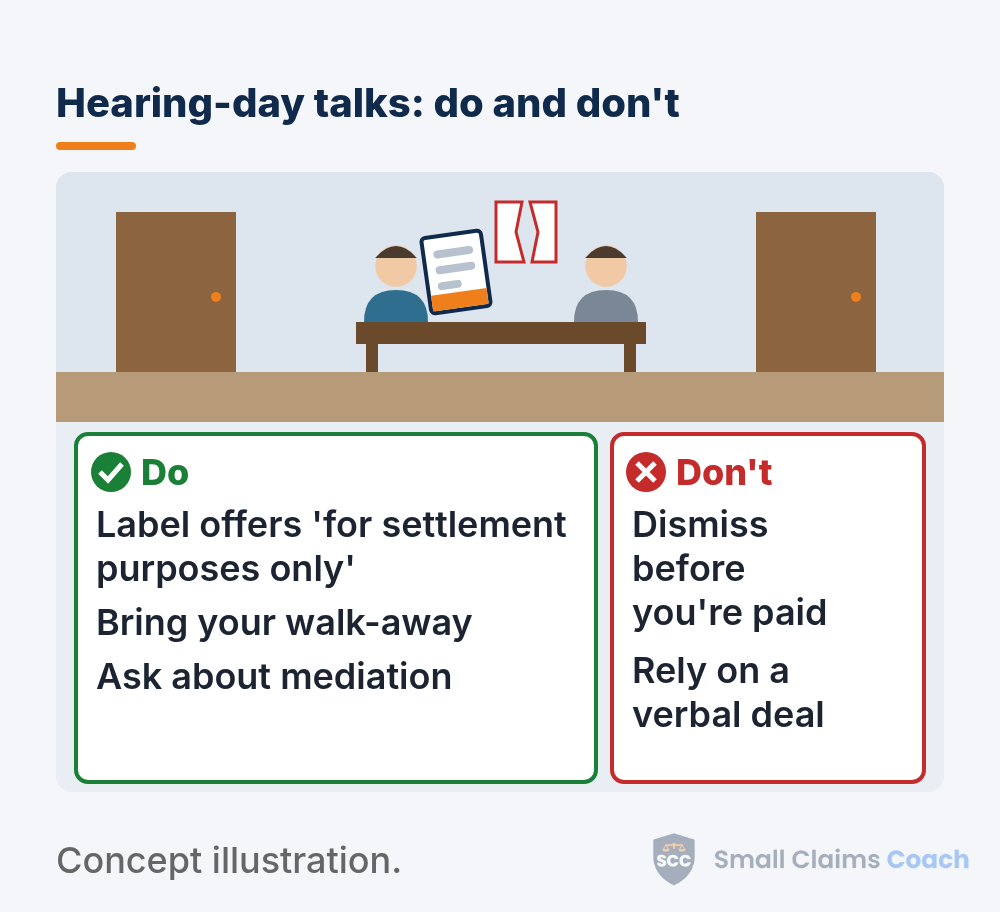
In many courts, offers made to settle generally can't be used to prove who's right or how much is owed. The federal version is Federal Rule of Evidence 408. States have their own versions, and small claims courts may apply evidence rules loosely, so don't assume anything is protected. Label offers "for settlement purposes only" and keep them separate from your demand letter. Check your state's rules.
What is a settlement agreement?
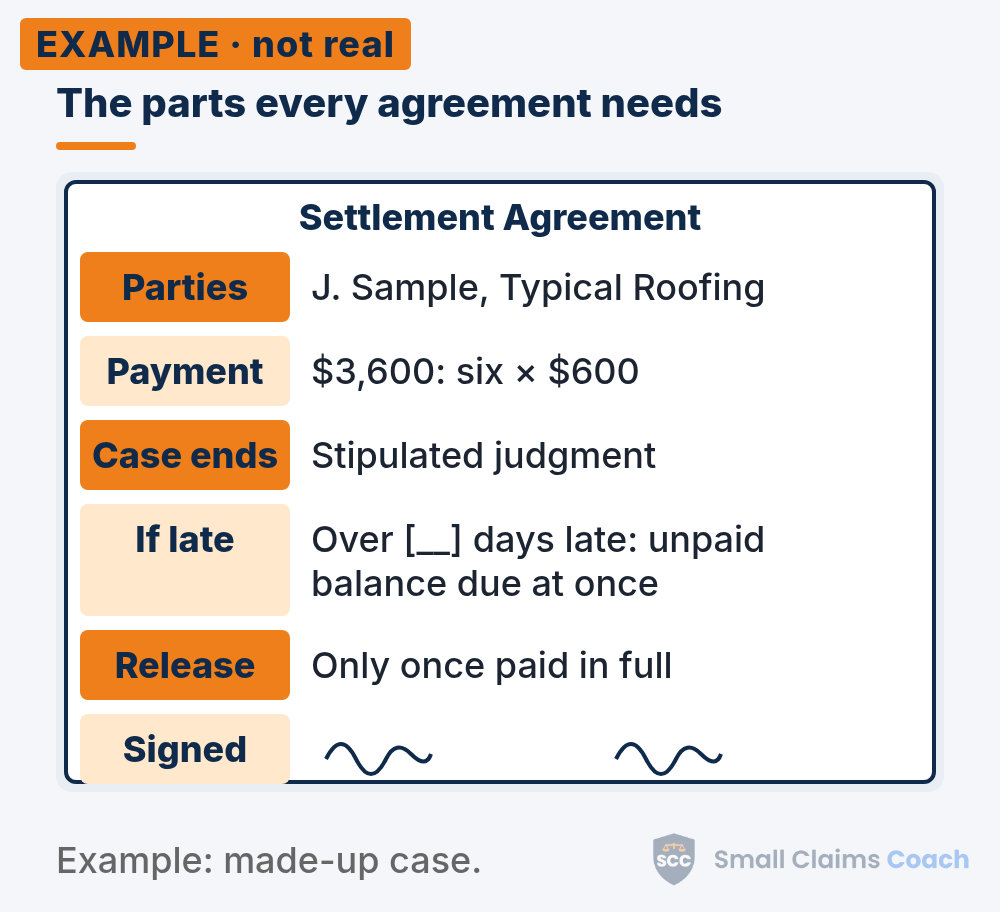
A settlement agreement is a written contract that ends the dispute. It names both parties and the case, says how much will be paid and when, says how the case will end in court, and says what each side gives up. Both sides sign and keep a copy.
For a plain-language starting point, see the Settlement Agreement Template.
What is a stipulated judgment?
A stipulated judgment (also called a judgment by agreement or consent judgment in some places) is a settlement the judge turns into a court judgment. If they stop paying, you already have a judgment, so you can usually go straight to collecting instead of starting over. Whether and how your court enters one varies. Check your court's rules.
Stipulated judgment or dismissal: which is better for you?
From the person being paid, a stipulated judgment usually gives more protection, especially with a payment plan. A dismissal ends the case. If you dismiss first and they stop paying later, you may have only a contract claim, which can mean a new case. If they pay everything at once, a dismissal after the money clears is often simpler.
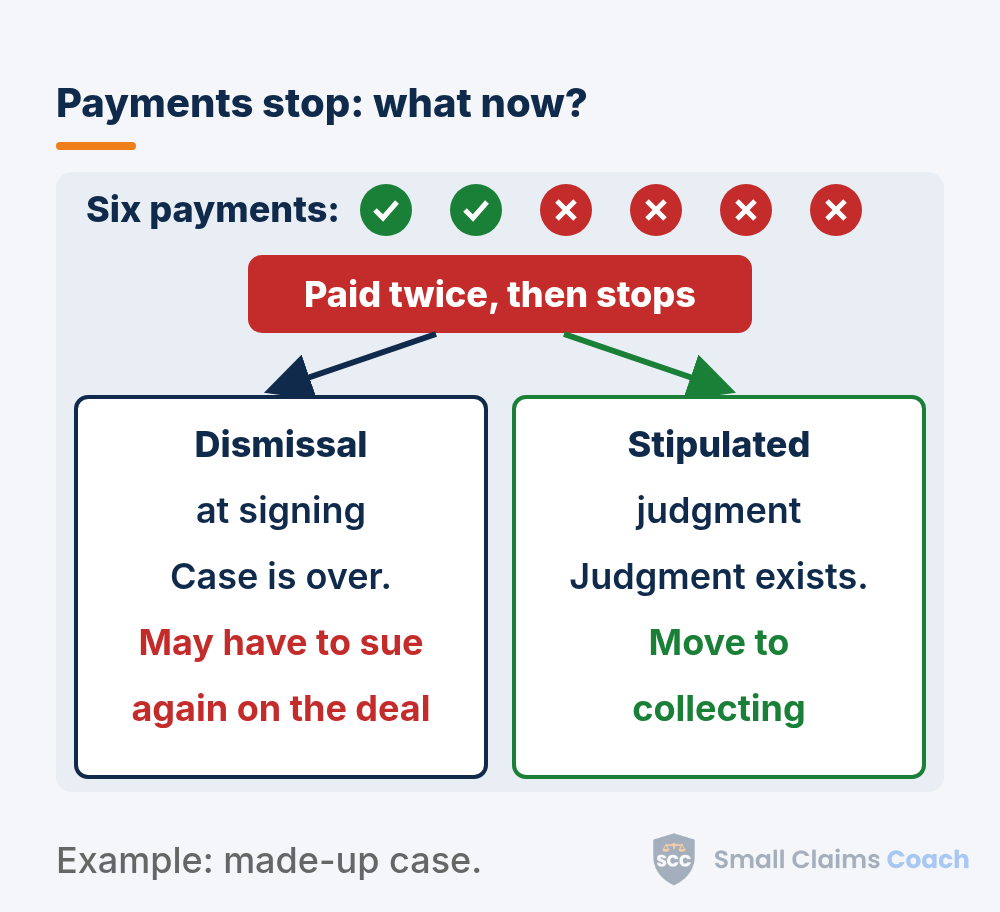
Made-up example: Jordan and Typical Roofing Co. agree on payments over six months. Typical Roofing pays twice, then stops.
- If Jordan agreed to a dismissal at signing: the case is over. Jordan may have to sue again on the settlement agreement and wait for another hearing.
- If Jordan has a stipulated judgment: Jordan already has a judgment for the unpaid amount (depending on the terms) and can move to collecting a judgment.
Coach's Tip: The other side may prefer a dismissal because it avoids a judgment. A middle path some courts allow: the case stays open or a judgment is entered only if they miss a payment. Ask the clerk what your court permits.
How do I propose a payment plan?
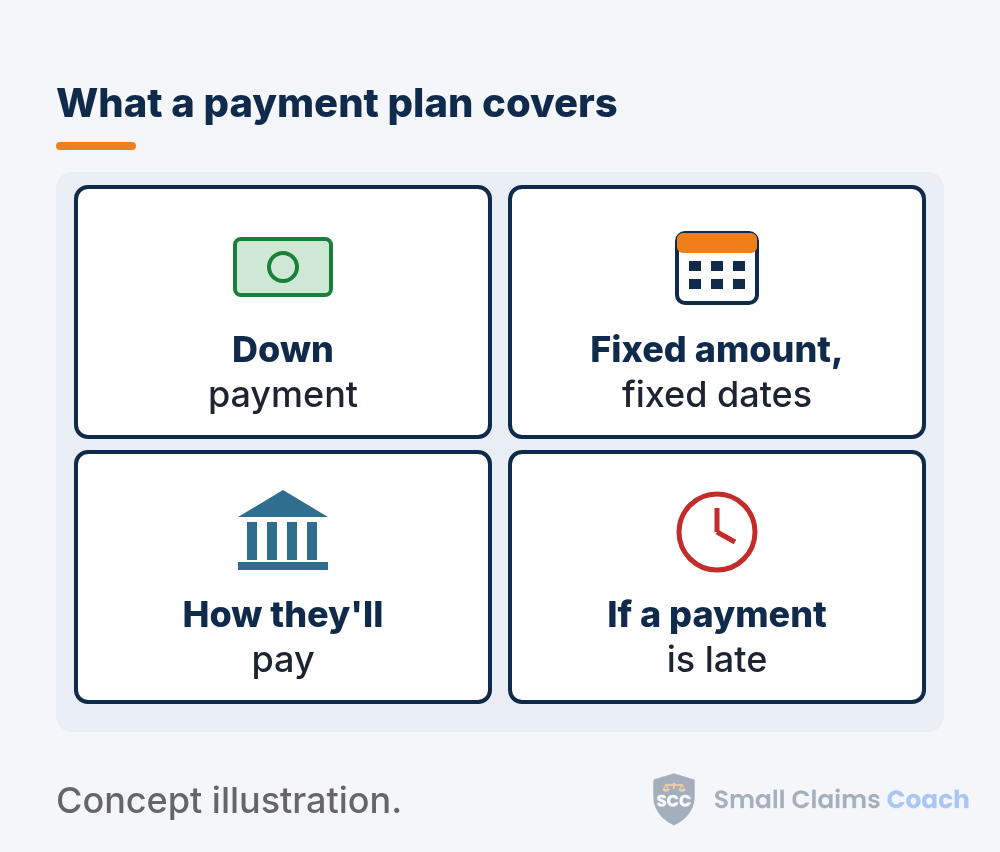
Offer a plan that's realistic for them and safe for you: a down payment, a fixed amount on fixed dates, how they'll pay, and what happens if a payment is late. Put that in writing, ideally inside your settlement agreement or a stipulated judgment.
If you agree to a plan, log each payment as it comes in with the Payment Log.
What happens if they stop paying?
It depends on how the case ended. With a stipulated judgment, you can usually start collecting the unpaid amount. With a dismissal, you may need to sue on the broken settlement agreement. Keep a record of every payment received and missed. See collecting a judgment (members) and how to get paid after you win.
Can I negotiate on hearing day?
Often, yes. Some courts encourage it or have mediators on hearing days. Bring your walk-away number, the terms you'd accept, and a payment-plan idea. Don't skip the hearing unless you're sure how your court records the settlement.
Frequently asked questions
What does dismissal with prejudice mean?
A dismissal with prejudice ends a case for good. The person who sued can't bring the same claim again. A dismissal without prejudice ends the case but may allow refiling. If you dismiss with prejudice before you're paid, you may lose your easiest way back to court.
Do I need a lawyer to write a settlement agreement?
No, many people write their own in small claims. If the amount is large or the terms are complicated, you may want a lawyer to look it over.
How much should I settle for?
There's no formula. Start from what you can document, weigh your chances, the cost of a hearing and how hard collecting may be, and set a walk-away number first. See how much can I sue for.
What should I tell the court if we settle?
That depends on your court. Some want a signed stipulated judgment, some a request for dismissal, some an appearance at the hearing. Check your court's rules.
This information is for educational purposes only. It is not legal advice. Rules vary by state and court. We try to keep every page up to date, but local rules, fees, and information change regularly. If you have questions, or our numbers don't match what your court publishes on its website, double-check with your court clerk.
This website and our Playbook are designed to give you the tools and confidence to handle your small claims case yourself, without a lawyer. If you think something is missing, we would like to hear about it so we can keep improving our Playbook. But if your situation is complicated, does not fit the samples we cover, or a filing deadline is close, you may want to call a lawyer.
In the full guide (Playbook members):
- A labeled SAMPLE settlement agreement with made-up names, including sample payment-plan and missed-payment clauses
- A settlement worksheet, including counterclaims
- Negotiation scripts for email and hearing day
- What a release of claims means, plus a checklist of what you're giving up
- A worked example from first offer to signed deal
- Common mistakes and a pre-signing checklist
You do the work. The Playbook hands you the plays.
The full guide covers the list above, step by step. Your membership also includes a filled-in sample of your state's claim form and your state's Playbook section, with prep guides that work in any state: a document checklist, exhibit labels, a prep timeline and a hearing-day outline.