
California small claims Playbook
Home › States › California › Playbook
The Playbook coaches you as you organize and present your own case. Members: the prep guides that work in any state are in Part 1 of the Playbook below, and Part 2 covers California's forms, filing steps, service and hearing. For the basics, see the California overview.
Can a business sue in California small claims?
Businesses use the same court, form, fees, and procedure, with a $6,250 limit. A lawyer generally can't appear for a business at the hearing. Instead:
- A corporation appears through a regular employee, officer, or director who wasn't hired or appointed just to handle small claims.
- An LLC, partnership, or association appears through a regular employee, officer, or director, or a partner for a partnership.
- A sole proprietor can send a regular employee only if the claim can be proved with business records and nothing else is in dispute.
- A rental property owner can send its property manager for claims about that property.
- The person appearing files SC-109, Authorization to Appear. A business using a fictitious name also files SC-103.
What happens after you file in California?
Filing is only the first step. After the clerk accepts your claim, the other side has to be formally told about the case, you show up on your hearing date with your proof, and the judge decides. If you win, collecting the money is a separate step, and either side may have a limited chance to appeal. Deadlines and methods differ from court to court, so when something below isn't spelled out, check your court's rules.
New to this? Our plain-language guides walk through each stage: how to fill out and file your claim form, how to serve small claims papers, and what to say on hearing day.
How much should I ask for in California small claims?
Ask for what you can prove: receipts, invoices, estimates and a simple running total. If your loss is bigger than the California limit described above, look closely at your options before filing, because what happens to the extra amount depends on your court's rules. Our guide to how much you can sue for in small claims explains the basics, and the damages calculator (free quick total; the itemized version is in your Playbook) helps you add up your numbers.
Where should I start?
If you're not sure whether small claims fits your problem, begin with Start Here. It points you to the right path whether you're ready to sue, just got sued, or already won. Need a different state? See every state guide.
Largest counties in California
These are the most populous counties in California. Courts, fees and local forms can differ by location, so always confirm details with the court that serves the defendant's area.
- Los Angeles County (county guide coming soon)
- San Diego County (county guide coming soon)
- Orange County (county guide coming soon)
- Riverside County (county guide coming soon)
- San Bernardino County (county guide coming soon)
Source: U.S. Census Bureau, Vintage 2023 county population estimates (July 1, 2023), co-est2023-alldata.
Checklist
Before you file
- A written request for payment, and a copy
- The right county and courthouse
- The defendant's correct name
- SC-100, plus SC-100A if there are more parties
- Filing for a business? SC-109, plus SC-103 if you use a fictitious name
- The fee, or a fee waiver request
- How you'll serve the papers, and SC-104 for proof
- Count your claims over $2,500 this year (no more than 2)
- Suing a government agency? File a claim with the agency first. The deadlines are strict, so check them right away
For the trial
- Your documents, with copies
- Your witnesses, or a subpoena (SC-107) for anyone who won't come on their own
- A one-page list of each amount you're asking for
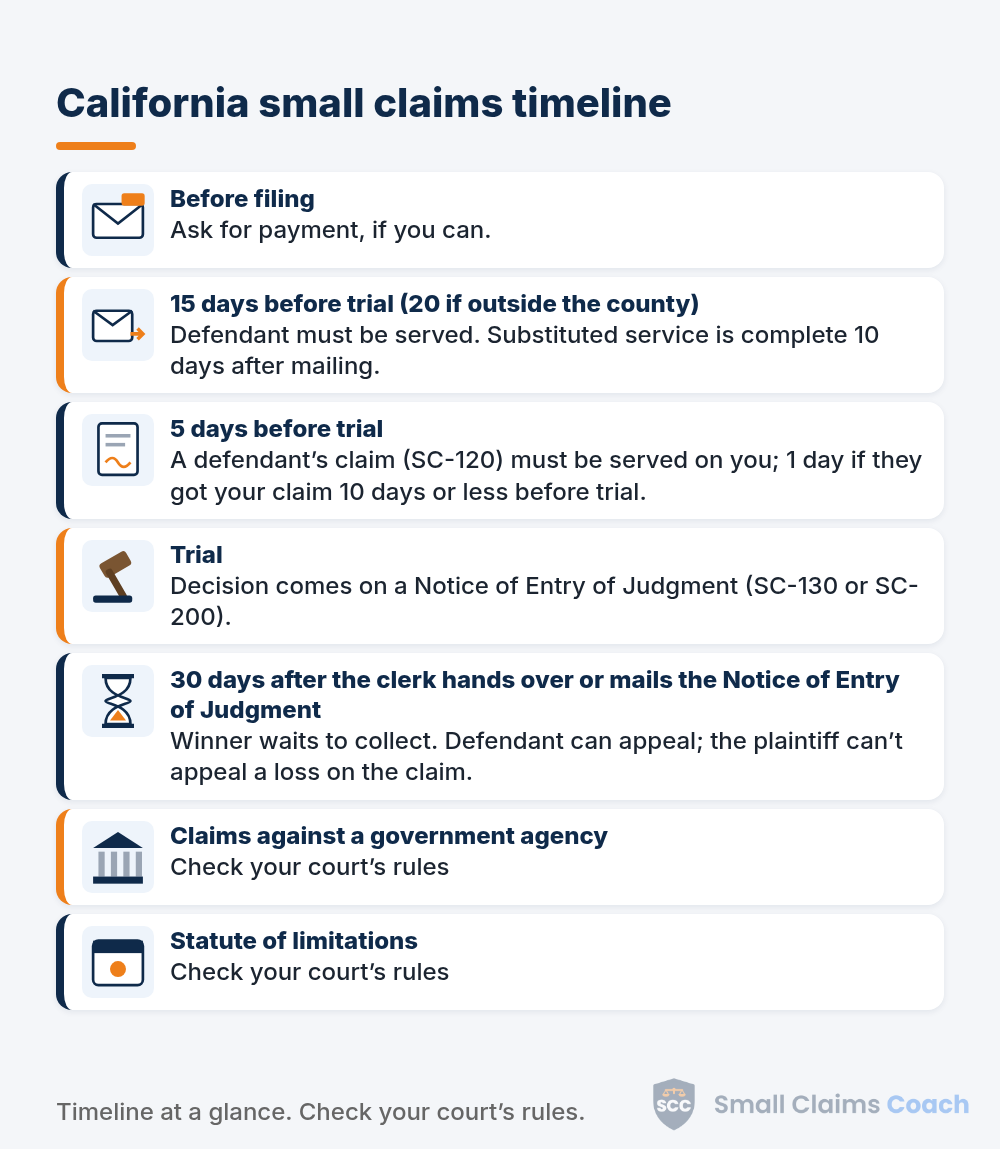
Timeline
| When | What happens |
|---|---|
| Before filing | Ask for payment, if you can. |
| At least 15 days before trial (20 if the defendant is outside the county) | The defendant has to be served. Substituted service is complete 10 days after mailing. |
| At least 5 days before trial | If the defendant files a claim against you (SC-120), they have to serve it on you, or at least 1 day before trial if they got your claim 10 days or less before trial. |
| Trial | The decision comes on a Notice of Entry of Judgment (SC-130 or SC-200). |
| 30 days after the clerk hands over or mails the Notice of Entry of Judgment | The winner has to wait this long before collecting. Within the same 30 days, the defendant can file an appeal. The person who brought the claim can't appeal a loss on it. |
| Claims against a government agency | Before you sue, you generally must file a written claim with the agency: within 6 months for death, injury to a person, or damage to personal property, and within 1 year for most other claims (Gov. Code § 911.2(a)). Check your court's rules if unsure. |
| Statute of limitations | Generally 2 years for personal injury (Code Civ. Proc. § 335.1), 4 years for a written contract (Code Civ. Proc. § 337(a)) and 2 years for an oral contract (Code Civ. Proc. § 339(1)). Other claims can have different deadlines, so check your court's rules if unsure. |
Sources: SC-100-INFO (PDF); California Courts Self-Help Guide: serving the claim; California Courts Self-Help Guide: after the trial; CCP § 116.750; CCP § 116.710(a) (the person who brought the claim can't appeal a loss on it). Checked 2026-10-24.
What's in the California Playbook section
- Part 1: Prep guides that work in any state
- Part 2: California specifics
- Sample filing (made-up example)
- Hearing outline
- California printables
- California day-of plan
- Collecting your California small claims judgment: step-by-step checklist
Want the whole game plan for California? The California Playbook takes you from filing to hearing day: what to gather, how to label your exhibits, a one-page timeline, and a day-of plan for your hearing. One yearly membership covers every state guide. See the Playbook
Small Claims Coach is built to help you handle your case yourself, without a lawyer — but if your situation is complicated, does not fit our samples, or a deadline is close, you may want to call a lawyer.
Small Claims Coach uses public information to build the Playbook, which coaches you as you organize and present your own case. We are not your lawyer, there is no attorney-client relationship, and we don't want the details of your case.
This information is for educational purposes only. It is not legal advice.