
Florida Small Claims Court: Limits, Fees, Forms, and Where to File
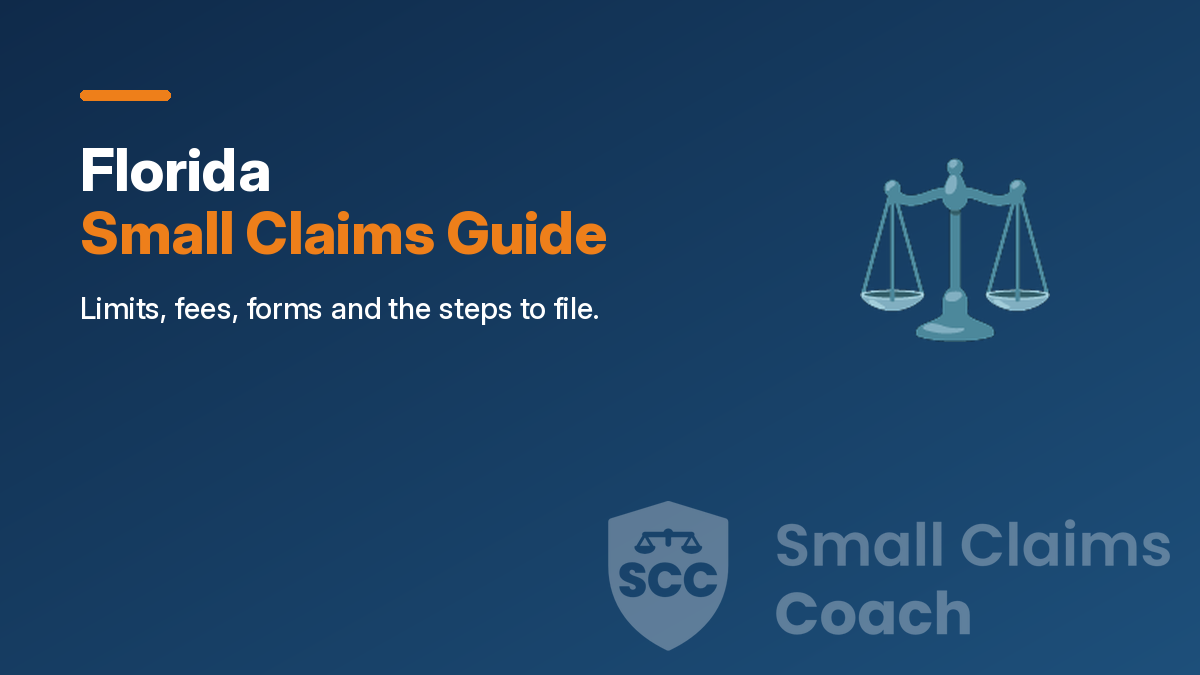
Florida small claims are heard in County Court for claims up to $8,000. Filing fees, the Statement of Claim, where to file, and the pretrial conference.
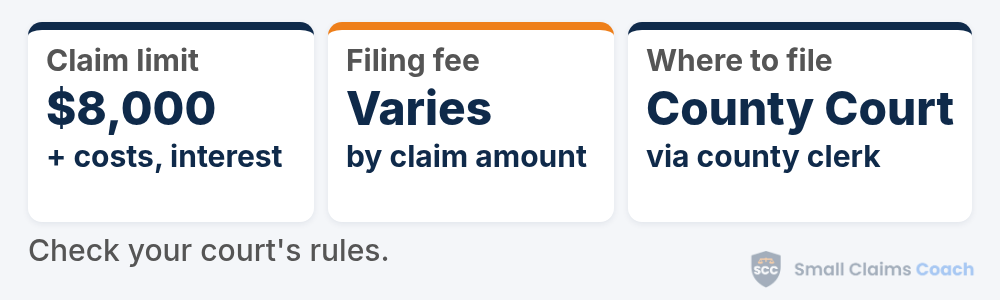
Quick answer: Florida small claims has an $8,000 limit, not counting costs, interest, and attorney's fees. Filing fees set by state law run from $50 to $295 depending on the amount, plus a $4 additional fee (34.041(1)(b)) and $10 per summons; your county clerk may charge more, so check the clerk's fee schedule. You file a Statement of Claim. Check with your county clerk.
Filing in Florida? See a filled-in sample first.
Everything on this page is free. The Small Claims Playbook adds a filled-in sample of Florida's Statement of Claim (Form 7.332, for work done and materials furnished), using a made-up case, with a box-by-box guide. One membership covers every state. $149 for your first year (introductory offer), then $199 a year. Join now.
How small claims works in Florida
Florida small claims are heard in County Court under the statewide Florida Small Claims Rules, with the same limit and the same approved forms in every county. The Clerk of the Circuit Court and Comptroller in each county runs the filing. The state court system warns that forms, fees, and procedure "may vary from county to county," so check with your county clerk. A pretrial conference is set no more than 50 days after filing.
Checked October 2026. Sources: official sources are linked in each section and under Official links below.
What is the small claims limit in Florida?
$8,000, not counting costs, interest, and attorney's fees (Fla. Sm. Cl. R. 7.010(b)). Bigger cases go to County Court under the regular civil rules instead.
How much does it cost to file small claims in Florida?
Filing fees set by Fla. Stat. 34.041(1)(a):
- Under $100: $50
- $100 to $500: $75
- $500 to $2,500: $170
- $2,500 to $8,000 (the small-claims limit): $295
That's plus a $4 additional fee (34.041(1)(b)) and $10 per summons; your county clerk may charge more, so check the clerk's fee schedule. Service by sheriff or certified mail costs extra.
Where do I file a small claim in Florida?
Any of these counties works:
- Where the contract was made
- For an unsecured promissory note, where it was signed or where the maker lives
- To get property back or foreclose a lien, where the property is
- Where the event happened
- Where any defendant lives
- Any place agreed on in a contract
- For money owed with no agreement on where to sue, where payment was due
Some counties set specific filing locations by court order, so check with the clerk.
How to file in Florida: the basic steps
- Write a short Statement of Claim saying why you're owed money and how much. Attach any written document your claim is based on. The clerk has to help you prepare it if you ask.
- File it with the county clerk and pay the fee. Some clerks require it to be notarized if you sign it outside their office or file by mail.
- The clerk issues a summons for a pretrial conference.
- Have the defendant served. For defendants who live in Florida, the clerk can serve by certified mail. If the defendant isn't served within 120 days of filing, the court orders service or dismisses the case without prejudice.
- Go to the pretrial conference, which is set no more than 50 days after filing. Settlement or mediation is often explored there.
- If it doesn't settle, the trial is set no more than 60 days after the pretrial conference.
Ready to do these steps yourself?
Service is the step to watch: if the defendant isn't served within 120 days of filing, the court orders service or dismisses the case without prejudice. The steps above are free. The Playbook helps you do each one, with a filled-in sample of Form 7.332 and every box explained, plus your Florida Playbook section: a step-by-step filing walkthrough with a made-up sample filing, a checklist of what to gather before you file and for the hearing, the steps and deadlines in order, and a talking-point outline for your hearing.
You also get prep guides that work in any state: a document checklist, exhibit labels, a prep timeline and a hearing-day outline. $149 for your first year (introductory offer), then $199 a year. Join now.
Do I need a lawyer for small claims in Florida?
No. If you don't have one, you sign your own papers.
Small claims court by Florida county
The ten largest counties, largest first (2020 Census). Every county uses the same $8,000 limit and statewide rules. Fees are the statewide amounts in Fla. Stat. 34.041: $50–$295 by claim amount, plus a $4 filing fee and $10 per summons; your county clerk may add fees, so check their fee schedule. County guides are coming soon.
| County | Filing fee | Court |
|---|---|---|
| Miami-Dade | $50–$295 + $4 filing fee + $10/summons | County Court (clerk) |
| Broward | $50–$295 + $4 filing fee + $10/summons | County Court (clerk) |
| Palm Beach | $50–$295 + $4 filing fee + $10/summons | County Court (clerk) |
| Hillsborough | $50–$295 + $4 filing fee + $10/summons | County Court (clerk) |
| Orange | $50–$295 + $4 filing fee + $10/summons | County Court (clerk) |
| Duval | $50–$295 + $4 filing fee + $10/summons | County Court (clerk) |
| Pinellas | $50–$295 + $4 filing fee + $10/summons | County Court (clerk) |
| Lee | $50–$295 + $4 filing fee + $10/summons | County Court (clerk) |
| Polk | $50–$295 + $4 filing fee + $10/summons | County Court (clerk) |
| Brevard | $50–$295 + $4 filing fee + $10/summons | County Court (clerk) |
Know your clerk? Next, get your proof in order.
You can present your own case. The Playbook's exhibit-label guide and hearing-day outline help you put your documents in order and explain them clearly, step by step. General legal information, not advice about your case.
Florida small claims FAQ
What is the small claims limit in Florida?
$8,000, not counting costs, interest, and attorney's fees (Fla. Sm. Cl. R. 7.010(b)).
How much does it cost to file small claims in Florida?
Under Fla. Stat. 34.041(1)(a), $50 for claims under $100, $75 for $100–$500, $170 for $500–$2,500, and $295 for $2,500–$8,000, plus a $4 additional fee (34.041(1)(b)) and $10 per summons; your county clerk may charge more, so check the clerk's fee schedule. Service costs extra.
Where do I file small claims in Florida?
In a county where the contract was made, where the event happened, where any defendant lives, or another place the rules allow. Some counties set specific filing locations, so check with the clerk.
What form do I use for small claims in Florida?
A Statement of Claim. The Small Claims Rules include sample forms (Forms 7.330 to 7.337), and most clerks post their own fillable version.
Do I need a lawyer for small claims in Florida?
No. If you don't have one, you sign your own papers. A business needs a lawyer to appeal, and the court may require a lawyer for a business that buys or collects claims as its line of work.
How long does Florida small claims take?
The pretrial conference is set no more than 50 days after filing. If the case doesn't settle, trial is set no more than 60 days after the pretrial conference.
Official links
Related guides: Ready to sue · Just got sued · Small claims court basics · 10 things to do before you sue · How to save text messages as evidence · Sued in small claims? What to do next
Other states: pick your state on the map. Free: the Small Claims Starter Kit (basic timeline and checklists). Go deeper: preview the Playbook.
What's in the Florida Playbook section
- How to file a small claim in Florida, step by step (made-up sample filing)
- Checklist: what to gather before you file and for the hearing
- Timeline: the steps and deadlines in order
- What to expect at your hearing: a talking-point outline
You do the work. The Playbook hands you the plays.
This page covers the Florida rules. The Playbook coaches you from filing to hearing day: a filled-in sample of Form 7.332, your Florida Playbook section, and step-by-step prep guides. Every state and DC has a filled-in sample claim (for Mississippi, Oklahoma and Wyoming it's a sample layout we made, so you'd get the real form from the court clerk). One membership covers every state.
Small Claims Coach is built to help you handle your case yourself, without a lawyer — but if your situation is complicated, does not fit our samples, or a deadline is close, you may want to call a lawyer.
Small Claims Coach uses public information to build the Playbook, which coaches you as you organize and present your own case. We are not your lawyer, there is no attorney-client relationship, and we don't want the details of your case.
This information is for educational purposes only. It is not legal advice.