Can Small Claims Court Make Someone Do Something? What Judges Can Actually Order
Small claims court mostly awards money. When a judge can order property returned or a deal undone, why it varies by state, and how to frame your claim.
You want the deck finished. You want your bike back. You want the neighbor to stop. Most of the time, small claims court won't order any of that. It orders money.
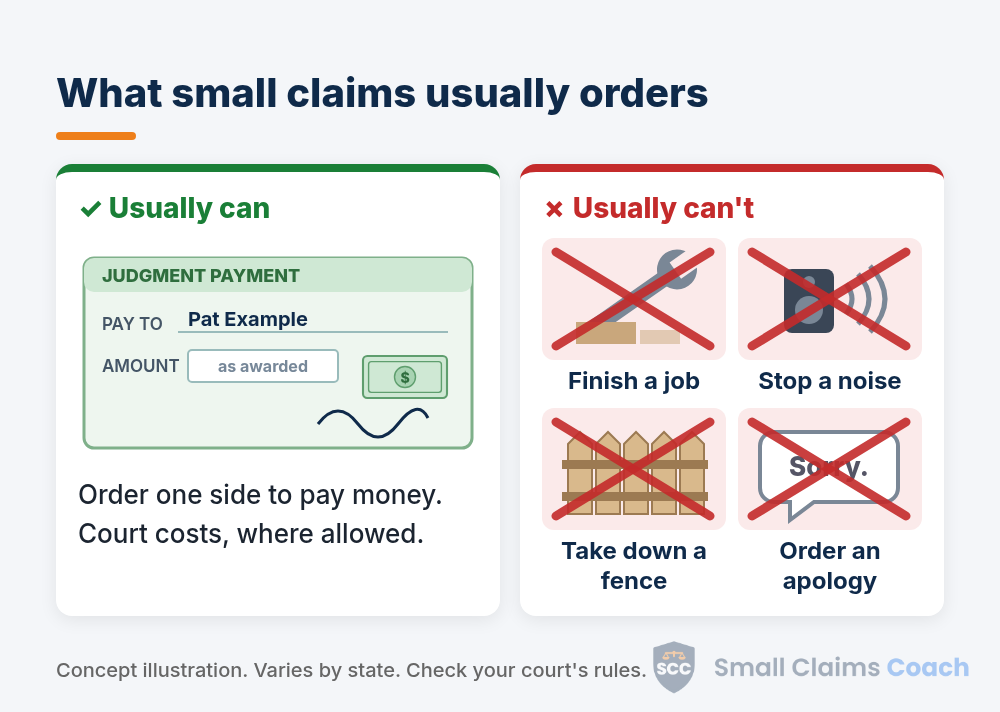
So the short answer is usually no. Small claims court mainly awards money, so you turn what you want (a finished deck, a returned item) into a dollar amount. Some states let judges order property returned, or in California sometimes order a deal undone or done as promised, in limited cases. Check your court's rules.
That surprises a lot of people. The contractor walked off halfway through. The ex-roommate kept your TV. The landlord won't fix the leak. What you want is the thing, not a check.
Here's the part that's hard to hear: in most small claims courts, the judge's main tool is a money judgment. The good news is that money is often enough, and some states give judges a little more room than you'd think. Knowing which kind of court you're in changes how you write your claim.
The quick answer
- Expect a money judgment. Small claims is mainly set up to decide how much one side owes the other.
- Turn what you want into a dollar amount. If you want the deck finished, figure out what it costs to have someone else finish it. Written estimates show where your number came from.
- Check whether your state allows return of property. Some states do, others don't. Check your court's rules.
- Put a value on everything you ask for. Even when you ask for property back, you usually still state what it's worth, and it has to fit your court's limit.
- If you only want an order, small claims may be the wrong court. “Stop the noise” or “tear down the fence” usually belongs in a regular civil court.
Want them to do something, not just pay? Get the full guide.
The full guide is for Playbook members: a 6-step method to turn "I want them to" into a claim, two worked examples (fictional), what proof looks like when you want to undo a deal, a section for when you're the one being sued, and a before-you-file checklist. The Playbook also gives you a filled-in sample of your state's claim form (every state and DC has one; for Mississippi, Oklahoma and Wyoming it's a sample layout we made, so you'd get the real form from the court clerk) and your state's Playbook section. One membership covers every state. $149 for your first year (introductory offer), then $199 a year. Join now.
Why is small claims court usually money only?
Small claims is built to be fast. A judge can look at a receipt and an estimate and decide a number in one hearing. An order to do something is different. Someone has to check whether it got done, and done right. That means more hearings, which small claims is designed to avoid. Ohio's small claims guide, for example, says claims must be for money only and the court can't order someone to return property.
What is equitable relief in small claims?
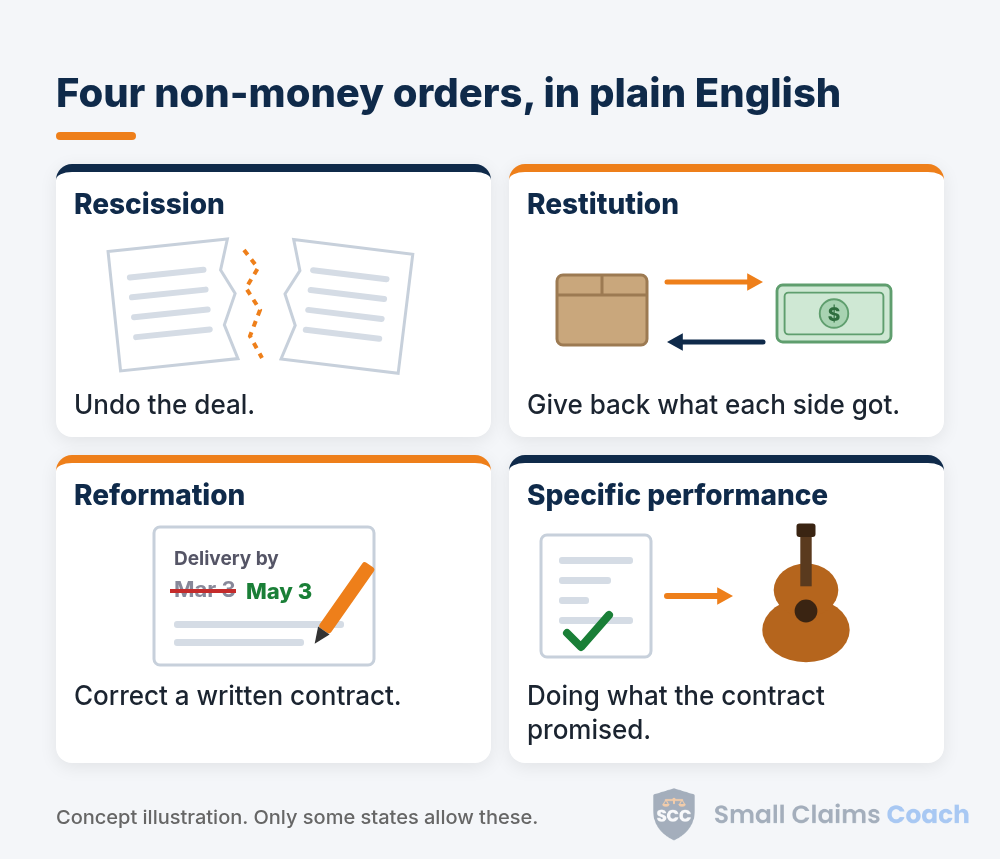
Money damages means the judge says, “Pay this amount.” Equitable relief means the judge orders someone to do something specific because money alone wouldn't be fair. Small claims courts generally don't issue injunctions. Where they have any non-money power, it's narrow and tied to a contract or property dispute. Four terms come up:
Rescission
Undoing a deal.
Restitution
Giving back what each side got.
Reformation
Correcting a written contract to match what both sides agreed.
Can small claims court order specific performance?
Specific performance means doing what the contract promised.
Turning what you want into a claim?
The full guide's 6-step method turns "I want them to" into a claim, with two fictional worked examples. Your state's rules decide what the judge can order. General legal information, not advice about your case.
Can small claims court make someone return property?
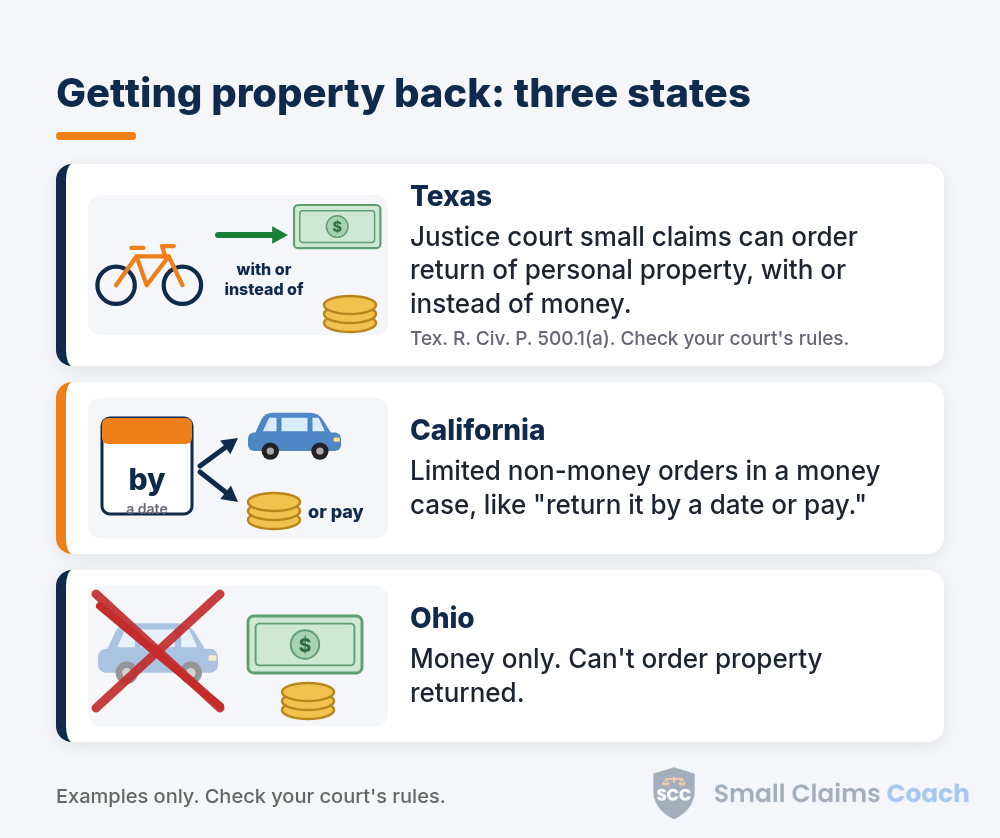
It depends on your state. North Carolina lists cases seeking return of specific personal property, such as a vehicle (G.S. 7A-210(2)). In California, a judge may sometimes issue a conditional judgment in a case about money, ordering something done, or the money paid instead (Cal. Code Civ. Proc. 116.220(b)). Ohio says no. Where return isn't available, you ask for what the item is worth. Other states differ, so check your court's rules.
Texas justice court rules let a small claims case seek money or the return of personal property (Tex. R. Civ. P. 500.1(a)); you list the item and its value (Rule 502.2). If you want an order making someone do something else, the Texas State Law Library says you may need a different court. Check your court's rules.
FAQ
Can small claims court force someone to pay?
A small claims judgment says what's owed, but the court usually doesn't collect it for you. If the other side doesn't pay, you typically use your state's collection steps.
Can small claims court order specific performance?
Usually not. A few states, like California, allow it in limited situations in a case that's also about money.
Can small claims court order something other than money?
In California, yes in some cases. In a case about money, the judge can order specific performance, rescission, restitution or reformation instead of or along with money, and can issue a conditional judgment (Cal. Code Civ. Proc. 116.220(b)). Check your court's rules.
Can small claims court order the return of property?
Some states allow it, like North Carolina. Others, like Ohio, say no. Where it isn't allowed, you ask for the item's value instead.
Can small claims court make a contractor finish the job?
Generally not. You ask for the money it takes to finish or fix the work, usually backed by written estimates from other contractors.
What if I only want them to stop doing something?
That's usually an injunction, and most small claims courts can't issue one. You'd typically need a regular civil court or, for harassment, a protective-order process.
You do the work. The Playbook hands you the plays.
The full guide covers the list above, step by step. Your membership also includes a filled-in sample of your state's claim form and your state's Playbook section, with prep guides that work in any state: a document checklist, exhibit labels, a prep timeline and a hearing-day outline. One membership covers every state.
In the full guide (Playbook members):
- A 6-step method to turn “I want them to” into a claim
- Two worked examples (fictional)
- Undoing a deal: what proof looks like
- If you're the one being sued
- A before-you-file checklist and common mistakes
Small Claims Coach uses public information to coach you as you organize and present your own case. We are not your lawyer, there is no attorney-client relationship, and we don't want the details of your case.