
Colorado small claims Playbook
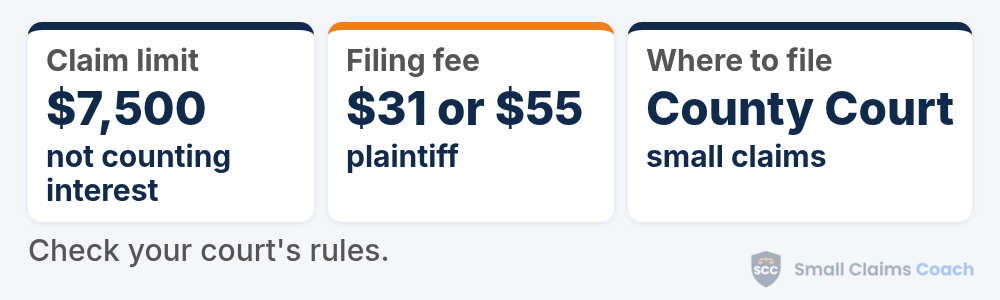
Quick answer: Colorado small claims are a division of each county's County Court, with the same limit, rules, form and fees statewide (Denver County Court runs separately). You can claim up to $7,500, not counting interest or costs, and a plaintiff pays $31 or $55 to file. Lawyers generally can't appear. Either side can appeal to district court within 14 days. Check your court's rules.
How small claims works in Colorado
Colorado has one small claims process statewide. Small claims is a division of each county's County Court. The limit, the rules, the claim form, and the filing fees are the same everywhere. What changes locally is the courthouse, whether that court orders mediation, and the trial date the clerk sets. Denver County Court runs separately from the state court system, so check its forms and fees with that court directly.
Checked on 2026-10-08. Official sources are listed under Sources below.
What is the small claims limit in Colorado?
$7,500, not counting interest or costs. If your claim is bigger, you can give up the amount over $7,500 and stay in small claims, or file in county or district court instead. You can't split one claim into two cases to get under the limit.
Small claims covers things like money owed, contracts, and security deposits and other landlord-tenant disputes. It doesn't handle evictions, libel or slander, traffic, or criminal cases. The full list of exclusions is in C.R.S. § 13-6-403.
Can a business sue in Colorado small claims?
Businesses use the same court, limit, form, fees, and claim caps. Outside lawyers generally can't appear (Rule 520), so a business sends one of its own people.
| Who | Who can appear without a lawyer |
|---|---|
| For-profit corporation | A full-time officer or full-time employee |
| Nonprofit corporation | An elected officer who isn't a lawyer, or an employee |
| Partnership | An active general partner or an authorized full-time employee |
| Association | An active member or a full-time employee |
| Union | An authorized active member or a full-time employee |
| LLC | An active member or full-time employee (Rule 509 covers 'any other kind of organization or entity'); check your court's rules. |
| Landlord | A property manager who took the deposit or rent, or signed the lease for the owner |
A business can't sue on a purchased or assigned claim. If you're suing a business, look up its registered agent on the Colorado Secretary of State site and serve the right person, or the case can be dismissed. Source: Rules 509 and 520, checked 2026-10-08.
Where do I file a small claim in Colorado?
In the county where any defendant lives, works regularly, has a business office, or is a college student when you file. A security deposit dispute can also be filed in the county where the rental property is.
How much does it cost to file small claims in Colorado?
A plaintiff pays $31 for a claim of $500 or less and $55 for $500.01 to $7,500. Certified mail by the clerk: ask the clerk for the cost.
| Who | Claim | Fee |
|---|---|---|
| Plaintiff | $500 or less | $31 |
| Plaintiff | $500.01 to $7,500 | $55 |
| Defendant, no counterclaim | $500 or less | $26 |
| Defendant, no counterclaim | $500.01 to $7,500 | $41 |
| Defendant with a counterclaim | Both the claim and the counterclaim are $500 or less | $31 |
| Defendant with a counterclaim | Either one is more than $500 | $46 |
| Certified mail service by the clerk | Ask the clerk | |
| Sheriff or process server | Ask the sheriff or server |
If you can't afford the fee, ask to file without paying on JDF 205 with a blank JDF 206 order. Source: Colorado Judicial Branch: List of Fees (January 2025), checked 2026-10-08.
Who can sue in Colorado small claims?
- Any person, corporation, partnership, association, or other organization can sue or be sued.
- You can't sue on a claim someone assigned or sold to you. A court-appointed personal representative, conservator, or guardian is the exception.
- You can file no more than two small claims in a county in a month, and no more than 18 in a county in a calendar year.
Sources: Colorado Judicial Branch: Opening a Case; JDF 248, How to Guide to Small Claims; Colorado Rules of Procedure for Small Claims Courts (Rules 501–521). Checked October 2026.
Colorado small claims forms
Start the case with JDF 250, Notice, Claim and Summons to Appear for Trial. Fill in all four parts and don't attach exhibits. Read JDF 248, the court's how-to guide, first. JDF 250 (PDF).
How to file small claims in Colorado: the basic steps
- Check that your claim is within $7,500, isn't an assigned claim, and fits the two-a-month, 18-a-year cap.
- Fill out JDF 250.
- File at the county courthouse and pay the fee. The clerk sets a trial date at least 30 days out.
- Serve each defendant at least 15 days before trial, in person or by certified mail through the clerk.
- The court may order mediation. If you settle, file a stipulation on JDF 75.
- The trial is informal, with no jury and no discovery. A magistrate usually hears it.
Do I need a lawyer for small claims in Colorado?
No. In most cases lawyers can't appear at all. One exception is when the defendant files a notice (JDF 256) at least 7 days before the first trial date that they're bringing a lawyer, and then the plaintiff can use one too.
Small claims court by Colorado county
In every Colorado county, you file at the County Court in the county where any defendant lives, works regularly, has a business office, or is a college student. The ten largest counties, largest first (U.S. Census Bureau, Vintage 2023 estimates):
- El Paso County
- Denver County
- Arapahoe County
- Jefferson County
- Adams County
- Douglas County
- Larimer County
- Weld County
- Boulder County
- Pueblo County
Colorado small claims FAQ
What is the small claims limit in Colorado?
$7,500, not counting interest or costs. With a bigger claim, you can either waive everything above $7,500 and stay in small claims, or file in county or district court. Splitting one claim into two cases to get under the limit isn't allowed.
How much does it cost to file small claims in Colorado?
$31 for a plaintiff's claim of $500 or less, and $55 for $500.01 to $7,500. For certified-mail service by the clerk, ask the clerk what it costs. If you can't afford the fee, you can ask to file without paying on JDF 205.
What form do I use for small claims in Colorado?
Start the case with JDF 250, Notice, Claim and Summons to Appear for Trial. Complete all four parts, and leave exhibits off. Read JDF 248, the court's how-to guide, first.
Do I need a lawyer for small claims in Colorado?
No. Lawyers usually can't appear at all. The exception: if the defendant files a notice (JDF 256), at least 7 days before the first trial date, saying they're bringing a lawyer, the plaintiff can have one too.
Where do I file small claims in Colorado?
Any county where a defendant lives, regularly works, has a business office, or is a college student at the time you file. For a security deposit dispute, the county where the rental property is also works.
Can a business sue in Colorado small claims?
Yes. Businesses use the same court, limit, form, fees, and claim caps as individuals. Because outside lawyers generally can't appear (Rule 520), a business sends one of its own people.
Can I appeal a Colorado small claims judgment?
Yes. Either side can file a notice of appeal and an appeal bond in the small claims court within 14 days after judgment. The district court reviews the record; it isn't a new trial.
Sources
- Colorado Judicial Branch: Opening a Case
- JDF 248, How to Guide to Small Claims (PDF)
- Colorado Rules of Procedure for Small Claims Courts (PDF)
Related guides: Ready to sue · Just got sued · Small claims court basics · 10 things to do before you sue · How to save text messages as evidence · Sued in small claims? What to do next
Small Claims Starter Kit (basic timeline and checklists).
How much should I ask for in Colorado small claims?
Ask for what you can prove: receipts, invoices, estimates and a simple running total. Colorado's small claims limit is $7,500 (JDF 248). If your loss is bigger, you can give up the amount over $7,500 to stay in small claims, but you can't split one claim into two cases. Look closely at your options before filing. Our guide to how much you can sue for in small claims explains the basics, and the damages calculator (free quick total; the itemized version is in your Playbook) helps you add up your numbers.
What's in the Colorado Playbook section
- Who can appear for a business in Colorado?
- Where else can you file in Colorado?
- Small claims courts in Colorado's largest counties
- Filing in person or online
- Serving the defendant: options and fees
- Settling before trial
- How to file a small claim in Colorado, step by step (made-up example)
- Colorado small claims checklist
- Colorado small claims timeline and deadlines
- What to expect at your Colorado small claims hearing
- Appeals in Colorado small claims
- Collecting after you win in Colorado
Want the whole game plan for Colorado? The Small Claims Playbook takes you from filing to hearing day: what to gather, how to label your exhibits, a one-page timeline, and a day-of plan for your hearing. One membership covers all our state guides. See the Playbook
Small Claims Coach is built to help you handle your case yourself, without a lawyer — but if your situation is complicated, does not fit our samples, or a deadline is close, you may want to call a lawyer.
Small Claims Coach uses public information to build the Playbook, which coaches you as you organize and present your own case. We are not your lawyer, there is no attorney-client relationship, and we don't want the details of your case.
This information is for educational purposes only. It is not legal advice.