
New Hampshire Small Claims Court: Limits, Fees, Forms, and Where to File
How small claims works in New Hampshire: the limit, filing fee, forms, where to file, and the basic steps. Checked 2026-10-14.
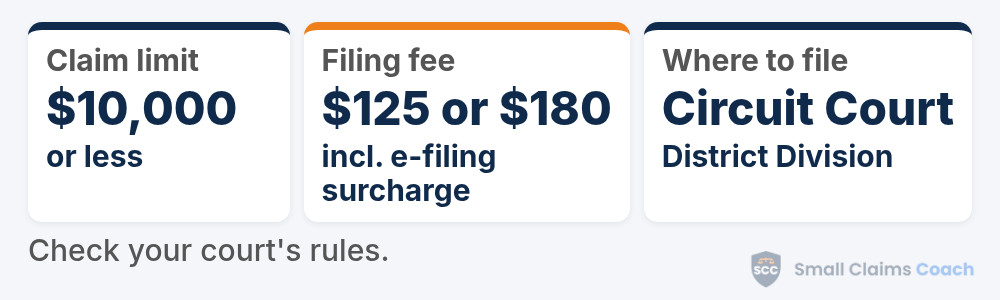
Quick answer: New Hampshire small claims are heard in the District Division of the Circuit Court, for claims of $10,000 or less. E-filing is generally required in small claims; check your court's rules. Filing costs $125 for claims of $5,000 or less and $180 above that, including the e-filing surcharge. Cases over $5,000 go to mandatory mediation. Check your court's rules.
Filing in New Hampshire? See a filled-in sample first.
Everything on this page is free. The Small Claims Playbook adds a filled-in sample of New Hampshire's Small Claim Complaint, e-File Only (NHJB-2370-De), using a made-up case, with a box-by-box guide. One membership covers every state. $149 for your first year (introductory offer), then $199 a year. Join now.
How small claims works in New Hampshire
Small claims is heard in the District Division of the Circuit Court. E-filing is generally required in small claims; check your court's rules.
Checked on 2026-10-14. Official sources are listed under Sources below.
What is the small claims limit in New Hampshire?
$10,000 or less. Cases over $5,000 go to mandatory mediation, and a defendant can ask for a jury if the claim is over $1,500.
How much does it cost to file small claims in New Hampshire?
$105 for claims of $5,000 or less and $160 for $5,001 to $10,000, plus a $20 e-filing surcharge ($125 or $180 total), under Rule 1.28. Check your court's rules for any added fees.
| Item | Amount |
|---|---|
| Filing, claim of $5,000 or less | $105 + $20 e-filing surcharge = $125 |
| Filing, claim of $5,001 to $10,000 | $160 + $20 e-filing surcharge = $180 |
| Counterclaim | Same as filing, by amount |
| Transfer fee (no surcharge) | $145 |
From Circuit Court Rule 1.28. The $20 surcharge is added to each small claims filing fee except the transfer fee.
Where do I file a small claim in New Hampshire?
The District Division court for the town where you or the defendant lives. If unsure, check your court's rules.
How to file in New Hampshire: the basic steps
- Gather the defendant's correct name and address.
- E-file the Small Claim Complaint and pay the fee ($125 or $180 with the surcharge).
- The court mails the complaint to the defendant.
- Go to mediation (required over $5,000) and then the hearing.
Ready to do these steps yourself?
Plan for two things: e-filing is generally required, and cases over $5,000 go to mandatory mediation. The steps above are free. The Playbook helps you do each one, with a filled-in sample of NHJB-2370-De and every box explained, plus your New Hampshire Playbook section: serving the other side, what to expect at your hearing, appeals, collecting a judgment, and a New Hampshire small claims checklist.
You also get prep guides that work in any state: a document checklist, exhibit labels, a prep timeline and a hearing-day outline. $149 for your first year (introductory offer), then $199 a year. Join now.
New Hampshire small claims FAQ
What is the small claims limit in New Hampshire?
$10,000 or less. Cases over $5,000 go to mandatory mediation.
How much does it cost to file small claims in New Hampshire?
$125 for claims of $5,000 or less and $180 for $5,001 to $10,000, including the $20 e-filing surcharge.
Where do I file a small claim in New Hampshire?
The District Division court for the town where you or the defendant lives. E-filing is generally required in small claims; check your court's rules.
Do I need a lawyer for small claims in New Hampshire?
No. Lawyers are allowed. A business may use a lawyer or a non-attorney officer, employee, partner, owner or trustee with written authorization (signed by an authorized official, notarized, and presented to the court under oath; RSA 503:11).
Can I get a jury in New Hampshire small claims?
If the claim is over $1,500, the defendant can ask for a jury trial by checking the box on the Response and filing it by the return date, with the $145 transfer fee. The case then moves to Superior Court (RSA 503:1(III); Rule 4.3(b); Rule 1.28). The statute also mentions 5 business days after filing, so file as early as you can.
Is mediation required in New Hampshire small claims?
Yes, for cases over $5,000.
Can a business sue in New Hampshire small claims?
Yes. A business can be represented by an officer, employee, partner, owner or trustee with written authorization (signed by an authorized official, notarized, and presented to the court under oath; RSA 503:11).
Sources
All checked 2026-10-14.
Related guides: Ready to sue · Just got sued · Small claims court basics · 10 things to do before you sue · How to save text messages as evidence · Sued in small claims? What to do next
Free: the Small Claims Starter Kit (basic timeline and checklists).
What's in the New Hampshire Playbook section
- How to serve the other side in New Hampshire
- What to expect at your New Hampshire small claims hearing
- Appeals in New Hampshire small claims
- Collecting after you win in New Hampshire
- Printable checklist
- Common mistakes and a printable checklist
You do the work. The Playbook hands you the plays.
This page covers the New Hampshire rules. The Playbook coaches you from filing to hearing day: a filled-in sample of NHJB-2370-De, your New Hampshire Playbook section, and step-by-step prep guides. Every state and DC has a filled-in sample claim (for Mississippi, Oklahoma and Wyoming it's a sample layout we made, so you'd get the real form from the court clerk). One membership covers every state.
Small Claims Coach is built to help you handle your case yourself, without a lawyer — but if your situation is complicated, does not fit our samples, or a deadline is close, you may want to call a lawyer.
Small Claims Coach uses public information to build the Playbook, which coaches you as you organize and present your own case. We are not your lawyer, there is no attorney-client relationship, and we don't want the details of your case.
This information is for educational purposes only. It is not legal advice.