
Illinois Small Claims Court: Limits, Fees, Forms, and Where to File
Illinois small claims: money claims up to $10,000 in Circuit Court, statewide forms, county filing fees, e-filing through eFileIL, and the basic steps.
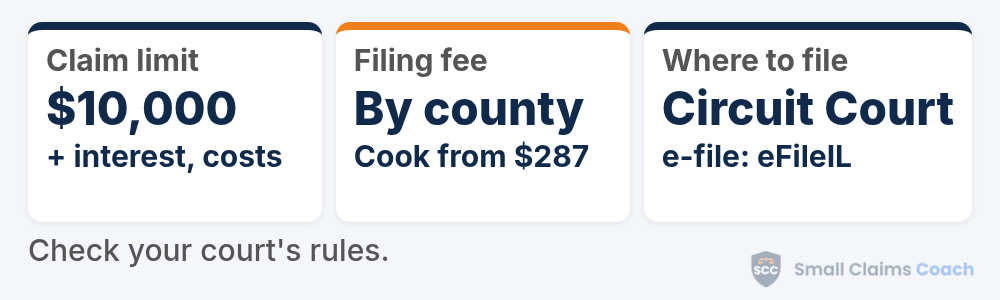
Quick answer: Illinois small claims are for money-only claims of $10,000 or less, not counting interest and costs, heard by the Circuit Court in every county. Each county sets its own filing fee; Cook County charges $287 to $379. Most filers must e-file through eFileIL. Individuals 18 or older don't need a lawyer.
Filing in Illinois? See a filled-in sample first.
Everything on this page is free. The Small Claims Playbook adds a filled-in sample of Illinois's Small Claims Complaint (CS-C 702.4), using a made-up case, with a box-by-box guide. One membership covers every state. $149 for your first year (introductory offer), then $199 a year. Join now.
How small claims works in Illinois
Illinois has one process statewide. Small claims are heard by the Circuit Court in every county, under the same dollar limit, the same Illinois Supreme Court rules, and the same approved forms, which every Illinois court must accept. What changes by county is the filing fee, the courthouse, and some local practice.
Checked October 2026. Sources: official sources are linked in each section and under Official links below.
What is the small claims limit in Illinois?
$10,000 or less, not counting interest and costs (Ill. S. Ct. Rule 281), for contract or injury and damage claims, money only. Cook County's Pro Se Small Claims Court (Chicago, First Municipal District) hears claims up to $3,000.
In the court's words, "The judge cannot require a person or business to do something or stop doing something, or to return property." Tax-collection cases aren't small claims.
How much does it cost to file small claims in Illinois?
Each county board sets its own fee within limits in state law, so check with your county's circuit clerk. The person being sued pays no appearance fee in a small claim. If you can't afford the fee, you can apply for a fee waiver.
Cook County example (fee schedule dated 05/21/26, checked October 2026):
- Small claim up to $2,500: $287
- Small claim over $2,500 (up to the $10,000 limit): $379
Where do I file a small claim in Illinois?
"Generally, you must file in the county where the Defendant lives or where the events of the case happened. For example, where the accident occurred, or where the contract was signed." A business can be sued in any county where it does business or has an office. Filing in the wrong county can get your case dismissed or transferred.
How to file in Illinois: the basic steps
- Try to resolve it first, and think about whether the other side can pay.
- Get the defendant's correct legal name. For a corporation, check the Illinois Secretary of State business database.
- Fill out the Small Claims Complaint. Attach any written contract or lease, or explain why you don't have it. Fill out a summons for each defendant, and ask the circuit clerk for the court date, time, and place to put on it.
- File with the circuit clerk. Illinois requires e-filing through eFileIL unless you qualify for an exemption, such as no home internet and trouble traveling, or trouble reading or speaking English.
- Pay the filing fee or apply for a fee waiver.
- Have each defendant served by circuit clerk certified mail (the cheapest option, per the court), the sheriff, or a special process server.
- Go to your hearing with your documents and witnesses.
Ready to do these steps yourself?
Two steps to get right: most filers must e-file through eFileIL unless they qualify for an exemption, and you fill out a summons for each defendant. The steps above are free. The Playbook helps you do each one, with a filled-in sample of CS-C 702.4 and every box explained, plus your Illinois Playbook section: a step-by-step filing walkthrough with a made-up sample filing, a checklist of what to gather before you file and for the hearing, the steps and deadlines in order, and a talking-point outline for your hearing.
You also get prep guides that work in any state: a document checklist, exhibit labels, a prep timeline and a hearing-day outline. $149 for your first year (introductory offer), then $199 a year. Join now.
Do I need a lawyer for small claims in Illinois?
Not if you're an individual 18 or older. A corporation filing a claim does need one, and people under 18 must have a lawyer. In Cook County's Pro Se Small Claims Court, the person suing has to represent themselves.
Small claims court by Illinois county
The ten largest counties, largest first (2020 Census). Every county uses the same $10,000 limit and statewide forms; each county sets its own fee. Where we haven't confirmed a county's fee, check your court's rules. County guides are coming soon.
| County | Filing fee | Court |
|---|---|---|
| Cook | $287 up to $2,500; $379 over | Circuit Court of Cook County |
| DuPage | Check your court's rules. | Circuit Court |
| Lake | Check your court's rules. | Circuit Court |
| Will | Check your court's rules. | Circuit Court |
| Kane | Check your court's rules. | Circuit Court |
| McHenry | Check your court's rules. | Circuit Court |
| Winnebago | Check your court's rules. | Circuit Court |
| Madison | Check your court's rules. | Circuit Court |
| St. Clair | Check your court's rules. | Circuit Court |
| Champaign | Check your court's rules. | Circuit Court |
Know your county? Next, get your proof in order.
You can present your own case. The Playbook's exhibit-label guide and hearing-day outline help you put your documents in order and explain them clearly, step by step. General legal information, not advice about your case.
Illinois small claims FAQ
What is the small claims limit in Illinois?
$10,000 or less, not counting interest and costs (Ill. S. Ct. Rule 281). Cook County's Pro Se Small Claims Court in Chicago hears claims up to $3,000.
How much does it cost to file small claims in Illinois?
Each county sets its own fee, so check with your circuit clerk. In Cook County (schedule dated 05/21/26), it's $287 up to $2,500 and $379 over $2,500. You can apply for a fee waiver.
What forms do I use for small claims in Illinois?
The statewide Small Claims Complaint (CS-C 702.4) and a Small Claims Summons (CS-S 705.4) for each defendant. Every Illinois court must accept them.
Do I need a lawyer for small claims in Illinois?
Not if you're an individual 18 or older. A corporation filing a claim must be represented by a lawyer. People under 18 must have a lawyer.
Do I have to e-file small claims in Illinois?
Yes, through eFileIL, unless you qualify for an exemption such as no home internet and trouble traveling, or trouble reading or speaking English.
Where do I file small claims in Illinois?
Generally in the county where the defendant lives or where the events happened. A business can be sued in any county where it does business or has an office.
Official links
Related guides: Ready to sue · Just got sued · Small claims court basics · 10 things to do before you sue · How to save text messages as evidence · Sued in small claims? What to do next
Other states: pick your state on the map. Free: the Small Claims Starter Kit (basic timeline and checklists). Go deeper: preview the Playbook.
What's in the Illinois Playbook section
- How to file a small claim in Illinois, step by step (made-up sample filing)
- Checklist: what to gather before you file and for the hearing
- Timeline: the steps and deadlines in order
- What to expect at your hearing: a talking-point outline
You do the work. The Playbook hands you the plays.
This page covers the Illinois rules. The Playbook coaches you from filing to hearing day: a filled-in sample of CS-C 702.4, your Illinois Playbook section, and step-by-step prep guides. Every state and DC has a filled-in sample claim (for Mississippi, Oklahoma and Wyoming it's a sample layout we made, so you'd get the real form from the court clerk). One membership covers every state.
Small Claims Coach is built to help you handle your case yourself, without a lawyer — but if your situation is complicated, does not fit our samples, or a deadline is close, you may want to call a lawyer.
Small Claims Coach uses public information to build the Playbook, which coaches you as you organize and present your own case. We are not your lawyer, there is no attorney-client relationship, and we don't want the details of your case.
This information is for educational purposes only. It is not legal advice.