
Arkansas Small Claims Court: Limits, Fees, Forms, and Where to File
How small claims works in Arkansas: the limit, filing fee, forms, where to file, and the basic steps. Checked 2026-10-08.
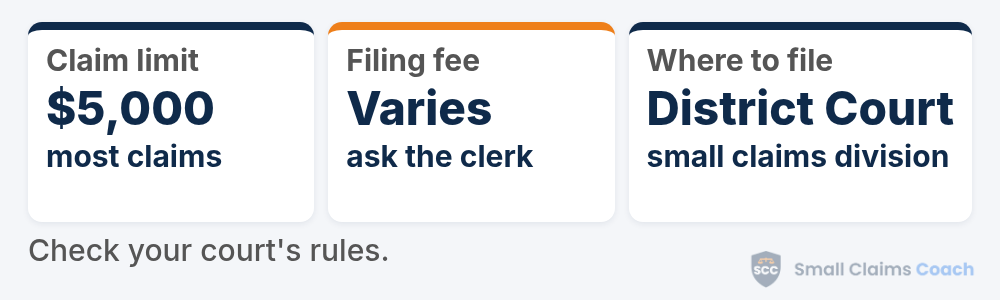
Quick answer: Every Arkansas District Court has a small claims division, with one process statewide. The limit is $5,000. Filing costs vary by court, so ask the clerk. No lawyers are allowed, and collection agencies, assignees and lenders can't file. You can appeal to circuit court within 30 days of judgment. Check your court's rules.
Filing in Arkansas? See a filled-in sample first.
Everything on this page is free. The Small Claims Playbook adds a filled-in sample of the Pulaski County District Court Small Claims Complaint, using a made-up case, with a box-by-box guide. Other district courts may use their own form, so ask the clerk. One membership covers every state. $149 for your first year (introductory offer), then $199 a year. Join now.
How small claims works in Arkansas
Arkansas has one small claims process statewide. Every District Court must have a small claims division. Arkansas Supreme Court Administrative Order No. 18 sets the limit and says who may sue, and District Court Rule 10 sets the procedure and the claim form. What changes locally is which district court covers your area (some are city-only, some countywide, some multi-county), the total filing cost, and the trial date.
Read this first: Arkansas limits who can use small claims
- No lawyers. Only the plaintiff and the defendant can take part. If a party has a lawyer, the case moves to the regular civil docket.
- Some filers are barred. Collection agencies, collection agents, anyone who was assigned a claim, and any business that lends money at interest can't file in small claims.
- Only certain corporations. A corporation can sue or be sued here only if it's organized under Arkansas law, isn't a barred lender or collector, and either has no more than three stockholders, has 85% or more of its voting stock held by people related by blood or marriage (within the third degree), or is closely held by unanimous vote of the shareholders.
- A corporation appears through an officer.
Source: Arkansas Supreme Court Administrative Order No. 18, as quoted in the Arkansas Judiciary's District Court Benchbook; District Court Rule 10.
Checked on 2026-10-08. Official sources are listed under Sources below.
What is the small claims limit in Arkansas?
You can sue for up to $5,000.
| Claim | Limit |
|---|---|
| Contract claims (not counting interest, costs, and attorney's fees) | $5,000 |
| Getting back personal property | Property worth $5,000 or less |
| Damage to personal property (not counting interest and costs) | $5,000 |
Small claims doesn't handle divorce, guardianship, name changes, bankruptcy, or disputes over title to or possession of real estate. If the defendant countersues for more than the limit on a claim that must be brought together with yours, the whole case moves to circuit court.
Sources: Arkansas Judiciary, District Courts; Arkansas Attorney General, Guide to Small Claims Court. Checked 2026-10-08.
Who can sue in Arkansas small claims?
- Anyone 18 or older. A minor can use the court with help from a parent, relative, or "next friend" over 18.
- See the box at the top of this page for who is barred and which corporations qualify.
Where do I file a small claim in Arkansas?
File in the district court whose territory covers the right place. A district can be city-wide, countywide, or cover more than one county. Fayetteville's, for example, covers only the city limits. Contract claims: file where the contract was to be performed or where the defendant lives. Property damage: where the damage happened or where the defendant lives. Other claims: where the defendant lives (Ark. Code § 16-17-706). Ask the clerk which district court covers that place.
How much does it cost to file small claims in Arkansas?
Costs vary from court to court, and service is extra, so we don't show one total. Ask the district court clerk what you'll pay.
| Item | Amount |
|---|---|
| Small claims filing fee | Ask the clerk |
| Court technology fee | Ask the clerk |
| Service by certified mail or the sheriff | Ask the clerk |
How to file small claims in Arkansas: the basic steps
- Check that your claim is $5,000 or less and that you're allowed to file (see the box above).
- Fill out the claim form: both parties, the defendant's address, what the claim is, how much you want, the date it arose, the facts, and your signature and address.
- Take it to the clerk in person and pay the fee.
- The clerk serves the defendant by certified mail, addressee only. You can ask for the sheriff instead. No separate summons is needed.
- The defendant has 30 days after service to file a written answer and mail you a copy.
- After the answer, the court tells you the trial date. Go to the hearing ready to prove your claim.
Ready to do these steps yourself?
You present the case yourself: lawyers aren't allowed in the Arkansas small claims division. The steps above are free. The Playbook helps you do each one, with a filled-in sample of the Pulaski County Small Claims Complaint and every box explained, plus your Arkansas Playbook section: a step-by-step filing walkthrough (made-up example), a Arkansas small claims checklist, the timeline and deadlines, what to expect at your hearing, and collecting a judgment.
You also get prep guides that work in any state: a document checklist, exhibit labels, a prep timeline and a hearing-day outline. $149 for your first year (introductory offer), then $199 a year. Join now.
Can a business sue in Arkansas small claims?
A business that's allowed to file uses the same court, limit, and claim form. No one may bring a lawyer.
| Who | Who can appear for it |
|---|---|
| Qualifying Arkansas corporation (see the box above) | An officer of the corporation |
The corporation rule covers only corporations organized under Arkansas law. If your business is an LLC, a partnership, or an out-of-state corporation, ask the district court clerk before you file.
Do I need a lawyer for small claims in Arkansas?
No. Lawyers aren't allowed in the small claims division. If one appears, the case moves to the regular civil docket.
Small claims court by Arkansas county
In every Arkansas county, you file in the district court whose territory covers your case; some districts are city-only and some cover more than one county. The ten largest counties, largest first (U.S. Census Bureau, Vintage 2023 estimates):
- Pulaski County
- Benton County
- Washington County
- Faulkner County
- Saline County
- Sebastian County
- Craighead County
- Garland County
- White County
- Lonoke County
Know your county? Next, get your proof in order.
You can present your own case. The Playbook's exhibit-label guide and hearing-day outline help you put your documents in order and explain them clearly, step by step. General legal information, not advice about your case.
Arkansas small claims FAQ
What is the small claims limit in Arkansas?
$5,000 for contract claims and for damage to personal property, not counting interest and costs (and attorney's fees for contract claims). You can also get back personal property worth $5,000 or less.
How much does it cost to file small claims in Arkansas?
There's no single statewide total: each court sets its own costs, and service costs extra. Your district court clerk can tell you the amount.
What form do I use for small claims in Arkansas?
District Court Rule 10(a)(1) sets the wording of the claim form, which also includes the summons and the return of service. Rule 10(c) has the answer form. According to the Attorney General's guide, most district court clerks keep complaint forms.
Do I need a lawyer for small claims in Arkansas?
No. The small claims division doesn't allow lawyers, and if a lawyer appears, the case is moved to the regular civil docket.
Where do I file small claims in Arkansas?
Use the district court whose territory covers the right place. Districts vary: some cover one city, some a whole county, and some more than one county. Fayetteville's district, for example, is limited to the city limits.
Can a business sue in Arkansas small claims?
If it's allowed to file, a business uses the same court, limit, and claim form as anyone else, and no one can bring a lawyer.
Can I appeal an Arkansas small claims judgment?
Yes, to circuit court within 30 days of the docket entry awarding judgment (District Court Rule 9). You'll pay another filing fee and may have to post a bond.
Sources
- Arkansas Judiciary, District Courts
- Arkansas District Court Rules, including Rules 9 and 10
- Arkansas Attorney General, Guide to Small Claims Court
Related guides: Ready to sue · Just got sued · Small claims court basics · 10 things to do before you sue · How to save text messages as evidence · Sued in small claims? What to do next
Free: the Small Claims Starter Kit (basic timeline and checklists).
What's in the Arkansas Playbook section
- How to file a small claim in Arkansas, step by step (made-up example)
- Arkansas small claims checklist
- Arkansas small claims timeline and deadlines
- What to expect at your Arkansas small claims hearing
- If you can't make it
- Collecting after you win in Arkansas
- Common mistakes and a printable checklist
You do the work. The Playbook hands you the plays.
This page covers the Arkansas rules. The Playbook coaches you from filing to hearing day: a filled-in sample of the Pulaski County Small Claims Complaint, your Arkansas Playbook section, and step-by-step prep guides. Every state and DC has a filled-in sample claim (for Mississippi, Oklahoma and Wyoming it's a sample layout we made, so you'd get the real form from the court clerk). One membership covers every state.
Small Claims Coach is built to help you handle your case yourself, without a lawyer — but if your situation is complicated, does not fit our samples, or a deadline is close, you may want to call a lawyer.
Small Claims Coach uses public information to build the Playbook, which coaches you as you organize and present your own case. We are not your lawyer, there is no attorney-client relationship, and we don't want the details of your case.
This information is for educational purposes only. It is not legal advice.