
Alaska Small Claims Court: Limits, Fees, Forms, and Where to File
How small claims works in Alaska: the limit, filing fee, forms, where to file, and the basic steps. Checked 2026-10-12.
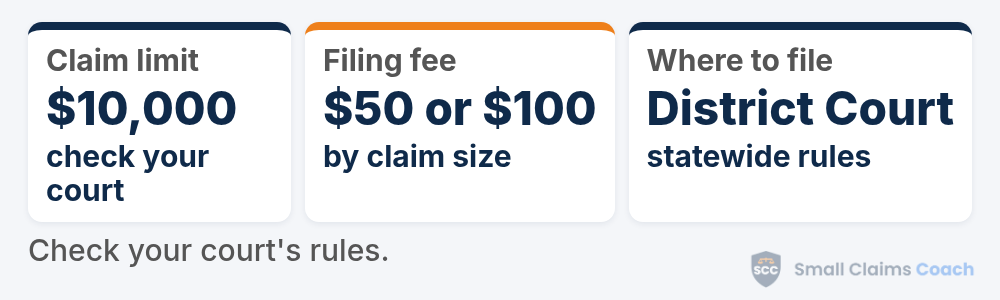
Quick answer: Alaska small claims are a simplified procedure in the District Court, with one set of rules, fees and forms statewide. The limit is $10,000, not counting costs, interest and attorney fees. Filing costs $50 for claims of $2,500 or less and $100 above that. Check your court's rules.
Filing in Alaska? See a filled-in sample first.
Everything on this page is free. The Small Claims Playbook adds a filled-in sample of Alaska's Small Claims Complaint (SC-1), using a made-up case, with a box-by-box guide. One membership covers every state. $149 for your first year (introductory offer), then $199 a year. Join now.
How small claims works in Alaska
The unified Alaska Court System runs small claims in the District Court under one statute, one set of Small Claims Rules, one statewide fee schedule and one set of SC-series forms and Handbook (SC-100) for every court location. Only the courthouse location changes.
Court name: District Court for the State of Alaska — small claims. There is no separately named "small claims court"; small claims is a simplified procedure inside District Court.
Checked on 2026-10-12. Official sources are listed under Sources below.
Does small claims work the same everywhere in Alaska?
- Not county-style. Alaska has no county courts; the same rules, forms and fees apply at every District Court / magistrate location.
- One real difference: who hears the case. A magistrate judge can't hear a small claim if the papers were served on the defendant outside Alaska, except for out-of-state landlords and nonresident drivers or vehicle owners in Alaska accidents. A district court judge can hear small claims against any out-of-state defendant.
What is the small claims limit in Alaska?
$10,000, "exclusive of costs, interest, and attorney fees". Exception: the Department of Labor and Workforce Development can bring wage claims as small claims up to $20,000.
- Over $10,000: you can still use small claims, but you waive anything over $10,000 in principal; interest and costs can go over the cap.
- Small claims needs everyone's agreement. Small claims court can only be used if all parties agree to use this simplified procedure. The defendant can opt into formal rules (Part I) within the answer deadline, and the plaintiff can do the same after a counterclaim. Either way, the case stops being a small claim.
- The judge must hear it as a small claim unless important or unusual points of law are involved or the state is a defendant. The court can also order formal rules for difficult questions.
- Excluded: disputes over title to real property, recovering possession of real property, evictions, claims against the State of Alaska or the U.S. government, injunctions, and actions to foreclose or enforce liens.
- Multiple claims can be joined only while the total stays within the limit. Counterclaims are capped at $10,000 in small claims.
How much does it cost to file small claims in Alaska?
| Item | Fee |
|---|---|
| Small claims filing, claim $2,500 or less | $50.00 |
| Small claims filing, claim more than $2,500 | $100.00 |
| Removal from small claims to district/superior court | no additional filing fee |
| Appeal to superior court from small claims | $100.00 (vs. $250 other district-court appeals) |
| Writ of execution | $25.00 |
| Process server | set by the server; max recoverable as costs $45 per person served (plus extra mileage/time) |
- Fee waiver: Request for Exemption from Payment of Fees (TF-920).
- Certified-mail service: you pay the post office directly.
Where do I file a small claim in Alaska?
File at a place that won't cause the defendant unnecessary expense or inconvenience, and at least one of these must be true:
- the court is the one nearest where the defendant lives or works;
- it's where the defendant caused personal injury or property damage;
- for a business, it's anywhere the business does or solicits business.
The defendant can ask to move the trial in the answer. The plaintiff has 20 days to oppose using form SC-5, and the court decides. Find your court in the Court directory.
How to file in Alaska: the basic steps
- Pick the court nearest where the defendant lives or works, where the injury or damage happened, or, for a business, where it does business.
- Fill out SC-1 Complaint and SC-2 Summons (one per defendant), plus a blank-topped SC-3 Answer.
- File and pay $50 (claims of $2,500 or less) or $100, or ask for a fee exemption on TF-920.
- You serve each defendant by certified mail (restricted delivery, return receipt) or a process server, within 120 days, and file an Affidavit of Service (SC-4).
- The defendant has 20 days after service to answer (40 if served outside the U.S.).
- The court mails a trial notice at least 15 days ahead. There's no jury.
- Either side can appeal to superior court within 30 days of the date on the judgment's distribution certificate (AP-100, $100). The appeal reviews the record; it isn't a new trial.
Ready to do these steps yourself?
Easy to miss: an appeal to superior court reviews the record. It isn't a new trial. The steps above are free. The Playbook helps you do each one, with a filled-in sample of SC-1 and every box explained, plus your Alaska Playbook section: serving the other side, what to expect at your hearing, appeals, and collecting a judgment.
You also get prep guides that work in any state: a document checklist, exhibit labels, a prep timeline and a hearing-day outline. $149 for your first year (introductory offer), then $199 a year. Join now.
Do I need a lawyer for small claims in Alaska?
No. You don't need a lawyer, but you can hire one; attorney fees awarded to a winner are capped at $1,000. Only lawyers or legal interns can represent another person, and a power of attorney doesn't let you represent someone.
A lawyer may be worth a call if your case is complicated, the other side has one, or a deadline is close.
Can a business sue in Alaska small claims?
Yes. Partnerships, LLCs, corporations and other groups can file. An officer or an employee with written permission can represent the business at every stage, including appeal, AS 22.20.040 notwithstanding. Who signs: an officer or authorized employee for a corporation, a managing member or authorized employee for an LLC, and a general partner for a partnership.
For an unincorporated association, a person authorized in writing by its charter, bylaws or governing body signs. The written authorization must be filed with the complaint, and the signer's title must be listed. On the Complaint (SC-1), a corporate plaintiff checks a box stating it has paid its taxes due the state and filed its required reports.
Assigned claims need a lawyer. Anyone suing on an assigned claim (for example a collection agency or debt buyer) must be represented at every stage by a lawyer or legal intern. Otherwise the court dismisses the case.
Alaska small claims forms and official help
Self-help. Handbook SC-100: Alaska Small Claims Handbook (SC-100) (Aug. 2021 edition — check for a newer one). Info sheet SC-95. Forms. Forms used to start a case: SC-1 Complaint, SC-2 Summons (one per defendant), SC-3 Answer (fill in only the caption; serve it on the defendant blank). The complaint, summons and answer forms are mandatory.
- Other SC forms (forms index): SC-4 Affidavit of Service; SC-5 Plaintiff's Response to Request for Change of Place of Trial; SC-8 Default Affidavit and Request for Judgment; SC-9 Dismissal; SC-13 Default Judgment; SC-17 Satisfaction of Judgment; SC-18 Stipulation to Pay Judgment in Installments; SC-23 Continuance; SC-24 Set Aside Default; SC-25 Agreement that Judgment be Entered; SC-26/27 Request and Response; SC-31 Telephonic Participation.
- Clerks and magistrates may help prepare complaints, answers and service forms. They first refer you to the Handbook and will write the form for you only if you can't read or write English or physically can't write.
Small claims court by Alaska borough
Alaska has no counties, so this list uses boroughs and census areas. You file at the District Court location nearest the defendant; see the court directory. The ten largest boroughs and census areas, largest first (U.S. Census Bureau, Vintage 2023 estimates):
- Anchorage Municipality
- Matanuska-Susitna Borough
- Fairbanks North Star Borough
- Kenai Peninsula Borough
- Juneau City and Borough
- Bethel Census Area
- Ketchikan Gateway Borough
- Kodiak Island Borough
- North Slope Borough
- Nome Census Area
Know your court? Next, get your proof in order.
You can present your own case. The Playbook's exhibit-label guide and hearing-day outline help you put your documents in order and explain them clearly, step by step. General legal information, not advice about your case.
Alaska small claims FAQ
What is the small claims limit in Alaska?
$10,000, not counting costs, interest and attorney fees. Check your court's rules.
How much does it cost to file small claims in Alaska?
$50 for claims of $2,500 or less, and $100 for claims over $2,500. You can ask for a fee exemption on form TF-920.
Where do I file small claims in Alaska?
At a place that won't cause the defendant unnecessary expense or inconvenience, such as the court nearest where the defendant lives or works.
Do I need a lawyer for small claims in Alaska?
You don't need a lawyer, but you can hire one. Only lawyers or legal interns can represent another person.
How long does the defendant have to answer in Alaska?
20 days after service, or 40 days if served outside the U.S.
How long do I have to appeal in Alaska small claims?
30 days from the date on the judgment's distribution certificate, to the superior court. The fee is $100.
Is there a jury in Alaska small claims?
No. A judge or magistrate judge decides the case.
Sources
- Small Claims - Alaska Court System
- Alaska Small Claims Handbook, SC-100, August 2021, incl. Appendix A statute + District Court Civil Rules 8–22
- Small Claims Information Sheet SC-95, rev. 4/21
- AS 22.15.040, Alaska Statutes 2025
- Current District Court Rules of Civil Procedure, Part II Small Claims Rules 8–22
- Alaska Rules of Administration, Rule 9 fee schedule
- Appellant Instructions: District Court to Superior Court Appeals, AP-200, April 2025
- Debt Collection - Collecting a Debt - Alaska Court System
- Execution Procedure: Judgment Creditor Booklet CIV-550
- Forms by Topic & Number (J - Z) - Alaska Court System
All checked 2026-10-12.
Related guides: Ready to sue · Just got sued · Small claims court basics · 10 things to do before you sue · How to save text messages as evidence · Sued in small claims? What to do next
Free: the Small Claims Starter Kit (basic timeline and checklists).
What's in the Alaska Playbook section
- How to serve the other side in Alaska
- What to expect at your Alaska small claims hearing
- Appeals in Alaska small claims
- Collecting after you win in Alaska
- Common mistakes and a printable checklist
You do the work. The Playbook hands you the plays.
This page covers the Alaska rules. The Playbook coaches you from filing to hearing day: a filled-in sample of SC-1, your Alaska Playbook section, and step-by-step prep guides. Every state and DC has a filled-in sample claim (for Mississippi, Oklahoma and Wyoming it's a sample layout we made, so you'd get the real form from the court clerk). One membership covers every state.
Small Claims Coach is built to help you handle your case yourself, without a lawyer — but if your situation is complicated, does not fit our samples, or a deadline is close, you may want to call a lawyer.
Small Claims Coach uses public information to build the Playbook, which coaches you as you organize and present your own case. We are not your lawyer, there is no attorney-client relationship, and we don't want the details of your case.
This information is for educational purposes only. It is not legal advice.