
Virginia small claims Playbook
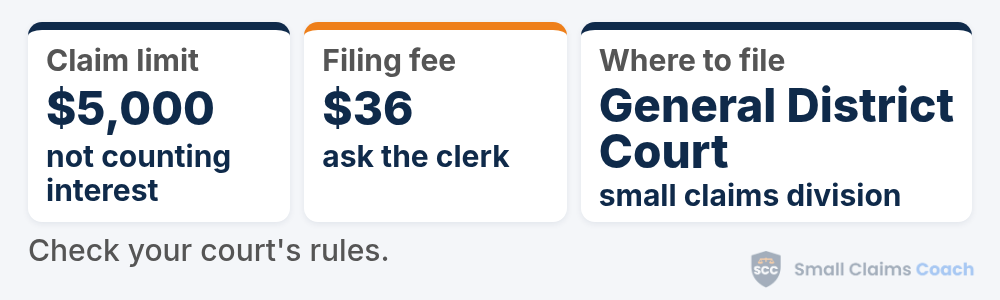
Quick answer: Virginia small claims go to the small claims division of the General District Court in the right city or county, for claims up to $5,000, not counting interest. To sue for money you file a Warrant in Debt (DC-402). The state's base court fee is $36; a sheriff's service fee is $12 per person served (Va. Code § 17.1-272); local add-ons vary by court, so ask the clerk for your total. Everyone represents themselves.
How small claims works in Virginia
Virginia has one process statewide. Every General District Court has a small claims division, called small claims court, with the same limit, rules, and state forms. To sue for money you file a Warrant in Debt. What changes locally is which city or county court you use and the total cost to file and serve.
Checked October 2026. Sources: official sources are linked in each section and under Official links below.
What is the small claims limit in Virginia?
- Money (Warrant in Debt): $5,000, not counting interest.
- Getting property back (Warrant in Detinue): property worth up to $5,000.
- Counterclaims: up to $5,000 (Va. Code § 16.1-122.3(F)).
You can't sue the Commonwealth of Virginia under the Virginia Tort Claims Act, or state officers and employees for their official duties (Va. Code § 16.1-122.1).
Sources: Va. Code § 16.1-122.2; Virginia Court Self-Help: Small Claims.
How much does it cost to file small claims in Virginia?
$36 base fee (Va. Code § 16.1-69.48:2), plus a $12 sheriff's service fee per person served (Va. Code § 17.1-272) and any local add-ons; ask the clerk for your total. Fees have to be paid in cash, by certified check, or by money order.
Where do I file a small claim in Virginia?
File in the General District Court of the right city or county. Under Virginia's general venue law (Va. Code § 8.01-262), that includes where the defendant lives or has its main place of work or business, where it has a registered office or agent, where it regularly does substantial business (if the case has a practical connection to that place, such as witnesses or evidence there), or where the problem happened. Find the court in the General District Court directory.
Virginia small claims forms
- DC-402 Warrant in Debt, Small Claims Division (instructions), for money
- DC-404 Warrant in Detinue, Small Claims Division, for property
How to file in Virginia: the basic steps
- Find the defendant's correct name and street address (no P.O. boxes). For a business using an assumed name, check the fictitious name statement at the local circuit court clerk. For a corporation or LLC, get its registered agent from the State Corporation Commission (Va. Code § 8.01-299).
- Fill out DC-402 (money) or DC-404 (property): the original for the court, a copy for each defendant, and a copy for you.
- File with the General District Court clerk and pay the filing and service fees.
- The clerk sends the warrant to the sheriff to serve, or you can use a private process server.
- Your trial happens on the first court date unless there's good reason to postpone (Va. Code § 16.1-122.3(E)).
Who can speak in court in Virginia small claims?
All parties represent themselves. A business can be represented by an owner, partner, officer, member or employee. A lawyer can appear only for themselves, or for a defendant who wants to move the case to general district court, which a defendant can do any time before the judge decides. If the judge finds a party can't understand or take part in the hearing on their own, a friend or relative who knows the facts and isn't a lawyer can represent them (Va. Code § 16.1-122.4).
Businesses: a corporation, partnership, LLC or other business uses the same court, limit, forms and fees. The chief judge can limit how many cases one person sets for trial on the same day (Va. Code § 16.1-122.3).
Small claims court by Virginia county
The ten largest localities, largest first (Census Bureau Vintage 2024 population estimates). Virginia's independent cities are separate from counties and have their own General District Courts. Every court uses the same $5,000 limit and state forms; the total cost varies, so check your court's rules. County guides are coming soon.
| Locality | Type | Where to file |
|---|---|---|
| Fairfax | County | General District Court, small claims division |
| Prince William | County | General District Court, small claims division |
| Virginia Beach | City | General District Court, small claims division |
| Loudoun | County | General District Court, small claims division |
| Chesterfield | County | General District Court, small claims division |
| Henrico | County | General District Court, small claims division |
| Chesapeake | City | General District Court, small claims division |
| Arlington | County | General District Court, small claims division |
| Richmond | City | General District Court, small claims division |
| Norfolk | City | General District Court, small claims division |
Virginia small claims FAQ
What is the small claims limit in Virginia?
$5,000, not counting interest, for money (Warrant in Debt). Property worth up to $5,000 (Warrant in Detinue), and counterclaims up to $5,000 (Va. Code § 16.1-122.3(F)).
How much does it cost to file small claims in Virginia?
The state's base court fee for a civil warrant in district court is $36 (Va. Code § 16.1-69.48:2). Sheriff service is $12 per person served (Va. Code § 17.1-272). Local add-ons vary by court, so ask the clerk for the total.
What form do I use for small claims in Virginia?
DC-402 Warrant in Debt, Small Claims Division, for money. DC-404 Warrant in Detinue, Small Claims Division, for property.
Do I need a lawyer for small claims in Virginia?
In Virginia small claims, everyone represents themselves, and a business can be represented by an owner, general partner, officer, member or employee. A lawyer can appear only for themselves, or for a defendant who wants to move the case to general district court (Va. Code § 16.1-122.4).
Where do I file small claims in Virginia?
In the General District Court of the right city or county, including where the defendant lives or does business, where it has a registered agent, or where the problem happened (Va. Code § 8.01-262).
Can a business sue in Virginia small claims?
Yes. A business can be represented by an owner, a general partner, an officer, a member, or an employee, not a lawyer.
Official links
- Virginia Court Self-Help: Small Claims
- Va. Code § 8.01-299 (serving a corporation or LLC through its registered agent)
Related guides: Ready to sue · Just got sued · Small claims court basics · 10 things to do before you sue · How to save text messages as evidence · Sued in small claims? What to do next
Other states: pick your state on the map. Small Claims Starter Kit (basic timeline and checklists). Go deeper: preview the Playbook.
What's in the Virginia Playbook section
- Suing or being sued as a business in Virginia: the details
- How much should I ask for in Virginia small claims?
- Where to file in Virginia
- Serving the defendant: options and fees
- How to file a small claim in Virginia, step by step (made-up example)
- Virginia small claims checklist
- Virginia small claims timeline and deadlines
- What to expect at your Virginia small claims hearing
- Collecting after you win in Virginia
Want the whole game plan for Virginia? The Virginia Playbook takes you from filing to hearing day: what to gather, how to label your exhibits, a one-page timeline, and a day-of plan for your hearing. One yearly membership covers every state guide. See the Playbook
You can handle your case yourself, but if it's complicated, doesn't fit our samples, or a deadline is close, consider calling a lawyer.
Small Claims Coach uses public information to build the Playbook, which coaches you as you organize and present your own case. We are not your lawyer, there is no attorney-client relationship, and we don't want the details of your case.
This information is for educational purposes only. It is not legal advice.