
North Carolina Small Claims Playbook: Filing, Service, Hearing and Collecting
Home › States › North Carolina
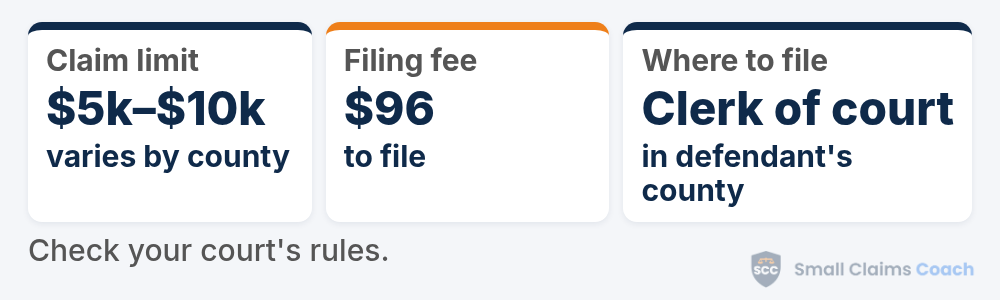
Quick answer: North Carolina small claims are part of District Court, and a magistrate hears the case. The limit varies by county under local rules, from $5,000 to $10,000, so ask your county clerk. Filing costs $96. You file with the clerk of superior court in the county where a defendant lives, the trial is set within 30 days, and either side has 10 days to appeal.
Checked October 2026. Sources: official sources are linked in each section and under Official links below.
What is the small claims limit in North Carolina?
The limit varies by county under local rules, from $5,000 to $10,000. Ask your county clerk for the local limit.
- Claims above that limit, up to $25,000, go to district court.
- Small claims can handle money, recovery of personal property worth up to $10,000, and evictions (summary ejectment).
Sources: NC Judicial Branch small claims help; G.S. 7A-210; G.S. 7A-305 (costs).
How much does it cost to file small claims in North Carolina?
- Filing fee: $96 ($80 court fee + $12 facilities fee + $4 court technology fee, G.S. 7A-305).
- Sheriff service: $30 per person served.
- Certified mail service: postage; check your court's rules.
If you can't afford the costs, use the Petition to Proceed as an Indigent (form AOC-G-106).
Where do I file a small claim in North Carolina?
The clerk of superior court's office in the county where at least one defendant lives. Small claims has no other venue options. Find your clerk on the NC court locations page.
How to file in North Carolina: the basic steps
- Confirm your county's limit with the clerk.
- Fill out the complaint and write "Small Claim" on it.
- Bring 3 copies of the complaint, 3 Magistrate Summons (top part), the servicemembers affidavit, and $96 to the clerk of superior court.
- The clerk issues the summons and sets the trial within 30 days.
- Arrange service by the sheriff ($30) or certified mail.
- Go to trial before the magistrate.
- Either side has 10 days to appeal. After that, you can collect.
Do I need a lawyer for small claims in North Carolina?
Many people represent themselves in small claims, and the process is designed to be accessible to people without a lawyer. Clerks and magistrates can't give legal advice. A business can be represented by a non-attorney authorized agent, such as an owner or employee (NC Judicial Branch, Small Claims help page). For anything else about representation, check your court's rules.
A lawyer may be worth a call if your case is complicated, the other side has one, or a deadline is close.
Small claims court by North Carolina county
The ten largest counties, largest first. In every county you file with the clerk of superior court; confirm the local limit and address with the clerk. Check your court's rules. County guides are coming soon.
| County | Where to file |
|---|---|
| Wake | Clerk of Superior Court, Wake County Courthouse |
| Mecklenburg | Clerk of Superior Court, Mecklenburg County Courthouse, 832 East Fourth St, Charlotte, (704) 686-0400 |
| Guilford | Clerk of Superior Court |
| Forsyth | Clerk of Superior Court |
| Cumberland | Clerk of Superior Court |
| Durham | Clerk of Superior Court |
| Buncombe | Clerk of Superior Court |
| Union | Clerk of Superior Court |
| Cabarrus | Clerk of Superior Court |
| Gaston | Clerk of Superior Court |
North Carolina small claims FAQ
What is the small claims limit in North Carolina?
It varies by county under local rules, from $5,000 to $10,000. Ask your county clerk for the local limit. Claims above that limit, up to $25,000, go to district court.
How much does it cost to file small claims in North Carolina?
$96 to file ($80 court fee, $12 facilities fee and $4 court technology fee). Sheriff service is $30 per person served.
Where do I file a small claim in North Carolina?
With the clerk of superior court in the county where at least one defendant lives.
When is the trial in North Carolina small claims?
The clerk sets the trial within 30 days, and a magistrate hears the case.
How long do I have to appeal in North Carolina small claims?
Either side has 10 days after the judgment to appeal to district court.
Do I need a lawyer for small claims in North Carolina?
Many people represent themselves in small claims, and the process is designed to be accessible to people without a lawyer. Clerks and magistrates can't give legal advice.
Can a business use a non-lawyer in North Carolina small claims?
Yes. According to the NC Judicial Branch, a business can be represented by a non-attorney authorized agent, such as an owner or employee.
Official links
Related guides: Ready to sue · Just got sued · Small claims court basics · 10 things to do before you sue · How to save text messages as evidence · Sued in small claims? What to do next
Other states: pick your state on the map. Small Claims Starter Kit (basic timeline and checklists). Go deeper: preview the Playbook.
What's in the North Carolina Playbook section
- Can a business sue in North Carolina small claims?
- How much should I ask for in North Carolina small claims?
- Where to file in North Carolina
- North Carolina small claims forms and fees
- Serving the defendant: options and fees
- How to file a small claim in North Carolina, step by step (made-up example)
- North Carolina small claims checklist
- North Carolina small claims timeline and deadlines
- What to expect at your North Carolina small claims hearing
- Appeals in North Carolina small claims
- Collecting after you win in North Carolina
Want the whole game plan for North Carolina? The North Carolina Playbook takes you from filing to hearing day: what to gather, how to label your exhibits, a one-page timeline, and a day-of plan for your hearing. One yearly membership covers every state guide. See the Playbook
You can handle your case yourself, but if it's complicated, doesn't fit our samples, or a deadline is close, consider calling a lawyer.
Small Claims Coach uses public information to build the Playbook, which coaches you as you organize and present your own case. We are not your lawyer, there is no attorney-client relationship, and we don't want the details of your case.
This information is for educational purposes only. It is not legal advice.