
Kansas Small Claims Playbook: Filing, Service, Hearing and Collecting
Quick answer: Kansas small claims are heard in the District Court, for money or property worth $10,000 or less, not counting interest and costs. Lawyers generally can't represent anyone before judgment, there's no jury, and either side has 14 days to appeal. Filing fees: the Kansas Self-Help page lists $47.50 or $67.50, but check your court's rules before you pay.
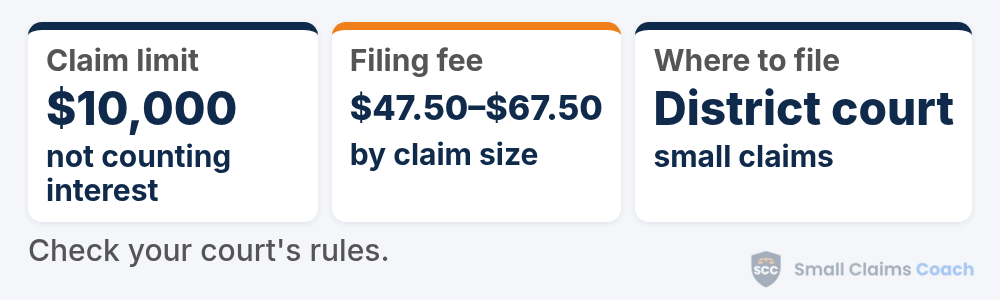
How small claims works in Kansas
The Small Claims Procedure Act is an alternative procedure inside District Court for limited civil actions statewide. Judicial Council forms and the Self-Help fee schedule apply everywhere; local district court pages add clerk Coach's Tips and sheriff fees.
Court name: Small Claims / small claims court in the District Court (Self-Help; Judicial Council).
Checked on 2026-10-12. Official sources are listed under Sources below.
Does small claims work the same everywhere in Kansas?
- Clerk practice: hearing scheduling, how the sheriff is paid, and packet contents vary by district.
- County add-on fees: Johnson County adds $1.50 and Sedgwick County adds $2.00 on top of the listed totals.
- Limit, docket-fee statute, no-lawyer rule, 14-day appeal and Judicial Council forms are statewide.
What is the small claims limit in Kansas?
You can sue for up to $10,000, not counting interest and costs.
- $10,000 or less for money or personal property, not counting interest, costs and damages under K.S.A. 60-2610.
- You can't bring assigned claims, subrogation claims, or claims on a debt owed to someone else unless you're a full-time employee or officer of the creditor.
- If a claim is over the limit, the court may dismiss it without prejudice, let you amend it to give up the excess, or convert it to a general district court case if it fits there.
How much does it cost to file small claims in Kansas?
| Item | Amount |
|---|---|
| Small claims ≤ $500 (total, Kansas Self-Help) | $47.50 |
| Small claims $500.01–$10,000 (total, Kansas Self-Help) | $67.50 |
| Statutory docket fee ≤ $500 | $35 |
| Statutory docket fee > $500 | $55 |
| Johnson County add-on | +$1.50 |
| Sedgwick County add-on | +$2.00 |
- The docket fee is the only cost the law requires to file. Sheriff service is usually paid separately; check your court's rules.
- Later court costs (hearing in aid of execution, writ of execution, garnishment) are listed in the Playbook section.
- Can't afford the fee? File a Poverty Affidavit to ask for a waiver.
Can a business sue in Kansas small claims?
- Yes, a company can file.
- A company generally can't use a lawyer before judgment; a full-time employee or officer who isn't a lawyer appears for it. If another party uses a lawyer, everyone else may hire one too (K.S.A. 61-2714).
- Assigned claims and third-party debt collectors generally cannot use small claims.
- Each person or business can file no more than 20 small claims a year in the same court.
Where do I file a small claim in Kansas?
File in a county allowed by the usual venue rules.
- The usual venue rules (Chapter 61, Article 34) apply, except that the county where the claim arose works only if it's shown the defendant lived in that county when the claim arose.
- To find your court, use Kansas Self-Help's “Find My District Court.”
How to file in Kansas: the basic steps
- Find your court with Kansas Self-Help "Find My District Court."
- Use the Judicial Council filing set, including the Petition, Summons and Request for Service.
- Sign the petition (usually before a notary or the clerk) and file it with the fee, or a Poverty Affidavit to ask for a waiver.
- The clerk issues the summons, and the sheriff often serves it; sheriff fees are separate. Check your court's rules.
- Go to the hearing. The judge decides; there's no jury and no discovery.
- Either side can file a notice of appeal within 14 days after judgment, for a new trial before a different judge.
- If you win, mail the judgment and a blank Statement of Assets to the other side within 14 days and file proof of mailing.
Who can sue in Kansas small claims?
- A “person” includes an individual, partnership, LLC, corporation, fiduciary, joint venture, society, organization or other association.
- Self-Help: you present your own case; “You cannot be represented by a lawyer unless the other party is a lawyer.”
- By statute, no party may use a lawyer before judgment, except as K.S.A. 61-2714 allows. A party may appear through a full-time employee, officer or other representative who is not a lawyer.
- Under K.S.A. 61-2714, if any party is represented by a lawyer or former lawyer, or a lawyer represents themself, all other parties may hire a lawyer too, and the court may grant one continuance so they can.
Kansas small claims FAQ
What is the small claims limit in Kansas?
$10,000 or less, for money or personal property, not counting interest and costs (K.S.A. 61-2703).
How much does it cost to file small claims in Kansas?
The statutory docket fee is $35 up to $500 and $55 above that, and Kansas Self-Help lists totals of $47.50 and $67.50 with surcharges. Johnson and Sedgwick counties add a little more. Confirm the current amount with your clerk; check your court's rules.
How many small claims can I file in Kansas?
No more than 20 in the same court in a calendar year (K.S.A. 61-2704).
Do I need a lawyer for small claims in Kansas?
No. Generally no one may be represented by a lawyer before judgment, unless another party uses one.
Can a debt collector use Kansas small claims?
Generally no. Assigned claims and claims on a debt owed to someone else (unless the filer is the creditor's full-time employee or officer) aren't small claims.
How long do I have to appeal in Kansas small claims?
14 days after the judgment is entered. The appeal is a new trial before a different district judge.
Is there a jury in Kansas small claims?
No. The judge decides the case, and there's no discovery.
Sources
- Small Claims - Kansas Self-Help
- District Court Filing Fees - Kansas Self-Help
- Kansas Judicial Council Small Claims forms hub
- Judicial Council filing forms list
- K.S.A. 61-2703, Definitions; small claim, amount
- Kansas Statutes 61-2704
- K.S.A. 61-2705, Pleadings
- K.S.A. 61-2706, Claims exceeding scope of the small claims jurisdiction of the court
- K.S.A. 61-2707, Trial of action; exclusion of attorneys; appearance by others in a representative capacity
- Kansas Statutes 61-2708
- K.S.A. 61-2709, Appeals
- K.S.A. 61-2713, Forms
- Kansas Statutes 61-2714
- Kansas Secretary of State | Publications | Session Laws of Kansas | 2026 Session Laws of Kansas | Chapter 35: House Bill 2393
- Kansas 6th Judicial District - KS Courts
- Small Claims - Kansas Self-Help
All checked 2026-10-12.
Related guides: Ready to sue · Just got sued · Small claims court basics · 10 things to do before you sue · How to save text messages as evidence · Sued in small claims? What to do next
Small Claims Starter Kit (basic timeline and checklists).
What's in the Kansas Playbook section
- Suing or being sued as a business in Kansas: the details
- How much should I ask for in Kansas small claims?
- Where to file in Kansas
- Kansas small claims forms and fees
- Serving the defendant: options and fees
- How to file a small claim in Kansas, step by step (made-up example)
- Kansas small claims checklist
- Kansas small claims timeline and deadlines
- What to expect at your Kansas small claims hearing
- Appeals in Kansas small claims
- Collecting after you win in Kansas
Want the whole game plan for Kansas? The Kansas Playbook takes you from filing to hearing day: what to gather, how to label your exhibits, a one-page timeline, and a day-of plan for your hearing. One yearly membership covers every state guide. See the Playbook
Small Claims Coach is built to help you handle your case yourself, without a lawyer — but if your situation is complicated, does not fit our samples, or a deadline is close, you may want to call a lawyer.
Small Claims Coach uses public information to build the Playbook, which coaches you as you organize and present your own case. We are not your lawyer, there is no attorney-client relationship, and we don't want the details of your case.
This information is for educational purposes only. It is not legal advice.