
Georgia Small Claims Playbook: Filing, Service, Hearing and Collecting
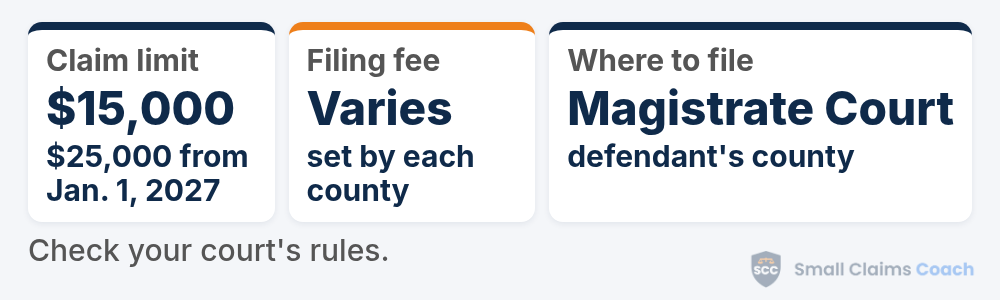
Quick answer: Georgia small claims go to the county Magistrate Court, for claims of $15,000 or less for cases filed through Dec. 31, 2026, and $25,000 or less for cases filed on or after Jan. 1, 2027 (O.C.G.A. 15-10-2, as amended by HB 999). Each county sets its own filing and service fees. The defendant has 30 days to answer, and you don't need a lawyer.
How small claims works in Georgia
In Georgia, small claims cases go to the Magistrate Court of the county, for claims of $15,000 or less for cases filed through Dec. 31, 2026, and $25,000 or less for cases filed on or after Jan. 1, 2027 (O.C.G.A. 15-10-2, as amended by HB 999). Magistrate courts are county courts, so each county sets its own filing and service fees, filing method and local forms. The limit and the 30-day answer deadline are statewide. There's no jury: a judge decides.
Checked October 2026. Sources: official sources are linked in each section and under Official links below.
What is the small claims limit in Georgia?
Limit: $15,000 or less for cases filed through Dec. 31, 2026; $25,000 or less for cases filed on or after Jan. 1, 2027 (O.C.G.A. 15-10-2, as amended by HB 999).
- If the defendant's counterclaim is more than the magistrate court can hear, the case moves to a higher court (O.C.G.A. 15-10-45).
- Magistrate court can't order prejudgment attachment.
- Heads-up: The new limit applies by filing date; cases filed before Jan. 1, 2027 stay under the $15,000 limit.
Sources: Gwinnett Magistrate Court civil filing (quotes O.C.G.A. 15-10-2, -41, -43); Fulton County Magistrate Court small claims; HB 999 signed act (Act 707, signed 05/12/2026), Section 4(b); Georgia General Assembly 2026 summary of acts (legis.ga.gov).
How much does it cost to file small claims in Georgia?
Each county sets its own filing and service fees, so ask your county's magistrate court clerk for the total before you file. Payment rules vary too: DeKalb, for example, doesn't take personal checks or cards. If you can't afford the fee, ask the clerk about a Pauper's Affidavit.
Where do I file a small claim in Georgia?
- The magistrate court of the county where the defendant lives.
- A corporation: the county of its registered office or agent. Look it up with the Secretary of State business search.
- An unincorporated business: the county where it's physically located.
- Filed in the wrong county? Ask the judge to transfer it. There's no transfer fee, but the new county may charge its own fees.
How to file in Georgia: the basic steps
- Check that the claim is $15,000 or less ($25,000 or less if filed on or after Jan. 1, 2027) and pick the right county.
- Get the defendant's exact name and street address. For a business, find its registered agent.
- File a sworn Statement of Claim with the county magistrate clerk, or e-file where your county allows it.
- Pay the county filing and service fees, or file a Pauper's Affidavit.
- The sheriff, marshal, constable or an appointed adult serves the defendant.
- The defendant has 30 days to answer. If they don't, they're in default, but they get 15 more days to answer and pay costs. After that, you can ask for a default judgment.
- After an answer, the hearing is set 15 to 30 days after notice. Mediation may be offered first.
Do I need a lawyer for small claims in Georgia?
No. You can bring or defend a claim in magistrate court yourself, or hire a lawyer at your own expense. A business uses the same process: an employee can represent a corporation or other entity (O.C.G.A. 15-10-43(i)). Some counties require a form naming the business's agent, such as Fulton's Rule 31 Designation of Agent for Business Entity; elsewhere, check your court's rules.
A lawyer may be worth a call if your case is complicated, the other side has one, or a deadline is close.
Sources: DeKalb Magistrate Court FAQ; Fulton County Magistrate Court; Gwinnett Magistrate Court.
Small claims court by Georgia county
The ten largest counties, largest first (Census 2024 estimates). Every county uses the same limit ($15,000 for cases filed through Dec. 31, 2026; $25,000 for cases filed on or after Jan. 1, 2027) and 30-day answer deadline; each county sets its own fees, so check your court's rules. County guides are coming soon.
| County | Court |
|---|---|
| Fulton | Fulton County Magistrate Court, 185 Central Ave SW, Suite TG-100, Atlanta. E-filing (eFileGA) or courthouse public terminals required. |
| Gwinnett | Gwinnett County Magistrate Court |
| Cobb | Cobb County Magistrate Court. E-filing through eFlex. |
| DeKalb | DeKalb County Magistrate Court. No personal checks or cards. |
| Chatham | Chatham County Magistrate Court, Savannah |
| Clayton | Clayton County Magistrate Court, Harold R. Banke Justice Center, 9151 Tara Blvd, Jonesboro |
| Cherokee | Cherokee County Magistrate Court |
| Forsyth | Forsyth County Magistrate Court |
| Henry | Henry County Magistrate Court. E-filing: check your court's rules. |
| Hall | Hall County Magistrate Court |
Georgia small claims FAQ
What is the small claims limit in Georgia?
Limit: $15,000 or less for cases filed through Dec. 31, 2026; $25,000 or less for cases filed on or after Jan. 1, 2027 (O.C.G.A. 15-10-2, as amended by HB 999), in the county Magistrate Court. The new limit applies by filing date; cases filed before Jan. 1, 2027 stay under the $15,000 limit.
How much does it cost to file small claims in Georgia?
Each county sets its own filing and service fees, so check with your county's magistrate court clerk. If you can't afford the fee, ask about a Pauper's Affidavit.
Where do I file a small claim in Georgia?
In the magistrate court of the county where the defendant lives. Sue a corporation in the county of its registered office or agent, and an unincorporated business where it's physically located.
How long does the defendant have to answer in Georgia?
The defendant has 30 days to answer. If they don't, they're in default, but they get 15 more days to answer and pay costs. After that, you can ask for a default judgment.
When is the hearing in Georgia small claims?
After the defendant answers, the hearing is set 15 to 30 days after notice. Mediation may be offered first.
Do I need a lawyer for small claims in Georgia?
No. You can bring or defend a claim in magistrate court yourself, or hire a lawyer at your own expense. An employee can represent a corporation or other entity.
Official links
Related guides: Ready to sue · Just got sued · Small claims court basics · 10 things to do before you sue · How to save text messages as evidence · Sued in small claims? What to do next
Other states: pick your state on the map. Small Claims Starter Kit (basic timeline and checklists). Go deeper: preview the Playbook.
What's in the Georgia Playbook section
- How much should I ask for in Georgia small claims?
- Who can appear for a business in Georgia
- Where to file in Georgia
- Georgia small claims forms and fees
- Serving the defendant: options and fees
- How to file a small claim in Georgia, step by step (made-up example)
- Georgia small claims checklist
- Georgia small claims timeline and deadlines
- What to expect at your Georgia small claims hearing
- Appeals in Georgia small claims
- Collecting after you win in Georgia
Want the whole game plan for Georgia? The Georgia Playbook takes you from filing to hearing day: what to gather, how to label your exhibits, a one-page timeline, and a day-of plan for your hearing. One yearly membership covers every state guide. See the Playbook
Small Claims Coach is built to help you handle your case yourself, without a lawyer — but if your situation is complicated, does not fit our samples, or a deadline is close, you may want to call a lawyer.
Small Claims Coach uses public information to build the Playbook, which coaches you as you organize and present your own case. We are not your lawyer, there is no attorney-client relationship, and we don't want the details of your case.
This information is for educational purposes only. It is not legal advice.