
New York Small Claims for Businesses: Commercial Claims
Suing a business, or suing as one, in New York small claims: Small Claims Part vs Commercial Claims Part, limits by court, demand letter and 5-a-month cap.
Home › States › New York › Business
New York Small Claims for Businesses: Commercial Claims
Checked October 2026. Official sources are linked in each section and under Official links below.
New York has two paths. People sue in the Small Claims Part. Businesses that want to sue use commercial claims, heard in the Commercial Claims Part of the court (often called "commercial small claims court"). This page walks you through both.
Small Claims Part or Commercial Claims: which one fits your case?
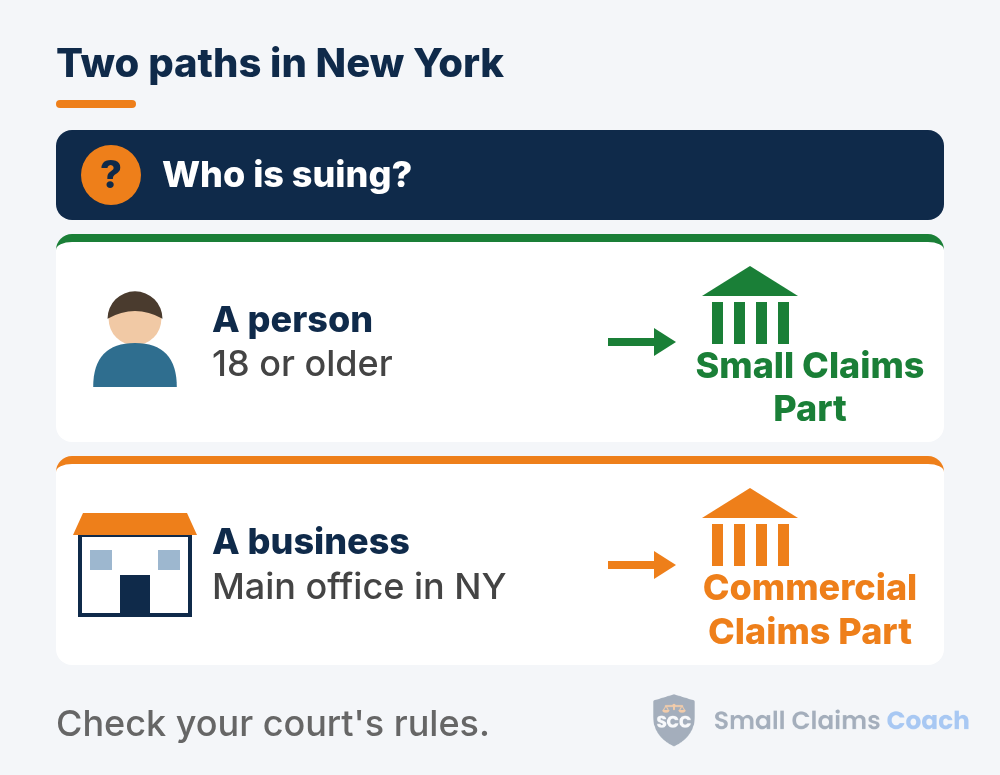
Ask one question first: who is suing?
- A person 18 or older files in the Small Claims Part. That's true even when the person is suing a business.
- A corporation, partnership, association, LLC or assignee files a commercial claim instead.
Coach's Tip: Pick your path before you pick your form. Courts use separate forms for small claims and commercial claims.
Suing a business in New York? See a filled-in sample first.
Everything on this page is free. The Small Claims Playbook adds a filled-in sample of the NYC Civil Court Statement of Claim for Small Claims (CIV-SC-50), using a made-up case, with a box-by-box guide. Outside New York City, get the claim form from that court's clerk. Businesses filing in NYC use the Commercial Claims form (CIV-SC-70). $149 for your first year (introductory offer), then $199 a year. Join now.
See what's in the PlaybookWho can file a commercial claim in New York
The state court guide says: "Any corporation, partnership, or association that has its principal office in New York State, or an assignee of any commercial claim, may file a commercial small claim." It adds that "corporation" includes municipal corporations, public benefit corporations, LLCs and PLLCs.
The key words are principal office in New York. If your business's main office is out of state, this path isn't open to it. Ask the court clerk or check your court's rules.
Who can appear for the business. A partner can appear for a partnership. For a corporation, an authorized officer, director or employee can appear, and an employee may need written authorization from an officer or director. A lawyer isn't required. If both sides have lawyers, the case may be moved to regular civil court.
Which court: NYC Civil Court, District Court, City Court or Town and Village Court
New York's small claims cases run through four kinds of trial courts. Where the case goes depends on where the defendant is.
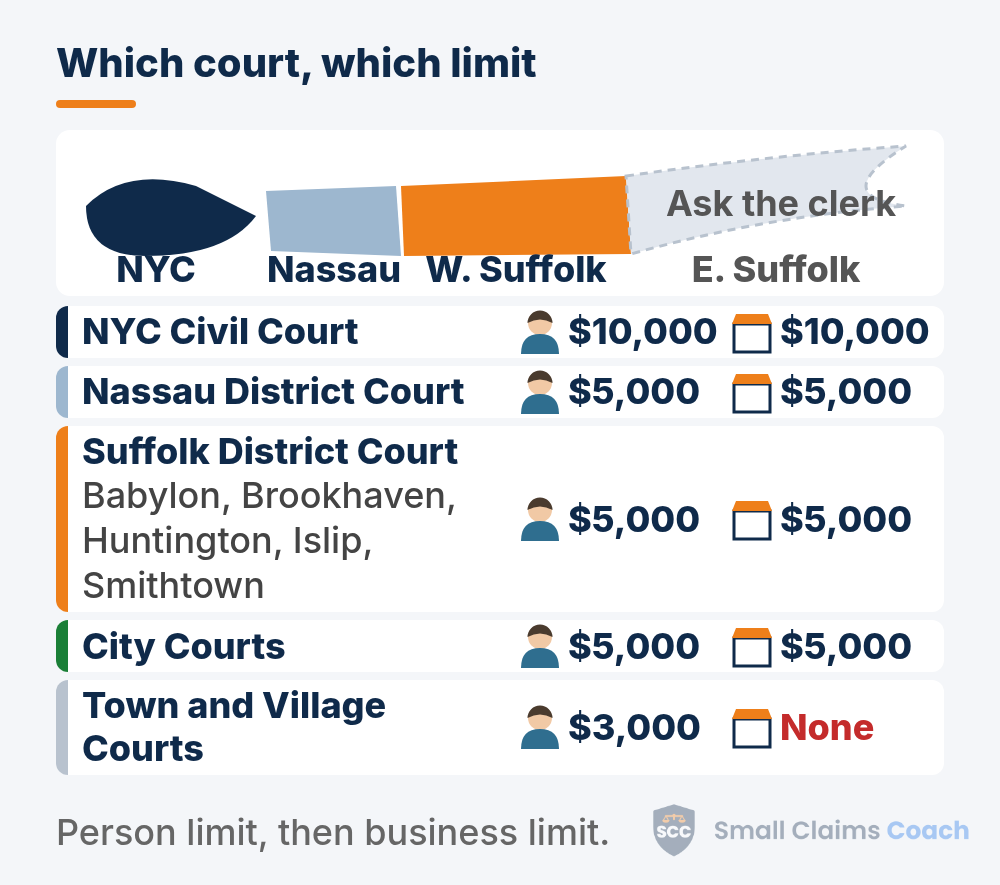
Limits by court (person = Small Claims Part; business = commercial claim):
- NYC Civil Court (five boroughs): person $10,000 · business $10,000
- City Courts (cities outside NYC): person $5,000 · business $5,000
- Nassau County District Court: person $5,000 · business $5,000
- Suffolk County District Court (western Suffolk; see below): person $5,000 · business $5,000
- Town and Village Courts: person $3,000 · business: not available
District Court covers Nassau County and parts of Suffolk County. In Suffolk, District Court hears cases where the defendant lives, works or does business in the five western towns. Suffolk District Court's commercial claim form is the Complaint Form (DC-283). Its demand letter form is UCS-124 / DC-292, and its certification form is UCS-119 / DC-293.
Buffalo City Court uses the City Court Small Claims Universal Claim Form; commercial claims cost $25 plus postage for each respondent.
Town and Village Courts don't hear commercial claims. A business can't use them for this path.
Coach's Tip: Don't split one debt into two cases to fit under a limit. The state court guide says, "You cannot split your claim into smaller claims to get around the limit."
Commercial claim rules: five claims a month, the certification and the filing fee
Three rules apply to every commercial claim:
- Five a month. A business can file no more than five commercial claims statewide in one calendar month.
- Certification. When it files, the business certifies that it's within that cap.
- Fee. In City Courts outside NYC, the fee is $25 per claim, plus postage. Other courts set the fee by their own schedule or by the number of mailings, so ask the court clerk.
The business starts the case by filing a statement of claim with the court's commercial claims office.
Service: In City Courts, if the first-class copy of the notice isn't returned within 30 days, the court treats the defendant as served.
Consumer transactions: the demand letter (10 to 180 days before filing)
A consumer transaction is a commercial claim against an individual over goods or services bought mainly for personal, family or household use.
For these claims, the business must mail a demand letter first. It has to go out at least 10 days, and no more than 180 days, before the case begins. The business then certifies that it mailed the letter. The court has a demand letter form.
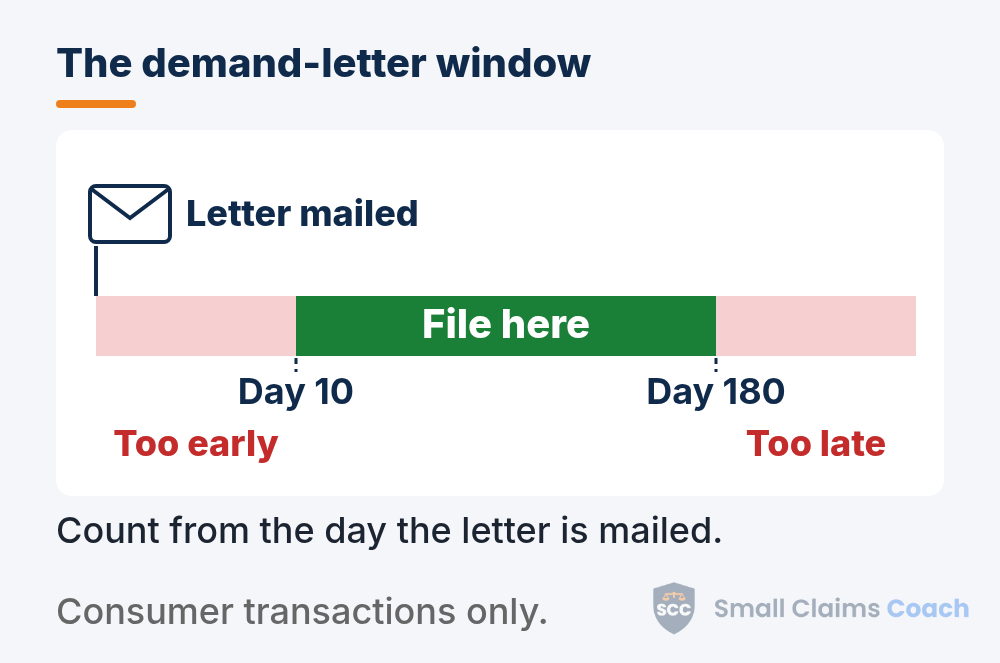
Coach's Tip: Keep proof of the mailing date. That date is what the 10-to-180-day window counts from.
Suing a business as an individual
If you're a person 18 or older, you file in the Small Claims Part, for money only. In NYC Civil Court, get the claim form from the court's small claims forms page.
Before you file:
- Get the business's correct name. The name on a sign isn't always the legal name.
- File in the right court for where the business is, using the list above.
Limits and local steps differ by court, so ask the court clerk.
Being sued by a business: counterclaims and your hearing
If a business sues you, you can answer at the hearing, and you can bring a counterclaim if the business owes you money. Bring your receipts, contracts, messages and photos. For deadlines and fees on counterclaims, ask the court clerk.
Coach's Tip: If it's a consumer transaction, ask whether the business mailed the demand letter on time. That's one of its filing requirements.
Judge or arbitrator: who decides, and appeal rights
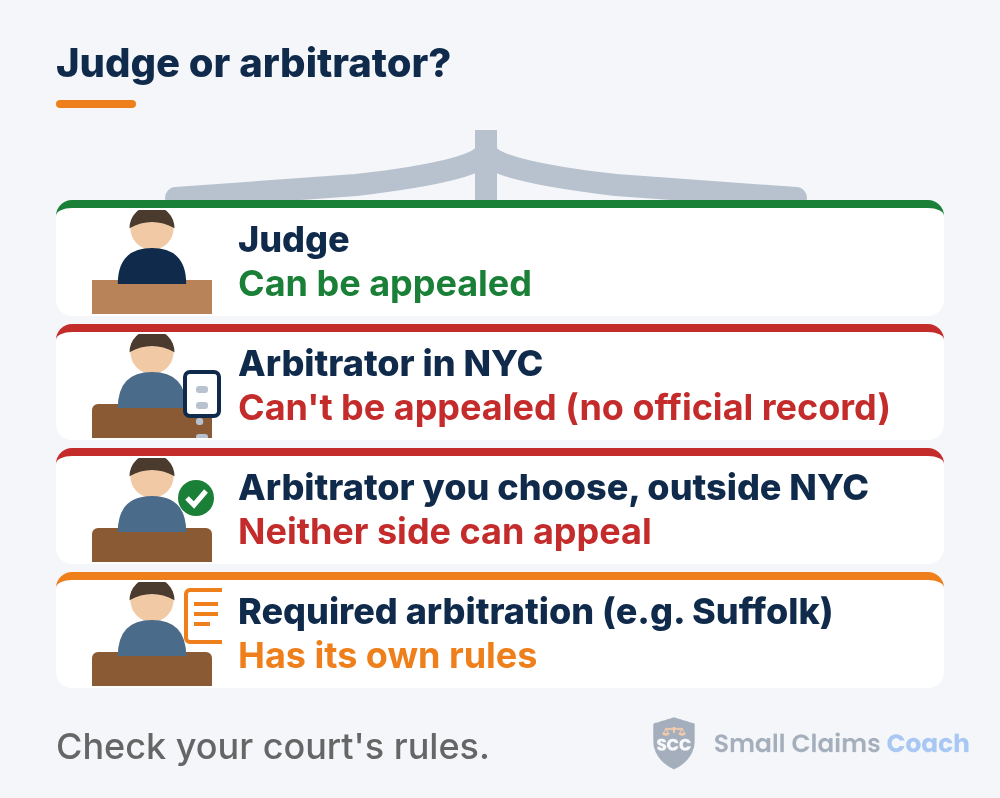
Your case may be heard by a judge or an arbitrator. In NYC Civil Court, the court says, "An Arbitrator's decision cannot be appealed because there is no official record of the proceedings." (NYC Courts, checked 2026-10-27) Outside NYC, where you get to choose, the state court guide says that if you pick an arbitrator, "Neither side can appeal. The decision is binding," while a judge's decision can be appealed. Some courts, such as Suffolk District Court, use mandatory arbitration, which has its own rules, so ask the court clerk.
Collecting from a business: information subpoena, restraining notice, execution
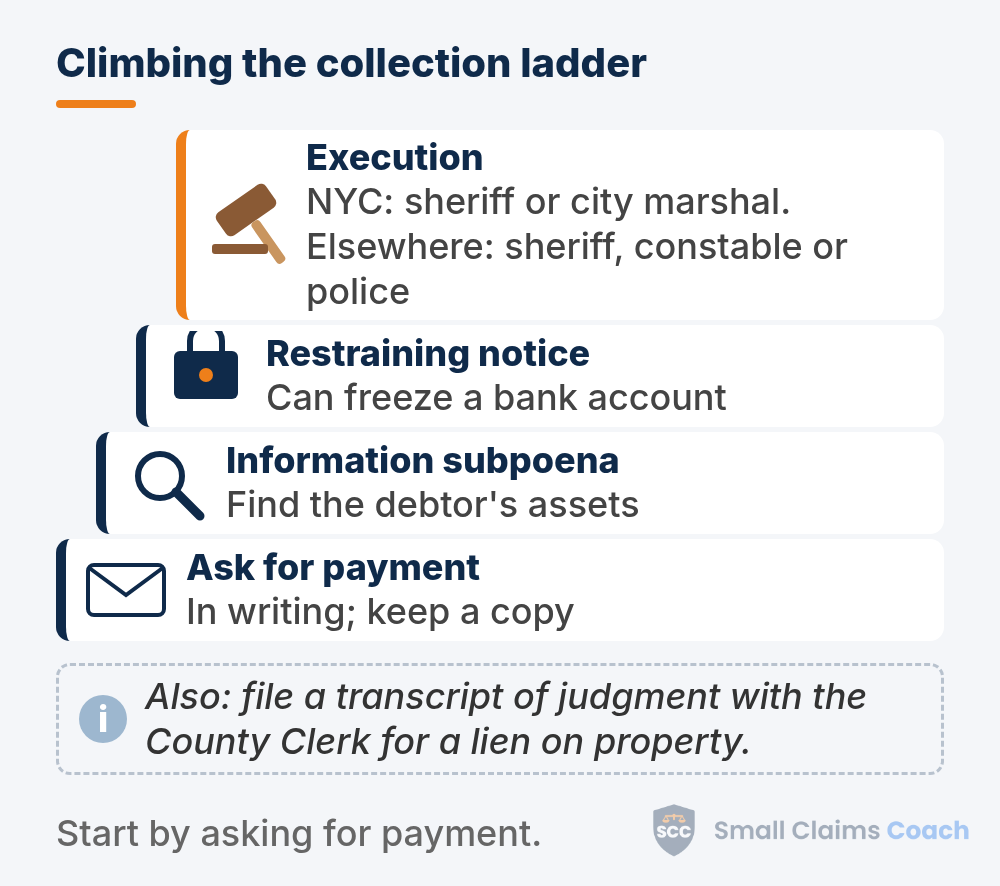
A judgment in your favor doesn't pay you by itself; you may still need to collect it. If the court rules for you, you're the judgment creditor, and the business is the judgment debtor.
- Ask for payment first.
- Information subpoena: helps you find the debtor's assets.
- Restraining notice: can freeze a bank account.
- Execution: an income execution or property execution, carried out by an enforcement officer: in NYC, a sheriff or city marshal; elsewhere, a sheriff, town or village constable, or local police officer.
- Transcript of judgment: filed with the County Clerk, it puts a lien on the debtor's property.
Coach's Tip: Start with a polite written request, and keep a copy. It's the first step, and it shows you tried.
Want the step-by-step Playbook?
A filled-in CIV-SC-50 sample (made-up names), plus checklists, timelines and hearing outlines. $149 for your first year (introductory offer), then $199 a year. Join now.
New York business small claims FAQ
Can a business or LLC sue in New York small claims? Yes, but not in the ordinary Small Claims Part. A corporation, partnership, association, LLC or assignee with its principal office in New York files a commercial small claim in NYC Civil Court, a City Court or a District Court. Town and Village Courts don't hear commercial claims.
Can I sue a business in New York small claims? Yes. A person 18 or older can sue a business in the Small Claims Part for money only. The limit is $10,000 in NYC Civil Court, $5,000 in City and District Courts, and $3,000 in Town and Village Courts.
What is the commercial claims limit in New York? Up to $10,000 in the Commercial Claims Part of NYC Civil Court and up to $5,000 in City Courts, Nassau County District Court and Suffolk County District Court (western Suffolk).
How many commercial claims can a business file each month? No more than five commercial claims statewide in one calendar month. The business has to certify this when it files.
What is a consumer transaction claim? It's a commercial claim against an individual over goods or services bought mainly for personal, family or household use. The business must mail a demand letter at least 10 days and no more than 180 days before filing, and certify that it did.
How do I collect a small claims judgment from a business in New York? Ask for payment first. If the debtor doesn't pay, you can use an information subpoena to find assets, a restraining notice to freeze a bank account, and an execution carried out by an enforcement officer (in NYC, a sheriff or city marshal; elsewhere, a sheriff, town or village constable, or local police officer).
Official links
- Guide to Small Claims & Commercial Small Claims (PDF)
- NYC Commercial Claims and Consumer Transactions
- NYC small claims forms
- Nassau County District Court case types
- Collecting a judgment (NYC)
Related guides
You do the work. The Playbook hands you the plays.
This page covers the rules for business cases in New York. The Playbook coaches you from filing to hearing day: a filled-in sample of the NYC Civil Court Statement of Claim for Small Claims (CIV-SC-50), your New York Playbook section, and step-by-step prep guides. General legal information, not advice about your case.
See the PlaybookSmall Claims Coach is built to help you handle your case yourself, without a lawyer — but if your situation is complicated, does not fit our samples, or a deadline is close, you may want to call a lawyer. Small Claims Coach uses public information to build the Playbook, which coaches you as you organize and present your own case. We are not your lawyer, there is no attorney-client relationship, and we don't want the details of your case.
This information is for educational purposes only. It is not legal advice.