
Illinois small claims Playbook
Home › States › Illinois › Playbook
The Playbook coaches you as you organize and present your own case. Members: the prep guides that work in any state are in Part 1 of the Playbook below, and Part 2 covers Illinois's forms, filing steps, service and hearing. For the basics, see the Illinois overview.
Illinois small claims forms
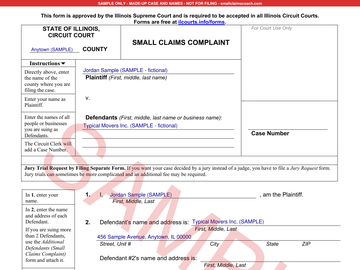
Use the statewide Small Claims Complaint forms: the Small Claims Complaint (CS-C 702.4), a Small Claims Summons (CS-S 705.4) for each defendant, and the filing and service instructions (SC-I 1802.4).
How much should I ask for in Illinois small claims?
Ask for what you can prove: receipts, invoices, estimates and a simple running total. If your loss is bigger than the Illinois small claims limit of $10,000 (not counting interest and costs), look closely at your options before filing, because what happens to the extra amount depends on your court's rules. Our guide to how much you can sue for in small claims explains the basics, and the damages calculator (free quick total; the itemized version is in your Playbook) helps you add up your numbers.
Checklist
Before you file
- The right county: where the defendant lives or where the events happened
- The defendant's correct legal name (corporations: Secretary of State database; unincorporated businesses: "Owner d/b/a Business Name")
- Small Claims Complaint, with any written contract or lease attached, or an explanation of why you don't have it
- A Small Claims Summons for each defendant, with the court date from the clerk
- An eFileIL account, or a Certification for Exemption from E-Filing if you qualify
- The filing fee from your circuit clerk, or an Application for Waiver of Court Fees
- A service method: clerk certified mail, sheriff, or special process server
- Filing for a corporation? A lawyer has to file it
For the hearing
- Your documents, with the original and a copy for each party
- Your witnesses, in person. Written statements are not a substitute
- A one-page list of each amount you're asking for and where it comes from
Timeline
| When | What happens |
|---|---|
| Filing day | The summons sets an appearance date between 40 and 61 days after it's issued (Rule 283). |
| At least 21 days before the appearance date | For certified-mail service to count, the receipt has to show delivery at least 21 days before the appearance date (Rule 284(c)). |
| Hearing | In person, by phone, or by video, depending on the court. |
| After judgment | The court can order payments in installments, over no more than 3 years (Rule 288). |
| Within 30 days of the ruling | If you lose, you have 30 days to ask the judge to reconsider or to file an appeal. |
| Statute of limitations | Generally 5 years for unwritten contracts and for damage to property (735 ILCS 5/13-205); 10 years for written contracts, promissory notes and other written evidence of a debt (735 ILCS 5/13-206). Other claims can have different deadlines, so check your court's rules if unsure. |
Sources: Illinois Supreme Court Rules 281 to 289 (PDF); SC-I 1802.4 instructions (PDF). Checked 2026-10-24.
What's in the Illinois Playbook section
- Part 1: Prep guides that work in any state
- Part 2: Illinois specifics
- Sample filing (made-up example)
- Hearing outline
- Collecting after you win in Illinois
- Illinois day-of plan
- More guides
Want the whole game plan for Illinois? The Illinois Playbook takes you from filing to hearing day: what to gather, how to label your exhibits, a one-page timeline, and a day-of plan for your hearing. One yearly membership covers every state guide. See the Playbook
Small Claims Coach is built to help you handle your case yourself, without a lawyer — but if your situation is complicated, does not fit our samples, or a deadline is close, you may want to call a lawyer.
Small Claims Coach uses public information to build the Playbook, which coaches you as you organize and present your own case. We are not your lawyer, there is no attorney-client relationship, and we don't want the details of your case.
This information is for educational purposes only. It is not legal advice.