
Kentucky small claims Playbook
Checked against official court sources, updated October 2026.
This information is for educational purposes only. It is not legal advice.
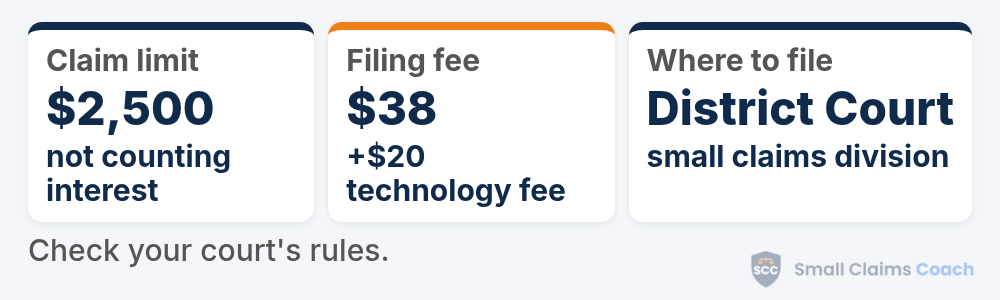
Quick answer: Kentucky small claims is a division of every District Court, with one process statewide. You can sue for up to $2,500, not counting interest or costs. Collection agencies and assigned claims aren't allowed, and there's a 25-claim yearly cap. You can appeal within 10 days. Check your court's rules.
How does small claims court work in Kentucky?
Kentucky has one small claims process statewide. Every District Court has a small claims division under the Small Claims Act (KRS 24A.200 to 24A.360). The limit, the rules, and the court forms are the same everywhere. What changes locally is the courthouse, a few local add-on fees, certified mail postage, and the hearing date the clerk sets.
Official sources are listed under Sources below.
How much can I sue for in Kentucky?
$2,500, not counting interest or costs. That covers money, damages, or the value of personal property, and cases to cancel a contract for goods or services worth up to $2,500. The court's handbook says that if your claim is bigger, you can choose to sue for only $2,500 in small claims.
Small claims doesn't hear libel, slander, alienation of affections, malicious prosecution, abuse of process, or criminal charges. There's no attachment or garnishment before judgment.
Where do I file a small claim in Kentucky?
In the judicial district where the defendant (or the defendant's agent) lives or does business (KRS 24A.260). For a corporation, the handbook says you can file in the county where its office or place of business is, or where its officer or process agent lives. If you're suing a corporation over a contract, you may also be able to file where the contract was made or was to be performed. The handbook says there are other options for some contract claims, so ask the clerk if yours doesn't fit.
File with the Office of Circuit Court Clerk in that county. The handbook also allows filing through the Kentucky Court of Justice eFiling system.
How much does it cost to file?
The filing fee is $38, plus a $20 court technology fee and any local fees. Ask the clerk for your total.
| Item | Amount |
|---|---|
| Small claims filing fee (claim of $2,500 or less) | $38 |
| Court technology fee, added on | $20 |
| Court facility and library fees | Ask the clerk |
| Fiscal court add-on, only in counties that have adopted it | $10 |
| Sheriff service, per process, paid to the sheriff | $20 |
| Certified mail, paid to the clerk in advance | Ask the clerk |
Local fees sit on top of the $38 and $20, so we don't show one total. Ask the clerk what you'll pay. Sources: Supreme Court Order 2026-15 (CR 3.03, effective July 1, 2026); KRS 24A.185; KRS 24A.170. Checked October 2026.
What forms do I need in Kentucky?
Start the case with AOC-175, Small Claims Complaint. Write your explanation on the form itself. The handbook says not to attach a separate explanation, and the clerk can't fill it out for you. Find it on the Kentucky Court of Justice forms page.
How do I file a small claim in Kentucky?
Fill out AOC-175, file it with the Circuit Court Clerk in the right county (or e-file), pay the fees, and choose certified mail or sheriff service.
- Check that your claim is $2,500 or less, is your own claim, and is under the 25-a-year cap.
- Fill out AOC-175, from the Kentucky Court of Justice forms page.
- File with the Circuit Court Clerk (or e-file) and pay the fees.
- Choose service by certified mail or by the sheriff. The clerk issues a summons with the hearing date, 20 to 40 days after service.
- Check with the clerk that the defendant was served. The case isn't heard until then.
- Go to the hearing ready to prove your claim, even if the other side doesn't show up.
Can a business sue in Kentucky small claims?
A business uses the same court, limit, form, and fees. A lawyer isn't required.
| Who | Who can come to the hearing |
|---|---|
| Corporation | An officer, a person regularly employed as a manager, or a lawyer |
| Partnership | A person regularly employed as a manager, or a lawyer |
- LLCs: check your court's rules.
If you're suing a corporation, look up its process agent on the Kentucky Secretary of State business search. Source: Small Claims Handbook (P-6), checked 2026-10-08.
Which court handles small claims in my Kentucky county?
In every Kentucky county, you file with the Office of Circuit Court Clerk for the small claims division of the District Court where the defendant lives or does business. Some of Kentucky's larger counties:
- Jefferson County
- Fayette County
- Kenton County
- Warren County
- Boone County
- Hardin County
- Daviess County
- Madison County
- Campbell County
- Bullitt County
Next step
- Confirm the county where the defendant lives or does business.
- Get AOC-175, Small Claims Complaint.
- Choose certified mail or sheriff service.
Kentucky small claims FAQ
Do I need a lawyer for small claims in Kentucky?
No. A lawyer can appear, but you don't need one. There's no jury in the small claims division. A defendant who wants a jury must ask in writing at least 7 days before the hearing, and the case then moves to the regular District Court docket.
Can I appeal a Kentucky small claims judgment?
Yes. Appeal within 10 days of the judgment to the Circuit Court. New evidence isn't allowed, and a filing fee is charged; ask the clerk for the amount.
How is the defendant served in Kentucky small claims?
By certified mail, paid to the clerk in advance, or by the sheriff for $20 per process. The hearing is 20 to 40 days after service, and you must check with the clerk that the defendant was served.
Related guides
Small Claims Starter Kit (basic timeline and checklists).
Sources
- KRS 24A.230 (checked 2026-10-24)
- KRS 24A.240 (checked 2026-10-24)
- KRS 24A.250 (checked 2026-10-24)
- KRS 24A.260 (checked 2026-10-24)
- KRS 24A.270 (checked 2026-10-24)
- KRS 24A.280 (checked 2026-10-24)
- KRS 24A.290 (checked 2026-10-24)
- KRS 24A.300 (checked 2026-10-24)
- KRS 24A.170 (checked 2026-10-24)
- KRS 24A.185 (checked 2026-10-24)
- KRS 24A.120 (checked 2026-10-24)
- KRS 29A.270 (checked 2026-10-24)
- Kentucky Supreme Court Order 2026-15 (CR 3.03) (PDF) (checked 2026-10-24)
- Kentucky Small Claims Handbook (P-6, PDF) (checked 2026-10-24)
- Kentucky District Court (checked 2026-10-24)
How much should I ask for in Kentucky small claims?
Ask for what you can prove: receipts, invoices, estimates and a simple running total. Kentucky's small claims limit is $2,500, not counting interest and costs (Small Claims Handbook P-6). If your loss is bigger, look closely at your options before filing, because what happens to the extra amount depends on your court's rules. Our guide to how much you can sue for in small claims explains the basics, and the damages calculator (free quick total; the itemized version is in your Playbook) helps you add up your numbers.
What's in the Kentucky Playbook section
- Where else can you file in Kentucky?
- Small claims courts in Kentucky's largest counties
- Filing in person or online
- Serving the defendant: options and fees
- Mediation before the hearing
- How to file a small claim in Kentucky, step by step (made-up example)
- Kentucky small claims checklist
- Kentucky small claims timeline and deadlines
- What to expect at your Kentucky small claims hearing
- If you settle
- Collecting after you win in Kentucky
Want the whole game plan for Kentucky? The Small Claims Playbook takes you from filing to hearing day: what to gather, how to label your exhibits, a one-page timeline, and a day-of plan for your hearing. One membership covers all our state guides. See the Playbook
Small Claims Coach is built to help you handle your case yourself, without a lawyer — but if your situation is complicated, does not fit our samples, or a deadline is close, you may want to call a lawyer.
Small Claims Coach uses public information to build the Playbook, which coaches you as you organize and present your own case. We are not your lawyer, there is no attorney-client relationship, and we don't want the details of your case.
This information is for educational purposes only. It is not legal advice.