
Washington Small Claims Court: Limits, Fees, Forms, and Where to File
How small claims works in Washington: the limit, filing fee, forms, where to file, and the basic steps. Checked 2026-10-25.
Checked against official court sources, updated October 2026.
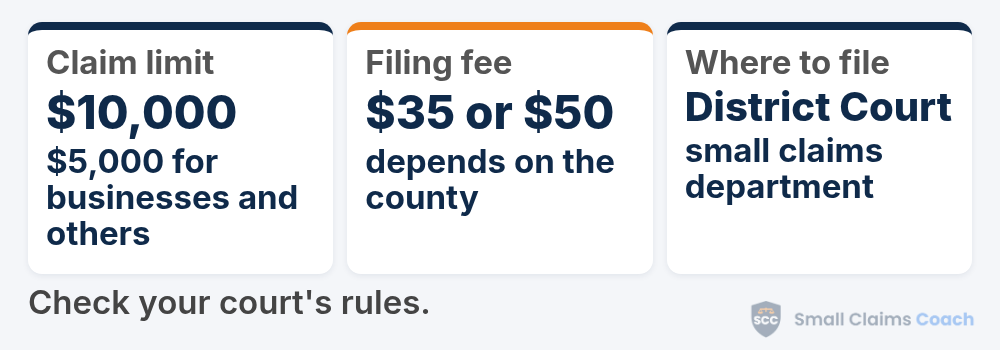
Quick answer: Every Washington district court has a small claims department, under one statewide law (chapter 12.40 RCW). A person can sue for up to $10,000; businesses and everyone else, up to $5,000. Filing costs $35 or $50, depending on the county's dispute-resolution surcharge. Lawyers can't take part without the judge's consent.
Filing in Washington? See a filled-in sample first.
Everything on this page is free. The Small Claims Playbook adds a filled-in sample of Washington's Notice of Small Claim (MISC 05.0100), the state's pattern form, using a made-up case, with a box-by-box guide. Some courts use their own version. One membership covers every state. $149 for your first year (introductory offer), then $199 a year. Join now.
How does small claims court work in Washington?
Washington has one process statewide. Every district court has a small claims department, with the same limits, fee, and rules under state law. What changes by county is which district court you use and, in some counties, an extra local fee.
Official sources are listed under Sources below.
How much can I sue for in Washington?
| Who is suing | Limit |
|---|---|
| A person | $10,000 |
| Everyone else, including businesses and corporations | $5,000 |
Small claims is for money only. Source: chapter 12.40 RCW; An Introduction to Small Claims Court (PDF). Checked 2026-10-24.
Who can sue in Washington small claims?
"Any individual, business, partnership or corporation (with a few exceptions) may bring a small claims action only to recover money." The real claimant has to bring the claim; someone who bought or was assigned a claim can't file it. The State of Washington can't be sued in small claims.
Can a business sue in Washington small claims?
Businesses use the same court, form, and fee, but their limit is $5,000 instead of $10,000. Lawyers and legal paraprofessionals can't appear for anyone without the judge's permission, and a corporation can't be represented by one except in one narrow situation set out in RCW 12.40.025.
Where do I file a small claim in Washington?
"In general, the claim must be filed in the district court of the county in which the defendant/s ... reside." (An Introduction to Small Claims Court, checked 2026-10-25.) A corporation counts as living anywhere it does business or has an office. Other exceptions are in RCW 3.66.040. Find the court in the Washington court directory.
How much does it cost to file?
| Item | Cost |
|---|---|
| Filing fee | $35 or $50, depending on the county's dispute-resolution surcharge |
| Counterclaim | $35 plus any surcharge |
| Serving papers | Extra; ask the clerk |
The county surcharge is up to $15.
What forms do I need in Washington?
The Notice of Small Claim (MISC 05.0100) is the state's pattern form. Some courts give out their own version through the clerk. All forms: Washington small claims forms.
How do I file a small claim in Washington?
Fill out the Notice of Small Claim (MISC 05.0100 or the court's own form), sign it in front of the clerk unless told otherwise, pay the fee, and have the defendant served.
- Fill out a Notice of Small Claim (PDF): your name and address, a sworn statement of the claim, the amount, when it happened, and the defendant's name and address.
- Sign it in front of the clerk unless the court tells you otherwise. The clerk fills in the hearing date.
- Pay the filing fee.
- Have the defendant served at least 10 days before the first hearing, by an adult who isn't part of the case, or by registered or certified mail with a signed return receipt. You can't serve the papers yourself.
- Go to the hearing with your documents and witnesses.
Ready to do these steps yourself?
Service has a deadline: the defendant has to be served at least 10 days before the first hearing, and you can't hand the papers over yourself. The steps above are free. The Playbook helps you do each one, with a filled-in sample of MISC 05.0100 and every box explained, plus your Washington Playbook section: a step-by-step filing walkthrough (made-up example), a Washington small claims checklist, the timeline and deadlines, what to expect at your hearing, and collecting a judgment.
You also get prep guides that work in any state: a document checklist, exhibit labels, a prep timeline and a hearing-day outline. $149 for your first year (introductory offer), then $199 a year. Join now.
Which court handles small claims in my Washington county?
Washington small claims are filed in the district court of the county where a defendant lives, with exceptions in RCW 3.66.040. Some of Washington's larger counties:
- King County
- Pierce County
- Snohomish County
- Spokane County
- Clark County
- Thurston County
- Kitsap County
- Yakima County
- Whatcom County
- Benton County
Next step
- Find the district court for the county where the defendant lives.
- Get the Notice of Small Claim (MISC 05.0100) or your court's version.
- Plan service at least 10 days before the first hearing.
Know your next step? Next, get your proof in order.
You can present your own case. The Playbook's exhibit-label guide and hearing-day outline help you put your documents in order and explain them clearly, step by step. General legal information, not advice about your case.
Washington small claims FAQ
Do I need a lawyer for small claims in Washington?
No. Lawyers and legal paraprofessionals can't appear for anyone without the judicial officer's consent (RCW 12.40.080).
How is the defendant served in Washington small claims?
At least 10 days before the first hearing, by personal or abode service from an adult who isn't a party, or by registered or certified mail with a signed return receipt filed with the court.
Can I appeal a Washington small claims judgment?
Sometimes. There's no appeal if the amount claimed was under $250, and the party who brought a claim can appeal only if they claimed $1,000 or more. The appeal deadline is 30 days (RCW 12.40.120).
Related guides
Free: the Small Claims Starter Kit (basic timeline and checklists).
Sources
- Washington Courts: Small Claims Court (checked 2026-10-25)
- An Introduction to Small Claims Court (PDF) (checked 2026-10-24)
- Washington Courts eService: File a small claim (checked 2026-10-24)
- Washington Courts: Small Claims forms (checked 2026-10-24)
- MISC 05.0100, Notice of Small Claim (PDF) (checked 2026-10-24)
- Chapter 12.40 RCW, Small Claims (checked 2026-10-24)
- RCW 12.40.025 (checked 2026-10-25)
- RCW 7.75.035, dispute-resolution surcharge (checked 2026-10-25)
- RCW 3.66.040, district court venue (checked 2026-10-25)
What's in the Washington Playbook section
- How to file a small claim in Washington, step by step (made-up example)
- Washington small claims checklist
- Washington small claims timeline and deadlines
- What to expect at your Washington small claims hearing
- Collecting after you win in Washington
- Common mistakes and a printable checklist
You do the work. The Playbook hands you the plays.
This page covers the Washington rules. The Playbook coaches you from filing to hearing day: a filled-in sample of MISC 05.0100, your Washington Playbook section, and step-by-step prep guides. Every state and DC has a filled-in sample claim (for Mississippi, Oklahoma and Wyoming it's a sample layout we made, so you'd get the real form from the court clerk). One membership covers every state.
Small Claims Coach is built to help you handle your case yourself, without a lawyer — but if your situation is complicated, does not fit our samples, or a deadline is close, you may want to call a lawyer.
Small Claims Coach uses public information to build the Playbook, which coaches you as you organize and present your own case. We are not your lawyer, there is no attorney-client relationship, and we don't want the details of your case.
This information is for educational purposes only. It is not legal advice.