
South Carolina Small Claims Court: Limits, Fees, Forms, and Where to File
How small claims works in South Carolina: the limit, filing fee, forms, where to file, and the basic steps. Checked 2026-10-24.
Checked against official court sources, updated October 2026.
Home › States › South Carolina
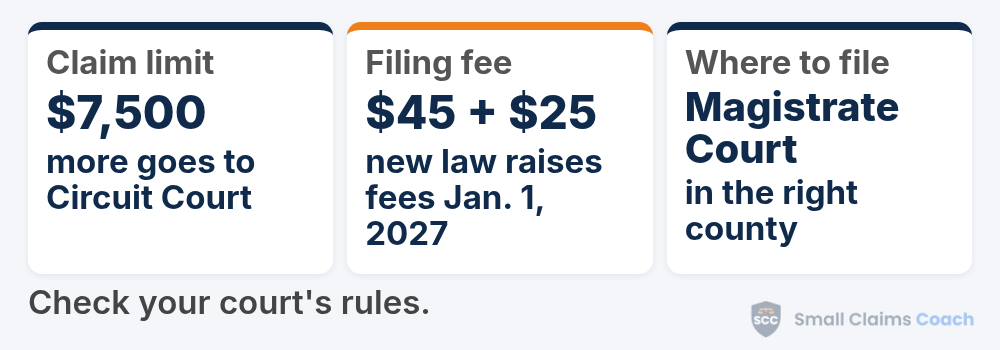
Quick answer: South Carolina doesn't call it small claims court. A civil claim of $7,500 or less goes to Magistrate Court, under one set of statewide rules. The statutory charges include $45 for the summons and judgment and a $25 assessment on the filing, and the fee is uniform statewide. The defendant has 30 days to answer, and either side can appeal to circuit court within 30 days. Check your court's rules.
Filing in South Carolina? See a filled-in sample first.
Everything on this page is free. The Small Claims Playbook adds a filled-in sample of South Carolina's Magistrates Court complaint form (SCCA 701), using a made-up case, with a box-by-box guide. One membership covers every state. $149 for your first year (introductory offer), then $199 a year. Join now.
How does small claims court work in South Carolina?
South Carolina doesn't have a court called "small claims court." Civil claims of $7,500 or less go to Magistrate Court, also called summary court. Each county has magistrate offices, but the limit, the rules, the complaint form, and the fees are the same statewide.
Official sources are listed under Sources below.
How much can I sue for in South Carolina?
$7,500. That covers money owed on a contract, damage to you or your property, getting personal property back, and fraud in a sale of personal property. Anything more goes to Circuit Court.
Magistrate Court generally can't hear a case where the State is a party or where title to real estate is in question. If a counterclaim is over $7,500, the whole case moves to the Court of Common Pleas.
Sources: S.C. Code §§ 22-3-10, 22-3-20, and 22-3-30; South Carolina Judicial Branch: Magistrate Court FAQ. Checked 2026-10-24.
Where do I file a small claim in South Carolina?
At a magistrate court in the county where at least one defendant lives, or where most of what the claim is about happened. A South Carolina corporation is sued in the county of its principal place of business. If the defendant lives out of state, you can file in the county where you live or where the claim arose.
How much does it cost to file?
The filing fee is the same in every county. These are the amounts in effect on October 8, 2026. A clerk may charge more than one of them on the same case, so ask the magistrate's office for your total.
| Charge | Amount |
|---|---|
| Issuing the summons and the judgment | $45 |
| Assessment on each summons and complaint | $25 |
| Serving the summons by a constable | $5 plus mileage |
A new law raises these fees starting January 1, 2027. If you can't afford the fees, you can ask the court to let you proceed without paying. Sources: S.C. Code § 8-21-1010 and § 8-21-1060; § 22-3-340. Checked 2026-10-24.
What forms do I need in South Carolina?
Start with SCCA 701, Complaint (revised 04/2026). If you go in person, you can also give your complaint out loud and the court will write it down. SCCA 701 (PDF).
How do I file a small claim in South Carolina?
Fill out SCCA 701, file it with a magistrates court in the right county and pay the fees; the court issues a summons to be served with your complaint.
- Make sure your claim is $7,500 or less.
- Fill out SCCA 701, Complaint (PDF), and give the court an address for notices.
- File with the magistrate in the right county and pay the fees.
- The summons and complaint are served together by the sheriff, a constable, certified mail, or another adult who isn't part of the case.
- The defendant has 30 days after being served to answer in writing or in person.
- If the defendant doesn't answer or doesn't show up for trial, the court may enter a default.
Ready to do these steps yourself?
Two 30-day clocks to know: the defendant has 30 days to answer, and either side has 30 days to appeal to circuit court. The steps above are free. The Playbook helps you do each one, with a filled-in sample of SCCA 701 and every box explained, plus your South Carolina Playbook section: a step-by-step filing walkthrough (made-up example), a South Carolina small claims checklist, the timeline and deadlines, what to expect at your hearing, and collecting a judgment.
You also get prep guides that work in any state: a document checklist, exhibit labels, a prep timeline and a hearing-day outline. $149 for your first year (introductory offer), then $199 a year. Join now.
Which court handles small claims in my South Carolina county?
South Carolina has a magistrates court in every county. You file in a county where at least one defendant lives or where most of the claim arose. Some of South Carolina's larger counties:
- Greenville County
- Richland County
- Charleston County
- Horry County
- Spartanburg County
- Lexington County
- York County
- Berkeley County
- Anderson County
- Beaufort County
Next step
- Confirm the county where a defendant lives or where most of the claim arose.
- Get SCCA 701, the Magistrates Court complaint.
- Ask the magistrate's office for your total fees before you file.
Know your next step? Next, get your proof in order.
You can present your own case. The Playbook's exhibit-label guide and hearing-day outline help you put your documents in order and explain them clearly, step by step. General legal information, not advice about your case.
South Carolina small claims FAQ
Do I need a lawyer in South Carolina Magistrate Court?
No. An individual can file and appear without one, and a lawyer may also appear.
How long does the defendant have to answer in South Carolina Magistrate Court?
30 days, counted from the first day after service. The answer can be written, or given in person and written down (Rule 7).
Can I appeal a South Carolina Magistrate Court judgment?
Yes, to the circuit court of the county where the judgment was made. File and serve a notice of appeal within 30 days of the judgment being announced in court, or within 30 days after written notice of it (Rule 18).
Related guides
Free: the Small Claims Starter Kit (basic timeline and checklists).
Sources
- S.C. Code title 22, chapter 3 (magistrates) (checked 2026-10-24)
- S.C. Code title 8, chapter 21 (fees) (checked 2026-10-24)
- Act No. 155 of 2026 (H. 4813) (checked 2026-10-24)
- S.C. Judicial Branch: Magistrate Court FAQ (PDF) (checked 2026-10-24)
- Rules of Magistrates Court, Rule 4 (checked 2026-10-24)
- Rules of Magistrates Court, Rule 5 (checked 2026-10-24)
- Rules of Magistrates Court, Rule 6 (checked 2026-10-24)
- Rules of Magistrates Court, Rule 7 (checked 2026-10-24)
- Rules of Magistrates Court, Rule 11 (checked 2026-10-24)
- Rules of Magistrates Court, Rule 18 (checked 2026-10-24)
- Rules of Magistrates Court, Rule 21 (checked 2026-10-24)
- SCCA 701, Complaint (PDF) (checked 2026-10-24)
- Fee memorandum for magistrate and municipal courts (checked 2026-10-08)
What's in the South Carolina Playbook section
- How to file a small claim in South Carolina, step by step (made-up example)
- South Carolina small claims checklist
- South Carolina small claims timeline and deadlines
- What to expect at your South Carolina small claims hearing
- Collecting after you win in South Carolina
- Common mistakes and a printable checklist
You do the work. The Playbook hands you the plays.
This page covers the South Carolina rules. The Playbook coaches you from filing to hearing day: a filled-in sample of SCCA 701, your South Carolina Playbook section, and step-by-step prep guides. Every state and DC has a filled-in sample claim (for Mississippi, Oklahoma and Wyoming it's a sample layout we made, so you'd get the real form from the court clerk). One membership covers every state.
Small Claims Coach is built to help you handle your case yourself, without a lawyer — but if your situation is complicated, does not fit our samples, or a deadline is close, you may want to call a lawyer.
Small Claims Coach uses public information to build the Playbook, which coaches you as you organize and present your own case. We are not your lawyer, there is no attorney-client relationship, and we don't want the details of your case.
This information is for educational purposes only. It is not legal advice.