
Connecticut Small Claims Court: Limits, Fees, Forms, and Where to File
How small claims works in Connecticut: the limit, filing fee, forms, where to file, and the basic steps. Checked 2026-10-08.
Checked against official court sources, updated October 2026.
This information is for educational purposes only. It is not legal advice.
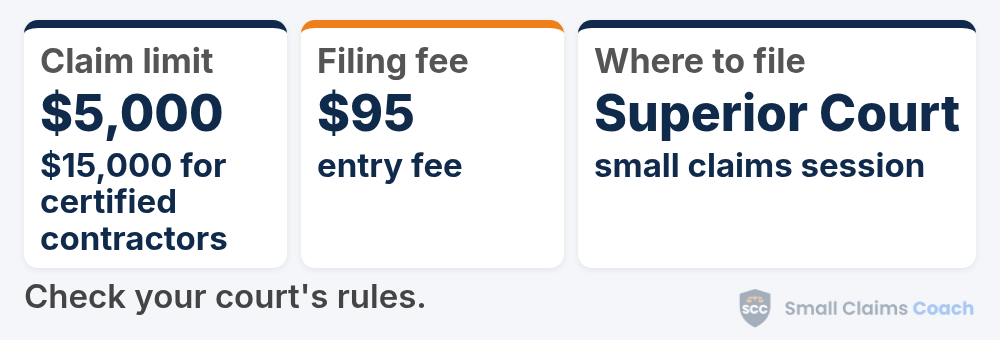
Quick answer: Connecticut small claims is a session of the Superior Court, with one process statewide. You can sue for up to $5,000 (up to $15,000 against a certified home-improvement or new-home-construction contractor), and filing costs $95. You serve the defendant before you file, hearings are usually remote, and the judgment is final, with no appeal. Check your court's rules.
Filing in Connecticut? See a filled-in sample first.
Everything on this page is free. The Small Claims Playbook adds a filled-in sample of Connecticut's Small Claims Writ and Notice of Suit (JD-CV-40), using a made-up case, with a box-by-box guide. One membership covers every state. $149 for your first year (introductory offer), then $199 a year. Join now.
How does small claims court work in Connecticut?
Connecticut has one small claims process statewide. Small claims is a session of the Superior Court. One statute sets the limits (C.G.S. § 51-15), one Practice Book chapter sets the procedure, and the entry fee is the same everywhere. What changes locally is which court location or housing session you file in, and marshal fees.
Official sources are listed under Sources below.
How much can I sue for in Connecticut?
You can sue for up to $5,000, or up to $15,000 against a certified home-improvement or new-home-construction contractor.
| Claim | Limit |
|---|---|
| Money damages, generally (including attorney fees and collection costs, not counting interest and court costs) | $5,000 |
| Home improvement work, or an offer to do it, by a contractor holding a certificate under chapter 400 | $15,000 |
| A contract for new home construction with a new home construction contractor holding a certificate under chapter 399a | $15,000 |
A tenant suing to get back a security deposit can be awarded up to twice the deposit, even if that's more than $5,000 (C.G.S. §§ 51-15(d), 47a-21(d)). Small claims is for money only, and it doesn't hear libel or slander.
Sources: C.G.S. § 51-15; Practice Book § 24-2; Judicial Branch small claims FAQ. Checked 2026-10-08.
Where do I file a small claim in Connecticut?
File at the Superior Court small claims location for the right town; which towns count depends on whether you're an individual or a business.
- If you're an individual: the court location for the town where you live, where the defendant lives or does business, or where the deal or injury happened.
- If you're a business (including an LLC): the court location for the town where the defendant lives or does business, or where the deal or injury happened. A business can't file based on its own town.
- Landlord-tenant claims (unpaid rent, damage, or a security deposit): the housing session for that judicial district, if there is one.
The town-by-town list is on the Judicial Branch's where to file small claims page. You can also file through Judicial Branch E-Services.
How much does it cost to file?
Filing costs $95. A counterclaim is also $95.
| Item | Fee |
|---|---|
| Small claims entry (filing) | $95 |
| Small claims counterclaim | $95 |
| Motion to transfer to the regular docket (paid by the person asking) | $125 |
| Motion to open, set aside, or modify a small claims matter | $75 |
| Marshal, mail, or courier service | Ask the clerk |
Pay by cash, check, or money order to "Clerk of the Superior Court," or by MasterCard or Visa in person. If you win, the entry fee and service costs are added to the judgment. Source: Judicial Branch court fees, checked 2026-10-08.
How do I file a small claim in Connecticut?
Serve the defendant first, then file JD-CV-40 with the clerk and pay $95 within one month after service.
- Check that your claim fits the $5,000 limit, or the $15,000 limit for a certified home-improvement or new-home-construction contractor.
- Verify the defendant's address using one of the methods in Practice Book § 24-9, within six months before filing.
- Fill out JD-CV-40 (PDF), using each party's exact legal name, and sign it in front of a clerk, notary or Connecticut attorney.
- Serve each defendant before filing, with the writ and JD-CV-121, Instructions to Defendant. You can use priority mail or certified mail with delivery confirmation, a courier with delivery confirmation, or a state marshal. An out-of-state business must be served by a marshal or other proper officer.
- File the writ, JD-CV-123 (Statement of Service), the delivery proof, and copies of your exhibits, and pay $95. Do this within one month after service.
- The clerk sets an answer date for the defendant; you don't go that day, and the clerk will tell you the hearing date. Hearings are usually held remotely over the internet.
Ready to do these steps yourself?
Connecticut runs in a different order: you serve the defendant before you file, and the judgment is final, with no appeal. The steps above are free. The Playbook helps you do each one, with a filled-in sample of JD-CV-40 and every box explained, plus your Connecticut Playbook section: a step-by-step filing walkthrough (made-up example), a Connecticut small claims checklist, the timeline and deadlines, what to expect at your hearing, and collecting a judgment.
You also get prep guides that work in any state: a document checklist, exhibit labels, a prep timeline and a hearing-day outline. $149 for your first year (introductory offer), then $199 a year. Join now.
Can a business sue in Connecticut small claims?
Businesses use the same court, limits, form, and fee. A lawyer isn't required. Someone who isn't a lawyer can't be paid to represent anyone (Practice Book § 24-6).
| Who | Who can represent it |
|---|---|
| Corporation | An officer, manager, or local manager |
| Partnership | One of the partners |
| Unincorporated business that isn't a partnership | An employee |
- LLCs: check your court's rules.
A consumer collection agency, or someone acting under a power of attorney, doesn't count as a representative. Source: Practice Book § 24-6, checked 2026-10-08.
Which court handles small claims in my part of Connecticut?
Connecticut doesn't assign small claims by county or planning region. Each town is assigned to a Superior Court small claims location, usually a Judicial District courthouse, and some towns have two options. Look up your town on the Judicial Branch's Where to File Small Claims page. Landlord-tenant claims go to the housing session for that town, if there is one.
Next step
- Confirm your court location on the Judicial Branch's where to file page.
- Get JD-CV-40, Small Claims Writ and Notice of Suit (PDF).
- Plan how you'll serve the defendant before you file.
Know your next step? Next, get your proof in order.
You can present your own case. The Playbook's exhibit-label guide and hearing-day outline help you put your documents in order and explain them clearly, step by step. General legal information, not advice about your case.
Connecticut small claims FAQ
What form do I use for small claims in Connecticut?
Start the case with JD-CV-40, Small Claims Writ and Notice of Suit, signed under oath.
Do I need a lawyer for small claims in Connecticut?
No. Magistrates, who are lawyers appointed by the court, hear most cases. Someone who isn't a lawyer can't be paid to represent anyone (Practice Book § 24-6). There's no jury in small claims.
Do I serve the papers before or after filing in Connecticut?
Before. Serve each defendant first, then file the writ, the Statement of Service (JD-CV-123) and the delivery proof within one month after service.
Can I appeal a Connecticut small claims judgment?
No. The judgment is final. A motion to open, set aside or modify costs $75.
Related guides
Free: the Small Claims Starter Kit (basic timeline and checklists).
Sources
- Connecticut General Statutes, chapter 870 (C.G.S. § 51-15) (checked 2026-10-08)
- Connecticut Practice Book, chapter 24 (PDF) (checked 2026-10-08)
- Connecticut Judicial Branch small claims FAQ (checked 2026-10-08)
- How Small Claims Court Works (JDP-CV-45, PDF) (checked 2026-10-08)
- Connecticut Judicial Branch court fees (checked 2026-10-08)
- Where to file small claims (checked 2026-10-08)
- JD-CV-40 Small Claims Writ and Notice of Suit (PDF) (checked 2026-10-08)
- Connecticut General Statutes, chapter 926 (statutes of limitation) (checked 2026-10-24)
What's in the Connecticut Playbook section
- How to file a small claim in Connecticut, step by step (made-up example)
- Connecticut small claims checklist
- Connecticut small claims timeline and deadlines
- What to expect at your Connecticut small claims hearing
- If the defendant doesn't answer
- Collecting after you win in Connecticut
- Common mistakes and a printable checklist
You do the work. The Playbook hands you the plays.
This page covers the Connecticut rules. The Playbook coaches you from filing to hearing day: a filled-in sample of JD-CV-40, your Connecticut Playbook section, and step-by-step prep guides. Every state and DC has a filled-in sample claim (for Mississippi, Oklahoma and Wyoming it's a sample layout we made, so you'd get the real form from the court clerk). One membership covers every state.
Small Claims Coach is built to help you handle your case yourself, without a lawyer — but if your situation is complicated, does not fit our samples, or a deadline is close, you may want to call a lawyer.
Small Claims Coach uses public information to build the Playbook, which coaches you as you organize and present your own case. We are not your lawyer, there is no attorney-client relationship, and we don't want the details of your case.
This information is for educational purposes only. It is not legal advice.