
West Virginia Small Claims Playbook: Filing, Service, Hearing and Collecting
Checked against official court sources, updated October 2026.
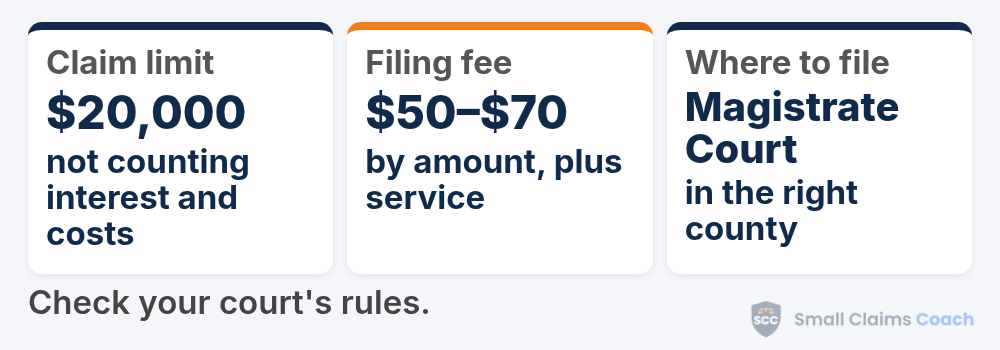
Quick answer: West Virginia has no court called small claims. Civil cases of $20,000 or less go to Magistrate Court in each county, under one statewide set of rules. Filing costs $50, $55, $60 or $70 depending on the amount, plus service. The defendant has 20 days to answer, and either side can appeal to circuit court within 20 days.
How does small claims court work in West Virginia?
West Virginia has no separate small claims court. Small civil cases are heard in Magistrate Court, under W. Va. Code ch. 50 and the Rules of Civil Procedure for Magistrate Courts. The same limit, fees and forms apply in all 55 counties, and every county has at least two magistrates.
Official sources are listed under Sources below.
How much can I sue for in West Virginia?
$20,000 or less, not counting interest and costs (W. Va. Code § 50-2-1). The limit went up to $20,000 on July 7, 2025, so older guides may show a lower number. Magistrate Court also hears claims for property and evictions. It can't hear equity cases, cases where title to real estate is in question, slander or libel, false imprisonment or malicious prosecution. If your claim is bigger, you can give up the amount over $20,000 in writing and keep the case in Magistrate Court (W. Va. Code § 50-4-11).
How much does it cost to file?
| Item | Amount |
|---|---|
| Claim of $500 or less | $50 |
| Claim of $500.01 to $1,000 | $55 |
| Claim of $1,000.01 to $2,000 | $60 |
| Claim of $2,000.01 to $20,000 | $70 |
| Service by the clerk by certified mail | $20 |
| Service by the clerk by first-class mail | $5 |
| Service by the sheriff | $30 per defendant |
| Answer or counterclaim | No fee |
| Jury trial | Actual cost of the jurors |
| Appeal or removal to circuit court | $200, plus a bond for an appeal |
The filing costs come from the court's plaintiff information sheet (SCA-MI 400) and W. Va. Code § 50-3-1(a) and (g). Service is paid in advance on top of them, and a service fee is charged for each defendant served (SCA-MI 400). Court costs are included in the judgment (W. Va. Code § 50-3-1). If you can't afford the fees, ask the magistrate clerk for the affidavit of indigency to request a waiver (Magistrate Civil Rule 22). Fee waivers are for individuals only (W. Va. Code § 59-2-1).
Who can sue in West Virginia Magistrate Court?
- Anyone can sue or be sued. For how a minor or a person who can't act for themselves sues or defends, check your court's rules.
- You can handle your case yourself or with a lawyer. Lawyers are allowed but not required.
- Businesses can sue and be sued in Magistrate Court. A corporation can appear through a lawyer or any officer or employee (Administrative Rule 10). For LLCs and partnerships, check your court's rules.
- Lenders and other commercial creditors use the itemized Civil Complaint for commercial creditor and contract actions (SCA-M208).
Where do I file a small claim in West Virginia?
In the magistrate court of a county where any defendant lives or where the claim arose (W. Va. Code §§ 50-2-2, 56-1-1). There's no e-filing for magistrate court.
What forms do I need in West Virginia?
- Civil Complaint (SCA-M207), from the West Virginia Judiciary Magistrate Court forms page.
- Information Sheet: Civil Case Plaintiff (SCA-MI 400), which explains fees and service.
- For the defendant: the Information Sheet: Civil Case Defendant (SCA-MI 401NP) and the Answer (SCA-M225).
- For a bad check, the Worthless Check: Civil Complaint (SCA-M337).
How do I file a small claim in West Virginia?
Fill out SCA-M207, the Civil Complaint, file it with the magistrate court clerk in the right county, and pay the filing cost and service fee.
- Fill out the Civil Complaint (SCA-M207), from the Magistrate Court forms page, with each defendant's full name and a physical address, and gather copies of your bills, estimates and other papers.
- File it with the magistrate clerk in the right county and pay the $50 to $70 filing cost plus the service fee.
- Choose how the defendant is served: certified mail, first-class mail, the sheriff or a private process server.
- Wait for the defendant's answer and the notice of trial, then go to the hearing with your documents and witnesses.
Which court handles small claims in my West Virginia county?
Every West Virginia county has a magistrate court. File where any defendant lives or where the claim arose. Some of West Virginia's larger counties:
- Kanawha County
- Berkeley County
- Monongalia County
- Cabell County
- Wood County
- Raleigh County
- Harrison County
- Jefferson County
- Mercer County
- Putnam County
Next step
- Confirm the county where a defendant lives or where the claim arose.
- Get SCA-M207, the Civil Complaint.
- Choose how the defendant will be served.
West Virginia small claims FAQ
Do I need a lawyer in West Virginia Magistrate Court?
No. Any party can appear in person, by an agent or by a lawyer (W. Va. Code § 50-4-4a). A corporation can appear by an officer or employee.
Is there a jury in West Virginia Magistrate Court?
Any party can ask in writing for a 6-person jury, no later than 20 days after service of the first answer. The juror costs are charged by court order.
Can I appeal a West Virginia Magistrate Court judgment?
Yes. File a notice of appeal in magistrate court within 20 days after the judgment. It costs the $200 circuit court filing fee plus an appeal bond tied to the judgment and the costs of the appeal.
Related guides
Small Claims Starter Kit (basic timeline and checklists).
Sources
- WV Judiciary: Magistrate Courts (checked 2026-10-18)
- WV Judiciary: Magistrate Court Forms (checked 2026-10-18)
- SCA-MI 400, Information Sheet: Civil Case Plaintiff (PDF) (checked 2026-10-18)
- SCA-MI 401NP, Information Sheet: Civil Case Defendant (PDF) (checked 2026-10-18)
- SCA-MI 600, Enforcement of Civil Judgments (PDF) (checked 2026-10-18)
- SCA-M1250-1, Appeal Process from Magistrate Court (PDF) (checked 2026-10-18)
- Rules of Civil Procedure for Magistrate Courts (checked 2026-10-18)
- Administrative Rules for the Magistrate Courts (checked 2026-10-18)
- West Virginia Rules of Civil Procedure (checked 2026-10-18)
- WV Judiciary: Court Information by County (checked 2026-10-18)
- WV Judiciary: 2026 judgment interest rate (checked 2026-10-18)
- HB 2761 (2025) bill history (checked 2026-10-18)
What's in the West Virginia Playbook section
- Can a business sue in West Virginia magistrate court?
- How much should I ask for in West Virginia small claims?
- Where to file in West Virginia
- West Virginia magistrate court forms and fees
- Serving the defendant: options and fees
- How to file in West Virginia magistrate court, step by step (made-up example)
- West Virginia magistrate court checklist
- West Virginia timeline and deadlines
- What to expect at your West Virginia small claims hearing
- Appeals in West Virginia magistrate court
- Collecting after you win in West Virginia
Want the whole game plan for West Virginia? The West Virginia Playbook takes you from filing to hearing day: what to gather, how to label your exhibits, a one-page timeline, and a day-of plan for your hearing. One yearly membership covers every state guide. See the Playbook
Small Claims Coach is built to help you handle your case yourself, without a lawyer — but if your situation is complicated, does not fit our samples, or a deadline is close, you may want to call a lawyer.
Small Claims Coach uses public information to build the Playbook, which coaches you as you organize and present your own case. We are not your lawyer, there is no attorney-client relationship, and we don't want the details of your case.
This information is for educational purposes only. It is not legal advice.