
Utah small claims Playbook
Checked against official court sources, updated October 2026.
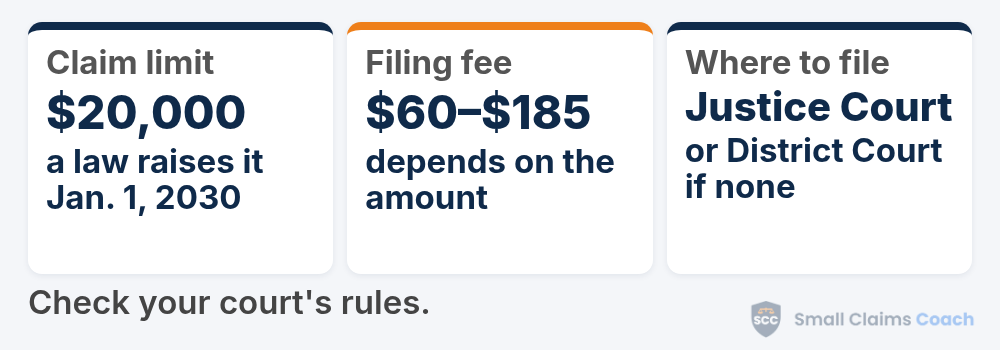
Quick answer: Utah small claims use one statewide set of rules in justice court, or District Court where there's no justice court. You can sue for up to $20,000, including attorney fees but not court costs or interest. Filing costs $60, $100 or $185, depending on the amount. Many justice courts use Online Dispute Resolution first. Either side can appeal within 28 days for a new trial in District Court.
How does small claims court work in Utah?
Utah has one small claims process statewide. Small claims is a division of the justice courts and the district courts (Utah Code 78A-8-101). One statute sets the limit, one set of rules (the Utah Rules of Small Claims Procedure) runs every case, and the fees are the same in justice court and District Court. What changes locally is which court you file in, whether that court uses Online Dispute Resolution (ODR), and the trial date the court sets.
Official sources are listed under Sources below.
How much can I sue for in Utah?
$20,000, including attorney fees, not counting court costs and interest. The limit rises to $25,000 on January 1, 2030. Until then, it's $20,000.
Small claims is for money only. You can't ask the court to order the other side to do something, like give back property. You can't sue a government agency in small claims, and evictions don't go there. A property-damage claim from a car accident can go to small claims without giving up a separate injury case.
Sources: Utah Code 78A-8-102; Utah Courts small claims self-help page. Checked 2026-10-08.
Where do I file a small claim in Utah?
Where the defendant lives or where the events happened. Then pick the court:
- The city or town justice court, if there is one.
- If not, the county justice court.
- If there's no county justice court, District Court. The courts' self-help page says only Cache County has no county justice court.
Some cities share another city's or county's justice court. Use the lookup table on the Utah Courts small claims page to find yours.
How much does it cost to file?
| Claim | Fee |
|---|---|
| $2,000 or less | $60 |
| More than $2,000 and less than $7,500 | $100 |
| $7,500 up to $20,000 | $185 |
| Counter affidavit, same three tiers | $50 / $70 / $120 |
| Service by a constable, sheriff, or process server | Check your court's rules |
The claim size for the fee doesn't count court costs, interest, or attorney fees. A claim of exactly $7,500 pays $185. If you can't afford the fee, you can ask for a fee waiver. Sources: Utah Courts filing fees (effective May 6, 2026); Utah Code 78A-2-301.5. Checked 2026-10-08.
What forms do I need in Utah?
The forms depend on whether your court uses ODR. The courts' small claims page lists which courts do.
- Every new claim: form 1024XX. The court says to check the cover sheet for the fee amount.
- Court without ODR: also form 1025XX.
- Court with ODR: also 2001SC, Small Claims Affidavit and Summons (Online Dispute Resolution Case). If you can't use ODR because of a disability, no internet access, or not speaking English, add 3006SC, Request to be Excused from Online Dispute Resolution and Order on Request.
Get the forms from the Utah Courts small claims page.
How do I file a small claim in Utah?
Pick the right court, file the small claims affidavit forms the court's page lists (1024XX, plus 1025XX or the ODR summons 2001SC) and pay the fee; the clerk schedules trial and issues the summons.
- Check that your claim is for money and is $20,000 or less.
- Find the right court, and check whether it uses ODR.
- Fill out the forms from the Utah Courts small claims page. Your affidavit counts as the complaint.
- File and pay. The clerk then sets a trial date and issues the summons.
- Have the defendant served: at least 30 calendar days before trial in a court without ODR, or within 120 days of filing in an ODR court. File proof of service within 10 business days after service.
- In an ODR court, log in within 7 days of filing, or the case is dismissed.
- Go to trial with every document about the dispute.
Can a business sue in Utah small claims?
A business uses the same court, limit, forms, and fees. A lawyer isn't required.
| Business type | Who can appear |
|---|---|
| Corporation | An authorized employee or a Utah-licensed lawyer |
| LLC | Check your court's rules |
| Partnership | Check your court's rules |
With the court's express approval, another person who isn't paid for it can also appear for a party (Rule 13).
Suing a business? Most businesses must register with the Utah Department of Commerce. Open its business registration page and click "Search Business Entity Records" under Additional Options to find where the business is located and how to serve it. Sources: Utah Code 78A-8-102(6); Small Claims Rule 13. Checked 2026-10-08.
Which court handles small claims in my Utah county?
Utah small claims aren't assigned by county. File in the city or town justice court if there is one, then the county justice court, then District Court; some cities share another court, and the state's small claims page has the lookup table. Some of Utah's larger counties:
- Salt Lake County
- Utah County
- Davis County
- Weber County
- Washington County
- Cache County
- Tooele County
- Iron County
- Box Elder County
- Summit County
Next step
- Find the right justice court and check whether it uses ODR.
- Get form 1024XX and the second form your court needs.
- Plan service on the defendant.
Utah small claims FAQ
Do I need a lawyer for small claims in Utah?
No. You can represent yourself, use a Utah-licensed lawyer, be represented by an employee, or, with the court's approval, by an unpaid person (Rule 13).
Does the defendant have to file an answer in Utah small claims?
No. All the claims are treated as denied (Rule 5). A defendant who wants to sue back files a counter affidavit at least 15 days before trial.
Can a defendant get a jury in Utah small claims?
Only by moving the case to District Court within 15 days of being served and paying the $250 jury fee there (Rule 4A), or on a new trial after appeal.
Can I appeal a Utah small claims judgment?
Yes. Any party can appeal within 28 days after the judgment, or after a motion to set it aside is denied. The case gets a new trial in District Court (Rule 12).
Related guides
Small Claims Starter Kit (basic timeline and checklists).
Sources
- Utah Courts: Small Claims (checked 2026-10-24)
- Utah Code § 78A-8-101 (checked 2026-10-08)
- Utah Code § 78A-8-102 (checked 2026-10-24)
- Utah Code § 78A-8-105 (checked 2026-10-08)
- Utah Code § 78A-2-301.5 (justice court fees) (checked 2026-10-08)
- Utah Courts: Filing Fees (checked 2026-10-24)
- Utah Rules of Small Claims Procedure (checked 2026-10-08)
What's in the Utah Playbook section
- Can a business sue in Utah small claims?
- How much should I ask for in Utah small claims?
- Filing: ODR court or paper forms
- If you use ODR
- Serving the defendant
- How to file a small claim in Utah, step by step (made-up example)
- Sample filled-in complaint
- Utah small claims checklist
- Utah small claims timeline and deadlines
- What to expect at your Utah small claims hearing
- Collecting after you win in Utah
Want the whole game plan for Utah? The Small Claims Playbook takes you from filing to hearing day: what to gather, how to label your exhibits, a one-page timeline, and a day-of plan for your hearing. One membership covers all our state guides. See the Playbook
Small Claims Coach is built to help you handle your case yourself, without a lawyer — but if your situation is complicated, does not fit our samples, or a deadline is close, you may want to call a lawyer.
Small Claims Coach uses public information to build the Playbook, which coaches you as you organize and present your own case. We are not your lawyer, there is no attorney-client relationship, and we don't want the details of your case.
This information is for educational purposes only. It is not legal advice.